Portrait of Paul Bril

The 80 Most Famous Paul Bril Paintings, Each One of a Kind

Updated November 2026 · ranked by our popularity score (searches, visits and orders for each work) · 82 works by Paul Bril in our catalogue

In short

Ruins and Figures (1600) is the Paul Bril painting that draws the most eyes; the original belongs to the The Louvre, Paris. After it, the eye goes to Feudo di Rocca Sinibalda (1601) and Penitent Magdalene (1590). Among the 82 works of Paul Bril in our catalog, these 80 are the most famous, each a unique original presented with its year, its museum and the reason it endures.

1554 – 1626, Antwerp Baroque Most works: Bavarian State Painting Collections

Top 10 paintings by Paul Bril, through the gallery's eye

1
Ruins and Figures (1600) by Paul Bril

Ruins and Figures

1600 · Oil On Copper · The Louvre, Paris

A Glimpse of Renaissance Arcadia: Paul Bril’s “Ruins and Figures” Paul Bril's "Ruins and Figures," painted in 1600, is more than just a landscape; it’s a carefully constructed meditation on time, memory, and the enduring beauty of nature. Housed within the hallowed halls of the Louvre Museum in Paris, this oil-on-copper masterpiece transports us to an idealized Italian countryside, a realm both familiar and profoundly evocative. Bril, a pivotal figure…

2
Feudo di Rocca Sinibalda (1601) by Paul Bril

Feudo di Rocca Sinibalda

1601 · Oil On Canvas · Galleria Nazional d Art Antica, Rome

To gaze upon Paulus Bril’s Feudo di Rocca Sinibalda is to be transported across the centuries, deep into the sun-drenched heart of an idealized Italian countryside. This magnificent canvas, dating from 1601, is far more than a mere depiction of scenery; it is a carefully orchestrated vision of harmony between human endeavor and the sublime power of nature. Bril, celebrated as a Master of the Italianate Landscape, possessed a unique…

3
Penitent Magdalene (1590) by Paul Bril

Penitent Magdalene

1590 · Oil On Panel · Bavarian State Painting Collections, Munich

This artwork is titled Penitent Magdalene and was executed by the artist Paul Bril. The painting dates to 1590. It depicts a specific period of repentance in the life of Mary Magdalene, a subject drawn from medieval legend. The composition focuses on this religious theme through a somber and dramatic landscape.

4
Italian Mountain Landscape with Walk to Emmaus (1604) by Paul Bril

Italian Mountain Landscape with Walk to Emmaus

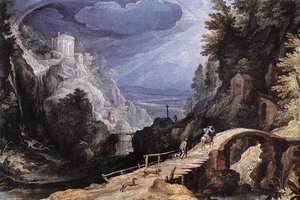
The scene unfolds within Italian Mountain Landscape with Walk to Emmaus, a panoramic landscape painted by Paul Bril. Created about 1604, the work captures a vast, rugged topography that stretches toward a luminous horizon. This expansive view invites the eye to wander through a world of dramatic cliffs and winding paths, where the scale of the mountains feels immense and heavy against the sky.

5
Landscape with Saint John the Baptist (1600) by Paul Bril

Landscape with Saint John the Baptist

1600 · Oil On Canvas

The scene unfolds within the rugged wilderness of Landscape with Saint John the Baptist, a work that captures a moment of profound solitude. Also known as Saint Jean Baptiste au désert, the painting presents a dramatic intersection of spiritual devotion and the untamed natural world. The artist, Paul Bril, places the subject in a landscape where the earth feels heavy and alive, drawing the viewer into a quiet, contemplative space…

6
Landscape with Eliezer and Rebecca (1595) by Paul Bril

Landscape with Eliezer and Rebecca

1595 · Oil On Canvas

In this 1595 oil painting, we find ourselves looking out over a vast, atmospheric landscape that feels both rugged and deeply settled. The scene depicts a moment from the story of Eliezer and Rebecca, set within a complex, panoramic terrain. In the foreground, the composition begins with a quiet intimacy; figures gather near a small stream, some tending to animals while others engage in quiet interaction. To the right, the…

7
Landscape with the Exorcism of the Gerasene demoniac (1601) by Paul Bril

Landscape with the Exorcism of the Gerasene demoniac

1601 · Oil On Panel · Bavarian State Painting Collections, Munich

Landscape with the Exorcism of the Gerasene demoniac, painted by Paul Bril, dates to about 1601. The work belongs to the artist's period of activity in Rome, where he established himself as a significant figure in the development of the Italianate landscape genre. Bril, a Flemish painter born in Antwerp, Belgium, brought a Northern European sensibility to the classical motifs of the Italian countryside.

8
Ruins and Figures (1600) by Paul Bril

Ruins and Figures

1600 · Oil On Copper

Ruins and Figures is an artwork by Paul Bril, dating to 1600. The scene captures a landscape shaped by antiquity, where the heavy weight of stone meets the lightness of the open air. It is a quiet intersection of history and the present moment.

9
A Landscape with Goatherds (1620) by Paul Bril

A Landscape with Goatherds

1620 · Oil On Panel · Royal Collection, London

In Paul Bril's A Landscape with Goatherds, a sense of movement pulls the viewer through a rugged, pastoral terrain. A large, light-colored mountain or hill descends from the upper left toward the center, creating a strong diagonal movement that dictates the flow of the entire scene. This sloping mass is balanced by a dark, dense cluster of trees anchored on the right side of the frame. Winding paths cut through…

Paul Bril's famous paintings, numbers 11 to 80

11Saint Francis of Assisi Receiving the Stigmata (1620) by Paul BrilSaint Francis of Assisi Receiving the Stigmata1620 · Walters Art Museum 12Landscape with rest on the flight into Egypt (1615) by Paul BrilLandscape with rest on the flight into Egypt1615 · Bonnefanten Museum 13Landscape with Latona and the Lycian Peasants (1610) by Paul BrilLandscape with Latona and the Lycian Peasants1610 · Gemäldegalerie 14Christ Tempted in the Wilderness (1626) by Paul BrilChrist Tempted in the Wilderness1626 · Birmingham Museum and Art Gallery 15Landscape with Shepherds (1625) by Paul BrilLandscape with Shepherds1625 · Indianapolis Museum of Art 16Landscape with Nymphs and Satyrs (1623) by Paul BrilLandscape with Nymphs and Satyrs1623 · Allen Memorial Art Museum 17Landscape with Bridge (1612) by Paul BrilLandscape with Bridge1612 · Kunsthistorisches Museum 18Landscape with Hunters (1619) by Paul BrilLandscape with Hunters1619 · Art Institute of Chicago 19Landscape with Roman Ruins (1580) by Paul BrilLandscape with Roman Ruins1580 · Torre dei Venti 20Landscape with Mercury and Argus (1612) by Paul BrilLandscape with Mercury and Argus1612 · Kunsthistorisches Museum 21Landscape with Stag Hunt (1595) by Paul BrilLandscape with Stag Hunt1595 22Rest on the Flight to Egypt (1623) by Paul BrilRest on the Flight to Egypt1623 · USC Fisher Museum of Art 23River Landscape with Tower Ruin (1600) by Paul BrilRiver Landscape with Tower Ruin1600 · Kunsthistorisches Museum 24Pan and Syrinx (1620) by Paul BrilPan and Syrinx1620 · The Louvre 25Coastal Landscape (1596) by Paul BrilCoastal Landscape1596 · Wallraf-Richartz-Museum 26Diana and Her nymphs at the Hunt (1600) by Paul BrilDiana and Her nymphs at the Hunt1600 · The Louvre 27A wooded landscape with a bridge and sportsmen at the edge of the river (1595) by Paul BrilA wooded landscape with a bridge and sportsmen at the edge of the river1595 · Art Gallery of New South Wales 28Fantastic Landscape (1598) by Paul BrilFantastic Landscape1598 · National Gallery of Scotland 29Landscape with a Marsh (1595) by Paul BrilLandscape with a Marsh1595 · Pinacoteca Ambrosiana 30Mountainous Landscape (1626) by Paul BrilMountainous Landscape1626 · Hermitage Museum 31View of a Port (1607) by Paul BrilView of a Port1607 · Galleria Borghese 32Forest Landscape with Lake and Hunt (1579) by Paul BrilForest Landscape with Lake and Hunt1579 33River Landscape with Figures (1590) by Paul BrilRiver Landscape with Figures1590 · Bavarian State Painting Collections 34Forest Landscape with Stag Hunt (1590) by Paul BrilForest Landscape with Stag Hunt1590 · Bavarian State Painting Collections 35Ideal landscape (1590) by Paul BrilIdeal landscape1590 · Bavarian State Painting Collections 36Landscape with View of a Bay (1595) by Paul BrilLandscape with View of a Bay1595 · Bavarian State Painting Collections 37Ships at a rocky coast (1600) by Paul BrilShips at a rocky coast1600 · National Museum of Art, Architecture and Design 38Landscape with Roman ruins (1600) by Paul BrilLandscape with Roman ruins1600 · Fitzwilliam Museum 39Landscape with the Flight into Egypt (1600) by Paul BrilLandscape with the Flight into Egypt1600 · Museum Boijmans Van Beuningen 40Forest landscape with nymphs and satyrs (1600) by Paul BrilForest landscape with nymphs and satyrs1600 · Noordbrabants Museum 41Roman Ruins Landscape (1600) by Paul BrilRoman Ruins Landscape1600 · Staatliche Kunstsammlungen Dresden 42Jonah and the whale (Brussels) (1605) by Paul BrilJonah and the whale (Brussels)1605 · Royal Museums of Fine Arts of Belgium 43Landscape with Roman Ruins and a Procession (1605) by Paul BrilLandscape with Roman Ruins and a Procession1605 · Gemäldegalerie 44Mountain Scene (1599) by Paul BrilMountain Scene1599 · Wallraf-Richartz-Museum 45The Campo Vaccino with a Gypsy Woman Reading a Palm (1603) by Paul BrilThe Campo Vaccino with a Gypsy Woman Reading a Palm1603 46Landscape with a Mythological Scene (1595) by Paul BrilLandscape with a Mythological Scene1595 · Pinacoteca Davia Bargellini 47Hilly Landscape (1618) by Paul BrilHilly Landscape1618 · Bavarian State Painting Collections 48The Deer Hunt (1610) by Paul BrilThe Deer Hunt1610 49Duck Hunt (1620) by Paul BrilDuck Hunt1620 50Landscape (1620) by Paul BrilLandscape1620 · Musée Denys-Puech 51A Landscape with Troglodyte Goatherds (1612) by Paul BrilA Landscape with Troglodyte Goatherds1612 · Petworth House 52Guests arrive (1620) by Paul BrilGuests arrive1620 · Slovak National Gallery 53Pilgrims at Emmaus (1617) by Paul BrilPilgrims at Emmaus1617 54Landscape with Boats on a River (1611) by Paul BrilLandscape with Boats on a River1611 · Palazzo-Pallavicini-Rospigliosi 55Armed Robbery in a Wood (1625) by Paul BrilArmed Robbery in a Wood1625 56Mountainous river landscape with fishermen (1624) by Paul BrilMountainous river landscape with fishermen1624 57Mountainous seashore (1624) by Paul BrilMountainous seashore1624 · Gemäldegalerie 58Landscape with Men Playing 'Mail  la Chicane' (1624) by Paul BrilLandscape with Men Playing 'Mail la Chicane'1624 · Minneapolis Institute of Art 59View of the Temple of the Sybil in Tivoli (1625) by Paul BrilView of the Temple of the Sybil in Tivoli1625 · Musée des Beaux-Arts de Bordeaux 60Winter Landscape by Paul BrilWinter LandscapeRijksmuseum 61Landscape with Erminia and the Shepherds by Paul BrilLandscape with Erminia and the ShepherdsShizuoka Prefectural Museum of Art 62Landscape with Mercury and Argus (1606) by Paul BrilLandscape with Mercury and Argus1606 · Galleria Sabauda 63The Port (1611) by Paul BrilThe Port1611 · Musées Royaux des Beaux-Arts 64Le Naufrage de Jonas (Jonas by Paul BrilLe Naufrage de Jonas (JonasGrand Palais 65River Landscape by Paul BrilRiver LandscapeBavarian State Painting Collections 66Landscape with sportsmen by Paul BrilLandscape with sportsmenFitzwilliam Museum 67View on the Rhine by Paul BrilView on the RhineFitzwilliam Museum 68Abduction of Ganymedes by Paul BrilAbduction of GanymedesRoyal Museum of Fine Arts Antwerp 69Italian Mountain Landscape with Shepherds by Paul BrilItalian Mountain Landscape with ShepherdsStatens Museum For Kunst 70Landscape by Paul BrilLandscape 71Hunting goats by Paul BrilHunting goatsGemäldegalerie 72An Extensive Landscape by Paul BrilAn Extensive Landscape 73Landscape by Paul BrilLandscapeKoninklijk Museum voor Schone Kunsten 74A Forest Pool (1595) by Paul BrilA Forest Pool1595 · Musées Royaux des Beaux-Arts 75View of Bracciano (1620) by Paul BrilView of Bracciano1620 · Art Gallery of South Australia 76Diana and Callisto (1620) by Paul BrilDiana and Callisto1620 · National Gallery 77Mountainous Landscape with Saint Jerome (1592) by Paul BrilMountainous Landscape with Saint Jerome1592 · Mauritshuis 78The Stag Hunt (1590) by Paul BrilThe Stag Hunt1590 · The Louvre 79Self-Portrait (1595) by Paul BrilSelf-Portrait1595 · Rhode Island School of Design Museum of Art 80River view wit Large Rock, Paul Bril (copy after), 1601 (1601) by Paul BrilRiver view wit Large Rock, Paul Bril (copy after), 16011601 · Rijksmuseum

Paul Bril's famous paintings, period by period

The subjects that held Paul Bril's eye

The four subjects that come back most often in these originals, each with its finest example.

The museums that keep Paul Bril's originals

The 8 museums that hold the most of the paintings on this page.

Museum City Works by Paul Bril Paintings from this list
Bavarian State Painting Collections, MunichBavarian State Painting Collections Munich 9 Penitent Magdalene, Italian Mountain Landscape with Walk to Emmaus, Landscape with the Exorcism of the Gerasene demoniac
The Louvre, ParisThe Louvre Paris 4 Ruins and Figures, Pan and Syrinx, Diana and Her nymphs at the Hunt
Gemäldegalerie, BerlinGemäldegalerie Berlin 4 Landscape with Latona and the Lycian Peasants, Landscape with Roman Ruins and a Procession, Mountainous seashore
Kunsthistorisches Museum, ViennaKunsthistorisches Museum Vienna 3 Landscape with Bridge, Landscape with Mercury and Argus, River Landscape with Tower Ruin
Fitzwilliam MuseumFitzwilliam Museum 3 Landscape with Roman ruins, Landscape with sportsmen, View on the Rhine
Wallraf-Richartz-Museum, CologneWallraf-Richartz-Museum Cologne 2 Coastal Landscape, Mountain Scene
Rijksmuseum, AmsterdamRijksmuseum Amsterdam 2 Winter Landscape, River view wit Large Rock, Paul Bril (copy after), 1601
Musées Royaux des Beaux-Arts, BrusselsMusées Royaux des Beaux-Arts Brussels 2 The Port, A Forest Pool

Paul Bril across the decades: one unique original for each

Works per decade

Pick a decade to see the original that defines it.

Paul Bril's paintings: questions for the gallery

What is the single most famous work of Paul Bril?Reveal the answer

Ruins and Figures (1600), The Louvre, Paris. Feudo di Rocca Sinibalda (1601) and Penitent Magdalene (1590) come next.

At what age did Paul Bril create Ruins and Figures?Reveal the answer

46 years old: Ruins and Figures dates from 1600, and Paul Bril was born in 1554.

Which ten paintings by Paul Bril are the most famous?Reveal the answer

Ruins and Figures, Feudo di Rocca Sinibalda, Penitent Magdalene, Italian Mountain Landscape with Walk to Emmaus, Landscape with Saint John the Baptist, Landscape with Eliezer and Rebecca, Landscape with the Exorcism of the Gerasene demoniac, Ruins and Figures, A Landscape with Goatherds and Landscape with Diana Discovering the Pregnancy of Callisto. The ranking above gives each one's year and museum.

How many works by Paul Bril are known?Reveal the answer

Our catalog holds 82 works by Paul Bril, dated from 1579 to 1626.

Where can the most famous Paul Bril originals be seen?Reveal the answer

Mostly in Bavarian State Painting Collections (Munich), The Louvre (Paris) and Gemäldegalerie (Berlin). The museum table above lists them all.

During which period did Paul Bril create the best-known paintings?Reveal the answer

In 1600s: 19 of the 80 works on this page were made then, Ruins and Figures among them.

Which famous Paul Bril painting is the earliest, and which the latest?Reveal the answer

On this page, the earliest is Forest Landscape with Lake and Hunt (1579) and the latest Christ Tempted in the Wilderness (1626).

What subjects did Paul Bril favour?Reveal the answer

Sky (41), Trees (37) and Landscape (27), across the 80 works on this page.

What materials did Paul Bril paint with most?Reveal the answer

Oil On Canvas, for 26 of the 80 works on this page.

Which movement does the work of Paul Bril belong to?Reveal the answer

Baroque, judging by the originals on this page.

What Paul Bril originals can I see at the Bavarian State Painting Collections?Reveal the answer

Penitent Magdalene, Italian Mountain Landscape with Walk to Emmaus and Landscape with the Exorcism of the Gerasene demoniac: the Bavarian State Painting Collections, Munich holds 9 of the works on this page.

Paul Bril: a portrait of the artist

Paulus Bril (Paul Brill): A Master of Italianate Landscape

Paulus Bril, also known as Paul Brill (1554-1626), was a highly influential Flemish painter and printmaker celebrated for his pioneering role in developing the Italianate landscape genre. Born in Antwerp, Belgium, he spent the majority of his career in Rome, where his work significantly impacted both Italian and Northern European landscape painting. His artistic legacy lies in his ability to capture the beauty and grandeur of the Italian countryside while incorporating classical motifs and a distinctive atmospheric perspective.

Early Life and Artistic Development

  • Birth and Family: Paulus Bril was born in Antwerp, though some sources suggest Breda as a possible birthplace. He hailed from an artistic family; his father was both a painter and an art dealer, providing young Paulus with early exposure to the art world.
  • Early Training & Influences: His initial training likely occurred within his family circle, absorbing the traditions of Flemish landscape painting. This foundation emphasized atmospheric effects – the use of light, color, and aerial perspective to create a sense of depth and mood. Early works reflect this influence, showcasing meticulous detail and a focus on realistic representation.
  • Move to Rome: A pivotal moment in Bril's career was his relocation to Rome. This move exposed him directly to the landscapes of Italy and allowed him to develop his signature style – the Italianate landscape.

The Italianate Landscape and Artistic Innovations

  • Defining Characteristics: Bril’s Italianate landscapes are characterized by their depiction of idealized views of the Italian countryside, often featuring classical ruins (temples, arches, columns), picturesque waterways, lush vegetation, and idyllic pastoral scenes.
  • Classical Motifs & Composition: He skillfully integrated classical architectural elements into his compositions, creating a harmonious blend of nature and antiquity. His landscapes are not merely depictions of scenery; they evoke a sense of history, grandeur, and timeless beauty.
  • Light and Atmosphere: Bril’s masterful use of light and color is crucial to the appeal of his work. He employed warm tones and subtle gradations to create a luminous atmosphere that draws the viewer into the scene. His understanding of aerial perspective – how objects appear fainter and bluer with distance – adds depth and realism to his landscapes.
  • Influence on Contemporaries: Bril's style had a profound impact on other artists, most notably Claude Lorrain, who greatly admired and emulated Bril’s approach to landscape painting. He also influenced Willem van Nieulandt, as evidenced by their shared interest in depicting Italianate ruins.

Major Achievements and Historical Significance

  • Revolutionizing Landscape Painting: Paulus Bril is considered a key figure in the development of the Italianate landscape genre, establishing a new standard for landscape painting both in Italy and Northern Europe.
  • Popularity & Patronage: His works were highly sought after during his lifetime, demonstrating his popularity among collectors and patrons.
  • Legacy: Bril’s emphasis on classical motifs, atmospheric perspective, and the idealized depiction of nature influenced generations of landscape painters who followed in his footsteps. He helped to elevate landscape painting from a secondary genre to one of considerable artistic merit.

Collections and Further Exploration

Works by Paulus Bril can be found in prestigious museums and collections across Europe. Notable holdings include:

To further explore his art, consider visiting the Paulus Bril artist page and related artworks on OriginalUniqueArt.com.