Portrait of John Vanderlyn

The 58 Most Famous John Vanderlyn Paintings, a Gallery Selection

Updated November 2026 · ranked by our popularity score (searches, visits and orders for each work) · 61 works by John Vanderlyn in our catalogue

In short

Of all the originals John Vanderlyn left, the most famous is The Death of Jane McCrea (1804). Close behind it come Oliver Wolcott, Jr. (1760-1833), B.A. 1778, LL.D. 1819 (1820) and Theodosia Burr (Mrs. Joseph Alston, 1783-1813) (1802). Our catalog holds 61 works by John Vanderlyn; the gallery has kept the 58 the world admires most, each shown with its date, its museum and its story.

1775 – 1852, Kingston Neoclassicism Most works: New York Historical Society

John Vanderlyn's top 10 paintings: the gallery's choice

1
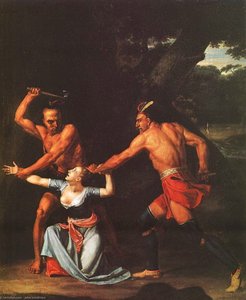
The Death of Jane McCrea (1804) by John Vanderlyn

The Death of Jane McCrea

1804 · Oil On Canvas

The Death of Jane McCrea is a history painting by John Vanderlyn. Created in 1804, the oil on canvas captures a violent fracture in the American Revolutionary War. The scene focuses on the abduction and killing of Jane McCrea by two Native American warriors. It is a moment frozen in the shadow of the Saratoga campaign of 1777.

2
Oliver Wolcott, Jr. (1760-1833), B.A. 1778, LL.D. 1819 (1820) by John Vanderlyn

Oliver Wolcott, Jr. (1760-1833), B.A. 1778, LL.D. 1819

1820 · Oil On Canvas · Yale University Art Gallery, New Haven

The portrait depicts a middle-aged man positioned in a bust-length composition. He is oriented slightly off-center, facing toward the left of the frame, while his gaze is directed toward the viewer. He wears a dark, double-breasted coat and a crisp white cravat. A small gold button is visible on his lapel. The background consists of dark, somber tones, including deep blacks, browns, and muted ochre. Light enters from the upper…

3
Theodosia Burr (Mrs. Joseph Alston, 1783-1813) (1802) by John Vanderlyn

Theodosia Burr (Mrs. Joseph Alston, 1783-1813)

1802 · Oil On Canvas · New York Historical Society, New York City

The silhouette of a young woman cuts through a dark, atmospheric void. She faces left, her profile a sharp, rhythmic line against the gloom. Light falls from the upper left, catching the curve of her forehead, the bridge of her nose, and the soft swell of her cheek. It is a study of quietude. The skin appears smooth, almost translucent, contrasting with the deep, heavy shadows that define the nape…

4
Roger Strong (1762–1836) (1802) by John Vanderlyn

Roger Strong (1762–1836)

1802 · Oil On Canvas · New York Historical Society, New York City

In this 1802 portrait, we encounter Roger Strong, a man whose presence is felt through a deliberate, Neoclassical restraint. He is presented in a bust-length composition, positioned slightly off-center as he turns his head toward the right, yet his gaze remains fixed upon us. There is a certain stillness here, a sense of dignity that comes from the muted, somber palette. His dark charcoal coat absorbs the light, creating a…

5
Henry Vanderlyn (1815) by John Vanderlyn

Henry Vanderlyn

1815 · Oil On Canvas · Saint Louis Art Museum, Saint Louis

The gaze of Henry Vanderlyn meets the viewer from within this 1815 oil on canvas. Painted by John Vanderlyn, the work captures the likeness of the subject, Henry Vanderlyn, in a moment of quiet, formal presence. This portrait exists now in the public domain, preserved for those who seek to encounter the man behind the name. The sitter, a brother to the artist, occupies the space with a steady, direct…

6
Aaron Burr (1756–1836) (1809) by John Vanderlyn

Aaron Burr (1756–1836)

1809 · Oil · New York Historical Society, New York City

The air in the room feels heavy, stilled by the weight of a single, dignified gaze. A man sits in profile, his silhouette cutting a sharp, clean line against a background of deep, somber tones. The light catches the ridge of his forehead and the bridge of his nose, casting the rest of his features into a soft, intentional shadow. He wears a dark coat that seems to absorb the…

7
Bacchante and Satyr (1806) by John Vanderlyn

Bacchante and Satyr

1806 · Oil · New York Historical Society, New York City

Bacchante and Satyr is a Neoclassical oil painting by the American artist John Vanderlyn. Created about 1806, this work depicts a mythological scene centered on the interaction between a Bacchante and a Satyr. The subject matter draws from classical antiquity, focusing on these specific mythological figures within a tightly packed composition. The arrangement of the figures is concentrated in the foreground, creating an intimate and crowded visual field.

8
James Madison (1816) by John Vanderlyn

James Madison

1816 · Oil On Canvas

In this portrait of James Madison, John Vanderlyn captures the statesman in a moment of quiet gravity. Painted about 1816, the work presents the subject in a bust-length view. He faces forward, though his gaze drifts slightly toward the viewer's right. A dark, heavy drapery hangs in the background, its deep red tones providing a somber weight to the composition. This shadow-filled space pushes the figure toward the light, isolating…

9
Elias Boudinot (1821) by John Vanderlyn

Elias Boudinot

1821 · Oil On Canvas · Yale University Art Gallery, New Haven

In this portrait of Elias Boudinot, artist John Vanderlyn presents a single male figure in a three-quarter view. The composition focuses on the subject from the chest up, set against a dark and indistinct background. This lack of environmental detail directs all attention toward the man's presence. The perspective is eye-level, establishing an intimate connection between the viewer and the sitter.

10
James Madison (1816) by John Vanderlyn

James Madison

1816 · Oil On Canvas

This oil on canvas portrait depicts James Madison. Executed by the artist John Vanderlyn, the work dates to about 1816. The painting measures 66.04 x 56.36cm. The subject is presented in a bust-length composition, positioned with a slight three-quarter turn toward the viewer. He wears a dark coat and a white cravat, set against a background containing muted red drapery and dark, indistinct architectural elements.

The John Vanderlyn selection continues, 11 to 58

11Theodosia Burr (Mrs. Joseph Alston, 1783-1813) (1817) by John VanderlynTheodosia Burr (Mrs. Joseph Alston, 1783-1813)1817 · New York Historical Society 12Dominick Lynch (1754-1824) (1817) by John VanderlynDominick Lynch (1754-1824)1817 · New York Historical Society 13Ariadne Asleep on the Island of Naxos (1821) by John VanderlynAriadne Asleep on the Island of Naxos1821 · New York Historical Society 14Eugene Aaron Vail (ca. 1792-1843) (1830) by John VanderlynEugene Aaron Vail (ca. 1792-1843)1830 · New York Historical Society 15The Landing of Columbus (1840) by John VanderlynThe Landing of Columbus1840 · Smithsonian American Art Museum 16Samuel Ringgold (1825) by John VanderlynSamuel Ringgold1825 · National Portrait Gallery 17Portrait of a Man (1820) by John VanderlynPortrait of a Man1820 · Detroit Institute of Arts 18Panoramic View of the Palace and Gardens of Versailles (1818) by John VanderlynPanoramic View of the Palace and Gardens of Versailles1818 · Metropolitan Museum of Art 19James Monroe by John VanderlynJames MonroeNational Portrait Gallery 20Horseshoe Falls from below the High Bank (Niagara Falls) by John VanderlynHorseshoe Falls from below the High Bank (Niagara Falls)Fine Arts Museums of San Francisco 21Theodosia Burr (Mrs. Joseph Alston) (1783-1812) by John VanderlynTheodosia Burr (Mrs. Joseph Alston) (1783-1812)Yale University Art Gallery 22A Muse by John VanderlynA Muse 23Aaron Burr by John VanderlynAaron BurrNew York Historical Society 24Robert Fulton (1765–1815) (1798) by John VanderlynRobert Fulton (1765–1815)1798 25Niagara and the Rapids (1801) by John VanderlynNiagara and the Rapids1801 · Crystal Bridges Museum of American Art 26A Distant View of the Falls of Niagara (1803) by John VanderlynA Distant View of the Falls of Niagara1803 · Albany Institute of History - Art 27Panoramic View of the Palace and Gardens of Versailles (1818) by John VanderlynPanoramic View of the Palace and Gardens of Versailles1818 · Metropolitan Museum of Art 28Francis Lucas Waddell (1837) by John VanderlynFrancis Lucas Waddell1837 · Metropolitan Museum of Art 29John A. Sidell (1830) by John VanderlynJohn A. Sidell1830 · Metropolitan Museum of Art 30John Armstrong, Class of 1776 (didn't graduate) by John VanderlynJohn Armstrong, Class of 1776 (didn't graduate) 31James Madison, Class of 1771 (1751-1836) by John VanderlynJames Madison, Class of 1771 (1751-1836) 32Portrait of the Artist 1 by John VanderlynPortrait of the Artist 1 33Elizabeth Maria Church by John VanderlynElizabeth Maria Church 34Mrs. Daniel Strobel, Jr. (Anna Church Strobel) and Her Son, George by John VanderlynMrs. Daniel Strobel, Jr. (Anna Church Strobel) and Her Son, George 35John Sudam by John VanderlynJohn SudamNational Gallery of Art 36Portrait of the Artist (1800) by John VanderlynPortrait of the Artist1800 · Metropolitan Museum of Art 37Mary Scott Swann (1815) by John VanderlynMary Scott Swann1815 38The Palace and Gardens of Versailles by John VanderlynThe Palace and Gardens of Versailles 39The caluny of apelles by John VanderlynThe caluny of apellesMetropolitan Museum of Art 40Daniel Strobel, Jr. by John VanderlynDaniel Strobel, Jr. 41The Cape of Pinzon by John VanderlynThe Cape of Pinzon 42Ariadne of Naxos (study) by John VanderlynAriadne of Naxos (study) 43Crouching Male Figure Holding Staff by John VanderlynCrouching Male Figure Holding Staff 44Sarah Russell Church (daughter of Edward Church) by John VanderlynSarah Russell Church (daughter of Edward Church) 45Zachariah Schoonmaker by John VanderlynZachariah SchoonmakerNational Gallery of Art 46Egbert Benson by John VanderlynEgbert BensonMetropolitan Museum of Art 47Chancellor Robert R. Livingston by John VanderlynChancellor Robert R. LivingstonNew York Historical Society 48Mrs marinus willet and her son marinus jr by John VanderlynMrs marinus willet and her son marinus jr 49Alexander Hamilton by John VanderlynAlexander Hamilton 50Sampson Vryling Stoddard Wilder by John VanderlynSampson Vryling Stoddard WilderWorcester Art Museum 51Francis Lucas Waddell by John VanderlynFrancis Lucas Waddell 52Mrs. Marinus Willett and Her Son Marinus, Jr. by John VanderlynMrs. Marinus Willett and Her Son Marinus, Jr.Metropolitan Museum of Art 53Adriadne Abandoned on the Island of Naxos by John VanderlynAdriadne Abandoned on the Island of Naxos 54Mary Ellis Bell (Mrs. Isaac Bell) by John VanderlynMary Ellis Bell (Mrs. Isaac Bell)National Gallery of Art 55Study for the Landing of Columbus by John VanderlynStudy for the Landing of Columbus 56Study for by John VanderlynStudy forBirmingham Museum of Art 57Columbus Landing at Guanahani, 1492 (1837) by John VanderlynColumbus Landing at Guanahani, 14921837 58Caius Marius amid the Ruins of Carthage by John VanderlynCaius Marius amid the Ruins of CarthageFine Arts Museums of San Francisco

John Vanderlyn's famous paintings, period by period

The subjects that held John Vanderlyn's eye

The four subjects that come back most often in these originals, each with its finest example.

The museums that keep John Vanderlyn's originals

The 8 museums that hold the most of the paintings on this page.

Museum City Works by John Vanderlyn Paintings from this list
New York Historical Society, New York CityNew York Historical Society New York City 10 Theodosia Burr (Mrs. Joseph Alston, 1783-1813), Roger Strong (1762–1836), Aaron Burr (1756–1836)
Metropolitan Museum of Art, New YorkMetropolitan Museum of Art New York 8 Panoramic View of the Palace and Gardens of Versailles, Panoramic View of the Palace and Gardens of Versailles, Francis Lucas Waddell
Yale University Art Gallery, New HavenYale University Art Gallery New Haven 3 Oliver Wolcott, Jr. (1760-1833), B.A. 1778, LL.D. 1819, Elias Boudinot, Theodosia Burr (Mrs. Joseph Alston) (1783-1812)
National Gallery of Art, WashingtonNational Gallery of Art Washington 3 John Sudam, Zachariah Schoonmaker, Mary Ellis Bell (Mrs. Isaac Bell)
National Portrait Gallery, Washington, D.C.National Portrait Gallery Washington, D.C. 2 Samuel Ringgold, James Monroe
Fine Arts Museums of San Francisco, San FranciscoFine Arts Museums of San Francisco San Francisco 2 Horseshoe Falls from below the High Bank (Niagara Falls), Caius Marius amid the Ruins of Carthage
Saint Louis Art Museum, Saint LouisSaint Louis Art Museum Saint Louis 1 Henry Vanderlyn
Smithsonian American Art Museum, Washington, D.C.Smithsonian American Art Museum Washington, D.C. 1 The Landing of Columbus

John Vanderlyn decade by decade: the original that defines each

Works per decade

Pick a decade to see the original that defines it.

Collectors' questions about John Vanderlyn's paintings

Which work is John Vanderlyn most famous for?Reveal the answer

The Death of Jane McCrea (1804). Oliver Wolcott, Jr. (1760-1833), B.A. 1778, LL.D. 1819 (1820) and Theodosia Burr (Mrs. Joseph Alston, 1783-1813) (1802) come next.

What age was John Vanderlyn when The Death of Jane McCrea was made?Reveal the answer

29 years old: The Death of Jane McCrea dates from 1804, and John Vanderlyn was born in 1775.

What are the ten most famous John Vanderlyn paintings?Reveal the answer

The Death of Jane McCrea, Oliver Wolcott, Jr. (1760-1833), B.A. 1778, LL.D. 1819, Theodosia Burr (Mrs. Joseph Alston, 1783-1813), Roger Strong (1762–1836), Henry Vanderlyn, Aaron Burr (1756–1836), Bacchante and Satyr, James Madison, Elias Boudinot and James Madison. The ranking above gives each one's year and museum.

How many paintings did John Vanderlyn leave?Reveal the answer

Our catalog holds 61 works by John Vanderlyn, dated from 1798 to 1840.

In which museums do John Vanderlyn's masterpieces hang?Reveal the answer

Mostly in New York Historical Society (New York City), Metropolitan Museum of Art (New York) and Yale University Art Gallery (New Haven). The museum table above lists them all.

In which years did John Vanderlyn paint the most famous works?Reveal the answer

In 1800s: 8 of the 58 works on this page were made then, The Death of Jane McCrea among them.

What are the first and the last famous originals of John Vanderlyn?Reveal the answer

On this page, the earliest is Robert Fulton (1765–1815) (1798) and the latest The Landing of Columbus (1840).

Which subjects did John Vanderlyn choose most often?Reveal the answer

Man (14), Portrait (12) and Dark background (9), across the 58 works on this page.

Which technique did John Vanderlyn use most?Reveal the answer

Oil On Canvas, for 19 of the 58 works on this page.

To which art movement does John Vanderlyn belong?Reveal the answer

Neoclassicism, judging by the originals on this page.

Which John Vanderlyn works hang at the New York Historical Society?Reveal the answer

Theodosia Burr (Mrs. Joseph Alston, 1783-1813), Roger Strong (1762–1836) and Aaron Burr (1756–1836): the New York Historical Society, New York City holds 10 of the works on this page.

John Vanderlyn: life and work

A Pioneer Bridging Worlds: The Life and Art of John Vanderlyn

John Vanderlyn, born in Kingston, New York, on October 15, 1775, occupies a unique position in the narrative of American art. He wasn’t merely a painter; he was a cultural bridge, forging a path for American artists to embrace European training—specifically, the burgeoning Neoclassical style emanating from Paris—rather than defaulting to the established artistic centers of London. His story is one of ambition, talent, and ultimately, a poignant struggle against financial hardship, yet his contributions remain significant in shaping the early landscape of American painting. Vanderlyn’s lineage itself hinted at an artistic destiny; he was the grandson of Pieter Vanderlyn, a respected colonial portraitist, inheriting not just a name but also a foundational understanding of form and representation. Early employment with a New York print seller provided practical exposure to the art world, while initial instruction under Archibald Robinson honed his fundamental skills. However, it was through copying portraits by Gilbert Stuart—and crucially, spending time within Stuart’s studio—that Vanderlyn truly began to cultivate his own portraiture abilities, absorbing the techniques of a master already renowned for capturing likeness and character.

Parisian Refinement and the Embrace of Neoclassicism

A pivotal moment arrived in 1796 when Aaron Burr, recognizing Vanderlyn’s potential, dispatched him to Paris to study art. This decision was revolutionary; it marked a deliberate shift away from the traditional British artistic influence that had long dominated American training. For five years, Vanderlyn immersed himself in the Parisian art scene, absorbing the principles of Neoclassicism—an aesthetic movement emphasizing classical forms, order, and thematic content drawn from ancient Greece and Rome. This exposure profoundly shaped his style, instilling a sense of clarity, balance, and idealized beauty into his work. He studied diligently, honing his skills at the *École des Beaux-Arts*, and quickly demonstrated an aptitude for historical painting—a genre considered more prestigious than portraiture at the time. Upon returning to America in 1801, Vanderlyn briefly resided with Aaron Burr and his daughter, continuing to paint portraits while grappling with how best to translate his Parisian training into a distinctly American artistic voice.

Major Works and Artistic Versatility

Vanderlyn’s career was remarkably diverse, encompassing portraiture, landscape painting, and even large-scale panoramic works. He secured commissions from prominent figures—James Monroe, John C. Calhoun, and Andrew Jackson all sat for his portraits—and skillfully replicated Gilbert Stuart's iconic Lansdowne portrait of George Washington. However, it was his ventures beyond traditional portraiture that truly distinguished him. In 1802, he created two striking views of Niagara Falls, which were subsequently engraved and published in London, bringing the majesty of the American landscape to a European audience. His ambition reached new heights with *Caius Marius Amid the Ruins of Carthage*, exhibited at the Paris Salon of 1808, where it earned him a coveted gold medal—a testament to his mastery of Neoclassical technique and composition. Later, he experimented with panoramic paintings, including “Panoramic View of the Palace and Gardens of Versailles” (1818-19), demonstrating an innovative approach to immersive art experiences. Perhaps his most historically significant work was *The Landing of Columbus*, commissioned by Congress in 1842 for the U.S. Capitol rotunda. Though controversial—Vanderlyn employed a French artist to assist with its execution—the painting achieved widespread recognition, even being reproduced on US five-dollar banknotes.

Legacy and Enduring Significance

John Vanderlyn’s legacy extends beyond his individual artworks. He was a true pioneer, challenging the established norms of American artistic training by championing the study of art in Paris. This opened doors for future generations of artists to explore new influences and develop their own unique styles. His commitment to Neoclassical principles contributed significantly to the development of this aesthetic movement within American art, influencing subsequent painters with its emphasis on form, clarity, and historical subject matter. Furthermore, his paintings served as a visual record of early American history, capturing the likenesses of important figures and depicting pivotal events. As one of the founding members of the National Academy of Design, Vanderlyn played an active role in establishing a professional organization dedicated to promoting American art. Despite facing financial difficulties later in life—he died in relative obscurity on September 23, 1852, in Kingston, New York, and is buried at Wiltwyck Rural Cemetery—his contributions to the development of American painting remain undeniable. He was an artist who dared to look beyond established conventions, embracing innovation and leaving an indelible mark on the cultural landscape of his time.