Portrait of Jan Miel

The 71 Most Famous Jan Miel Paintings, Each One of a Kind

Updated November 2026 · ranked by our popularity score (searches, visits and orders for each work) · 71 works by Jan Miel in our catalogue

In short

Scene from the Life of Tramps (Lazzaroni) (1650) is the Jan Miel painting that draws the most eyes; the original belongs to the Hermitage Museum, Saint Petersburg. After it, the eye goes to Hunters at Rest (1650) and Carnival Entertainment (1635). Among the 71 works of Jan Miel in our catalog, these 71 are the most famous, each a unique original presented with its year, its museum and the reason it endures.

1599 – 1663, Beveren Baroque Most works: Hermitage Museum

Top 10 paintings by Jan Miel, through the gallery's eye

1
Scene from the Life of Tramps (Lazzaroni) (1650) by Jan Miel

Scene from the Life of Tramps (Lazzaroni)

1650 · Oil On Canvas · Hermitage Museum, Saint Petersburg

A heavy, ochre light settles over the crumbling stone of ancient ruins. Here, the shadows are thick and deep, swallowing the corners of a chaotic street scene. Figures move through the haze of smoke and dust, their bodies caught in a sudden, sharp glare of sun. A man gestures with urgency, his hands carving shapes into the air, while others sit in the dirt, anchored by the weight of their…

2
Hunters at Rest (1650) by Jan Miel

Hunters at Rest

1650 · Oil On Canvas · Hermitage Museum, Saint Petersburg

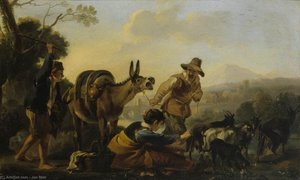
is an oil on canvas painting by the Flemish artist Jan Miel. Created about 1650, the work captures a quiet moment within a pastoral scene. It depicts a hunting party finding respite amidst the landscape. The scene is anchored by the presence of horses and the sturdy silhouette of a fortified tower.

3
Carnival Entertainment (1635) by Jan Miel

Carnival Entertainment

1635 · Oil On Canvas · Bavarian State Painting Collections, Munich

In "Carnival Entertainment" by Jan Miel, we find ourselves amidst a dense and dynamic urban scene. The composition is crowded, capturing a street festival where a large group of figures occupies the foreground and middle ground. These individuals—musicians, dancers, and various onlookers—are arranged to create a sense of constant movement. The perspective is a ground-level view, which provides a palpable sense of depth through the careful layering of people and…

4
Sine Cerere et Baccho Friget Venus (1645) by Jan Miel

Sine Cerere et Baccho Friget Venus

1645 · Oil

The oil painting titled Sine Cerere et Baccho Friget Venus presents a mythological scene of abundance. Jan Miel rendered this work in 1645. It captures a moment where classical deities gather amidst the symbols of harvest and intoxication. The figures exist within a lush, Baroque-style arrangement of life and plenty.

5
The Veneration of St. Lambert (1648) by Jan Miel

The Veneration of St. Lambert

1648 · Oil On Canvas · Fitzwilliam Museum

The air in the grand, classical space feels heavy with the scent of incense and the weight of sudden grief. In the center of this dramatic scene, St. Lambert lies in repose, his body a pale, still anchor amidst a sea of movement. Above him, the celestial realm breaks through the gloom; an angel descends with fluid, sweeping drapery that seems to catch a wind from another world. The light…

6
Soothsayer at an inn (1644) by Jan Miel

Soothsayer at an inn

1644 · Oil

The air at the roadside inn feels heavy with the scent of dust and old stone. Under a rugged stone archway, a group of travelers huddles in a moment of quiet tension. A woman in a garment of lapis blue leans toward a man, her presence a cool contrast to the earthy ochre and deep crimson that define the crowd. He is the soothsayer, a figure caught in the flickering…

7
Two hunters resting in a landscape (the standing hunter is a woman in men's clothes) (1639) by Jan Miel

Two hunters resting in a landscape (the standing hunter is a woman in men's clothes)

1639 · Oil On Canvas · New York Historical Society, New York City

The scene unfolds within the oil on canvas work titled Two hunters resting in a landscape (the standing hunter is a woman in men's clothes). This composition emerges from the hand of Jan Miel, a painter who brings a sense of immediate life to the quietude of the hunt. The work is dated 1639, capturing a specific moment of stillness amidst the natural world.

8
Three peasants having fun with music and dance (1639) by Jan Miel

Three peasants having fun with music and dance

1639 · Oil On Panel · Rafael Valls Limited, City of Westminster

Three peasants having fun with music and dance by Jan Miel presents a lively genre scene centered on three figures engaged in rhythmic activity. The composition is dynamic, utilizing an intimate perspective that places the viewer in close proximity to the subjects. Within this shallow space, the central figure is captured mid-motion, a choice that establishes a sense of rhythmic movement throughout the scene. To the left of the main…

9
The Travelers' Dinner. Peasants Eating Near an Inn or Resting (1650) by Jan Miel

The Travelers' Dinner. Peasants Eating Near an Inn or Resting

1650 · Oil On Canvas

The Travelers' Dinner. Peasants Eating Near an Inn or Resting is a genre painting by Jan Miel. This work emerged around 1650, a period when the artist was active within the artistic circles of the seventeenth century. The canvas captures a specific slice of rural life through the eyes of a painter who understood the weight of stone and the texture of coarse cloth.

10
An Italianate Landscape with Peasants Dancing (1650) by Jan Miel

An Italianate Landscape with Peasants Dancing

1650 · Oil On Canvas · Nostell Priory, Wakefield

We are looking at An Italianate Landscape with Peasants Dancing, a work by Jan Miel. This piece dates to about 1650, a period when the artist was deeply engaged with the stylistic shifts occurring within the Italian Baroque. It is a significant example of how Miel navigated the transition from the gritty, everyday observations of the Bamboccianti to more expansive, classical compositions.

Jan Miel's famous paintings, numbers 11 to 71

11Falcon hunters in front of an inn in a ruin (1650) by Jan MielFalcon hunters in front of an inn in a ruin1650 12The beggar (1650) by Jan MielThe beggar1650 13Barber and roulette players (1650) by Jan MielBarber and roulette players1650 14Military resting with a fortune teller (1650) by Jan MielMilitary resting with a fortune teller1650 15Carnival parade in Rome (1660) by Jan MielCarnival parade in Rome1660 16Hannibal's dream (1661) by Jan MielHannibal's dream1661 17Figures in the vicinity of architectural ruins (1650) by Jan MielFigures in the vicinity of architectural ruins1650 18The gathering of the hunters (1660) by Jan MielThe gathering of the hunters1660 · Galleria Sabauda 19Boar hunt (1660) by Jan MielBoar hunt1660 · Royal Palace of Venaria 20Bear hunt (1659) by Jan MielBear hunt1659 · Royal Palace of Venaria 21Diana the Huntress (1658) by Jan MielDiana the Huntress1658 · Royal Palace of Venaria 22Adoration of the Shepherds (1650) by Jan MielAdoration of the Shepherds1650 · Pushkin State Museum 23Serenade with dancers and musician (1650) by Jan MielSerenade with dancers and musician1650 24The Race of the Berber Horses in Rome (1664) by Jan MielThe Race of the Berber Horses in Rome1664 25Traveling theatre (1700) by Jan MielTraveling theatre1700 26Harbour (1652) by Jan MielHarbour1652 · Hermitage Museum 27La curea - curée - con corte Regale, Carlo Emanuele II e Franesca d (1661) by Jan MielLa curea - curée - con corte Regale, Carlo Emanuele II e Franesca d1661 · Royal Palace of Venaria 28Dance in the Trattoria (1647) by Jan MielDance in the Trattoria1647 · Academy of Fine Arts Vienna 29LE BARBIER NAPOLITAIN by Jan MielLE BARBIER NAPOLITAINThe Louvre 30St John the Baptist Preaching in the Desert by Jan MielSt John the Baptist Preaching in the DesertNationalmuseum 31The Arch of Constantine in Rome (1648) by Jan MielThe Arch of Constantine in Rome1648 · Barber Institute of Fine Arts 32Scene in front of a tavern (1638) by Jan MielScene in front of a tavern1638 · National Museum in Warsaw 33Figures Feasting at a Fair in Prati, Outside the Walls of Rome, with the Saint Peter's Basilica and Monte Mario Beyond (1650) by Jan MielFigures Feasting at a Fair in Prati, Outside the Walls of Rome, with the Saint Peter's Basilica and Monte Mario Beyond1650 34Deer hunt (1661) by Jan MielDeer hunt1661 · Royal Palace of Venaria 35The death of the deer (1660) by Jan MielThe death of the deer1660 · Royal Palace of Venaria 36The Courtyard of Palazzo Nardini in Rome (1650) by Jan MielThe Courtyard of Palazzo Nardini in Rome1650 · Palazzo Barberini 37Hunters at Rest by Jan MielHunters at RestMuseo del Prado 38Architectural Landscape (1638) by Jan MielArchitectural Landscape1638 · Hermitage Museum 39Carnival Time in Rome (1653) by Jan MielCarnival Time in Rome1653 · Museo del Prado 40The snack by Jan MielThe snackMuseo del Prado 41Cottage with inhabitants by Jan MielCottage with inhabitantsMuseo del Prado 42The local Barber by Jan MielThe local BarberMuseo del Prado 43Popular scene by Jan MielPopular sceneMuseo del Prado 44The Flight into Egypt by Jan MielThe Flight into EgyptStatens Museum For Kunst 45Soldiers Resting by Jan MielSoldiers RestingNationalmuseum 46Peasants Resting by Jan MielPeasants RestingNationalmuseum 47Hunters Resting by Jan MielHunters RestingNationalmuseum 48Fox hunting by Jan MielFox huntingRoyal Palace of Venaria 49Jugglers passing – Carnival by Jan MielJugglers passing – CarnivalNational Museum in Warsaw 50MARCHAND D'ESCARGOTS by Jan MielMARCHAND D'ESCARGOTS 51Road in the Roman Campagna by Jan MielRoad in the Roman CampagnaHermitage Museum 52PAYSAGE AVEC FIGURES by Jan MielPAYSAGE AVEC FIGURES 53Maraudeurs italiens Une halte (autre titre) by Jan MielMaraudeurs italiens Une halte (autre titre) 54Pastorale avec bergère endormie by Jan MielPastorale avec bergère endormie 55The fugitive Erminia asks a fellow countryman for admission by Jan MielThe fugitive Erminia asks a fellow countryman for admission 56The Assembly (1660) by Jan MielThe Assembly1660 · Château de Versailles 57The vihuela player by Jan MielThe vihuela playerMuseo del Prado 58LA DINEE DES VOYAGEURS by Jan MielLA DINEE DES VOYAGEURSThe Louvre 59Genre Scene (1650) by Jan MielGenre Scene1650 · Hermitage Museum 60Landscape with herders by Jan MielLandscape with herdersMuseo del Prado 61LA HALTE MILITAIRE by Jan MielLA HALTE MILITAIREThe Louvre 62Landscape with a Battle between Two Rams (1640) by Jan MielLandscape with a Battle between Two Rams1640 · Metropolitan Museum of Art 63Hunters at Rest by Jan MielHunters at RestHermitage Museum 64Shepherds and herd in a mountainous landscape by Jan MielShepherds and herd in a mountainous landscapeMusée Calvet 65Carnival in the Piazza Colonna, Rome by Jan MielCarnival in the Piazza Colonna, RomeWadsworth Atheneum 66Roman Lime Kiln with Peasants Gambling by Jan MielRoman Lime Kiln with Peasants Gambling 67Italian Peasants outside a Tavern by Jan MielItalian Peasants outside a TavernRoyal Collection 68Un savetier by Jan MielUn savetier 69The bowls players by Jan MielThe bowls players 70LE MENDIANT by Jan MielLE MENDIANTThe Louvre 71Charlatan by Jan MielCharlatanHermitage Museum

Jan Miel's famous paintings, period by period

The subjects that held Jan Miel's eye

The four subjects that come back most often in these originals, each with its finest example.

The museums that keep Jan Miel's originals

The 8 museums that hold the most of the paintings on this page.

Museum City Works by Jan Miel Paintings from this list
Hermitage Museum, Saint PetersburgHermitage Museum Saint Petersburg 8 Scene from the Life of Tramps (Lazzaroni), Hunters at Rest, Harbour
Museo del Prado, MadridMuseo del Prado Madrid 8 Hunters at Rest, Carnival Time in Rome, The snack
Royal Palace of Venaria, Venaria RealeRoyal Palace of Venaria Venaria Reale 7 Boar hunt, Bear hunt, Diana the Huntress
The Louvre, ParisThe Louvre Paris 4 LE BARBIER NAPOLITAIN, LA DINEE DES VOYAGEURS, LA HALTE MILITAIRE
Nationalmuseum, StockholmNationalmuseum Stockholm 4 St John the Baptist Preaching in the Desert, Soldiers Resting, Peasants Resting
National Museum in Warsaw, WarsawNational Museum in Warsaw Warsaw 2 Scene in front of a tavern, Jugglers passing – Carnival
Bavarian State Painting Collections, MunichBavarian State Painting Collections Munich 1 Carnival Entertainment
Fitzwilliam MuseumFitzwilliam Museum 1 The Veneration of St. Lambert

Jan Miel across the decades: one unique original for each

Works per decade

Pick a decade to see the original that defines it.

Jan Miel's paintings: questions for the gallery

What is the single most famous work of Jan Miel?Reveal the answer

Scene from the Life of Tramps (Lazzaroni) (1650), Hermitage Museum, Saint Petersburg. Hunters at Rest (1650) and Carnival Entertainment (1635) come next.

At what age did Jan Miel create Scene from the Life of Tramps (Lazzaroni)?Reveal the answer

51 years old: Scene from the Life of Tramps (Lazzaroni) dates from 1650, and Jan Miel was born in 1599.

Which ten paintings by Jan Miel are the most famous?Reveal the answer

Scene from the Life of Tramps (Lazzaroni), Hunters at Rest, Carnival Entertainment, Sine Cerere et Baccho Friget Venus, The Veneration of St. Lambert, Soothsayer at an inn, Two hunters resting in a landscape (the standing hunter is a woman in men's clothes), Three peasants having fun with music and dance, The Travelers' Dinner. Peasants Eating Near an Inn or Resting and An Italianate Landscape with Peasants Dancing. The ranking above gives each one's year and museum.

How many works by Jan Miel are known?Reveal the answer

Our catalog holds 71 works by Jan Miel, dated from 1635 to 1661.

Where can the most famous Jan Miel originals be seen?Reveal the answer

Mostly in Hermitage Museum (Saint Petersburg), Museo del Prado (Madrid) and Royal Palace of Venaria (Venaria Reale). The museum table above lists them all.

During which period did Jan Miel create the best-known paintings?Reveal the answer

In 1650s: 18 of the 71 works on this page were made then, Scene from the Life of Tramps (Lazzaroni) among them.

Which famous Jan Miel painting is the earliest, and which the latest?Reveal the answer

On this page, the earliest is Carnival Entertainment (1635) and the latest Hannibal's dream (1661).

What subjects did Jan Miel favour?Reveal the answer

People (21), Landscape (15) and Architecture (14), across the 71 works on this page.

What materials did Jan Miel paint with most?Reveal the answer

Oil On Canvas, for 34 of the 71 works on this page.

Which movement does the work of Jan Miel belong to?Reveal the answer

Baroque, judging by the originals on this page.

What Jan Miel originals can I see at the Hermitage Museum?Reveal the answer

Scene from the Life of Tramps (Lazzaroni), Hunters at Rest and Harbour: the Hermitage Museum, Saint Petersburg holds 8 of the works on this page.

Jan Miel: a portrait of the artist

Jan Miel: Bridging Dutch Realism and Baroque Grandeur

Jan Miel (1599–1663) stands as a pivotal figure in the artistic landscape of the seventeenth century, embodying the fascinating confluence of Flemish tradition and Italian innovation. Born in Beveren, Belgium—though Antwerp and ‘s-Hertogenbosch remain contenders for his birthplace—Miel’s early life remains shrouded in relative obscurity, leaving biographical details sparse. However, what emerges from scholarly research is a remarkable artistic journey marked by stylistic evolution and collaborative endeavors that cemented his place within the vibrant cultural milieu of Rome and Turin.

His formative years were spent honing his craft primarily in Antwerp, where he absorbed the influences of prominent Flemish masters like Anthony van Dyck. While the precise scope of his training remains elusive, it undoubtedly instilled within him an appreciation for meticulous observation and refined technique—qualities that would characterize much of his subsequent oeuvre. This foundational grounding in classical draughtsmanship and portraiture provided the essential toolkit for a career that would eventually transcend regional boundaries.

The Roman Transformation and the Bamboccianti Spirit

Miel’s arrival in Rome around 1636 signaled a transformative moment in his artistic trajectory. He swiftly joined the Bentvueghels, an influential association of Dutch and Flemish artists residing in the Eternal City. Within this brotherhood, he adopted the memorable moniker ‘bieco’, a nickname reflecting his distinctive squinting gaze—a characteristic that would become synonymous with his artistic persona. This affiliation fostered deep connections within a broader artistic community deeply impacted by Pieter van Laert’s Bamboccianti style.

This movement was dedicated to depicting scenes of everyday life amongst the lower classes in Rome and its environs, eschewing the idealized grandeur of High Renaissance art for something far more visceral and immediate. Miel embraced this trend wholeheartedly, producing captivating genre paintings that captured the spirit of urban existence with remarkable realism and sensitivity. His works often featured:

  • Lively street scenes populated by travelers, merchants, and laborers.
  • A masterful use of light to evoke the dusty, sun-drenched atmosphere of Roman alleys.
  • The subtle interplay of human emotion within crowded, chaotic settings.
  • A meticulous attention to the textures of fabric, stone, and earth.

Evolution Toward Classicism and Courtly Grandeur

As his career progressed, Miel’s artistic vision underwent a significant metamorphosis. While he remained a master of the genre scene, he began to move away from the gritty realism of the Bamboccianti toward more classicizing history paintings. This shift reflected a broader trend in European art, where the raw energy of the Baroque was increasingly tempered by a desire for order, nobility, and classical allegory.

This evolution eventually led him to prestigious appointments, most notably serving as a court artist to Charles Emanuel II, Duke of Savoy. In the service of the Turin court, Miel’s work took on a more formal and magnificent character. The intimacy of his earlier Roman scenes gave way to compositions of greater scale and complexity, designed to reflect the power and prestige of his royal patron. This period represents the pinnacle of his professional achievement, where his Flemish roots in detail met the grand, sweeping narratives required by the European aristocracy.

The historical significance of Jan Miel lies in his ability to navigate these disparate worlds. He was an artist who could find beauty in the humble struggles of a Roman street urchin and dignity in the epic tales of antiquity. By bridging the gap between the meticulous realism of the North and the dramatic classicism of the South, Miel left an indelible mark on the seventeenth-century canon, ensuring his legacy as a true cosmopolitan of the Baroque era.