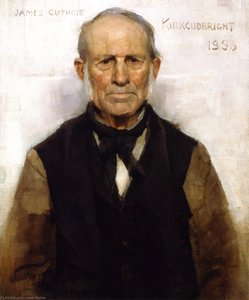
Portrait of James Guthrie

James Guthrie Paintings: The 64 Most Famous, Through a Gallery's Eye

Updated November 2026 · ranked by our popularity score (searches, visits and orders for each work) · 65 works by James Guthrie in our catalogue

In short

To the gallery's eye, James Guthrie's most famous painting is To Pastures New (1882). A Hind's Daughter (1883) and Revd Dr Andrew Gardiner (died 1892) (1888) complete the trio every eye recognises. Of the 65 works by James Guthrie in our catalog, the gallery presents the 64 most famous below, each original with its year, its museum and what makes it unique.

1859 – 1930, Greenock Impressionism Most works: Scottish National Portrait Gallery

The gallery's top 10 James Guthrie paintings

1
To Pastures New (1882) by James Guthrie

To Pastures New

1882 · Oil On Canvas

The scene unfolds in To Pastures New, an oil on canvas painted by James Guthrie. Completed in 1883, the work captures a quiet moment of movement across the landscape. The artist, who lived from 1859 to 1930, brings a sense of life to this specific rural setting through his careful application of oil pigments.

2
A Hind's Daughter (1883) by James Guthrie

A Hind's Daughter

1883 · Oil On Canvas · National Gallery of Scotland, Edinburgh

James Guthrie completed A Hind's Daughter in 1883. The work presents an essentially Scottish scene, capturing a small girl who has just straightened up after cutting a cabbage. She looks directly at the viewer from within a cabbage field, her presence inextricably merged with the surrounding landscape.

3
Revd Dr Andrew Gardiner (died 1892) (1888) by James Guthrie

Revd Dr Andrew Gardiner (died 1892)

1888 · Oil On Canvas · Scottish National Gallery, Edinburgh

A somber, three-quarter length portrait of an elderly man, rendered with the quiet dignity of the academic tradition. The subject sits turned slightly to his right, his gaze directed toward the viewer's right, emerging from a dark, atmospheric void. Light falls with dramatic intent upon his forehead, weathered skin, and hands, creating a chiaroscuro effect that emphasizes the textures of his white hair and the heavy fabric of his black…

4
Mrs Craig Sellar of Ardtornish (1844 - 1929) (1910) by James Guthrie

Mrs Craig Sellar of Ardtornish (1844 - 1929)

1910 · Oil On Canvas · Scottish National Gallery, Edinburgh

An elderly woman sits in profile, her presence anchored by the weight of an ornate chair. The light enters from the upper left, a soft wash that catches the curve of a cheek and the stillness of hands. She is draped in dark attire, a silhouette of deep blacks and browns that merges with the shadows of the room. The composition is quiet, placing her slightly off-center against a hazy,…

5
Crowland (1882) by James Guthrie

Crowland

1882 · Oil On Canvas

The afternoon air feels heavy and still as a man pauses on the sidewalk, his presence anchored by a sturdy pole. He wears a hat that casts a soft shadow over his features, and a cane rests in his hand, a silent companion to his slow, deliberate pace. At his side, a dog waits with loyal patience, while further off, another canine wanders through the scene. The world around them…

6
A Gallant of the Terror (1880) by James Guthrie

A Gallant of the Terror

1880 · Oil On Canvas · Scottish National Gallery, Edinburgh

In "A Gallant of the Terror," James Guthrie presents a solitary figure caught in a moment of heavy introspection. This oil on canvas, painted about 1880, focuses on a weary man from the waist up. He sits in a quiet, shadowed space, his presence filling the frame with a sense of profound fatigue. A dark bicorne-style hat rests upon his head, and a blue jacket covers his shoulders, while a…

7
Sir Henry Campbell-Bannerman, 1836 - 1908. Statesman (1908) by James Guthrie

Sir Henry Campbell-Bannerman, 1836 - 1908. Statesman

1908 · Oil On Canvas · Scottish National Portrait Gallery, Edinburgh

The portrait titled Sir Henry Campbell-Bannerman, 1836 - 1908. Statesman presents a commanding presence on the canvas. This work, painted about 1908, captures the likeness of the statesman and Prime Minister Sir Henry Campbell-Bannerman. Born in Glasgow, the subject meets the viewer through the steady gaze of a man who has navigated the highest levels of British politics. The painting emerges from the hand of Sir James Guthrie, a significant…

9
Sir James Guthrie, 1859 - 1930. Artist and President of the Royal Scottish Academy (Self-portrait) (1910) by James Guthrie

Sir James Guthrie, 1859 - 1930. Artist and President of the Royal Scottish Academy (Self-portrait)

1910 · Oil On Canvas · Scottish National Portrait Gallery, Edinburgh

In this intimate bust-length portrait, we encounter the artist himself, captured in a moment of profound introspection. The subject is positioned slightly off-center, his gaze directed toward the viewer's left while his eyes remain fixed forward, creating a sense of psychological depth. There is a certain gravity in his expression, a dignity that comes from a life spent observing the nuances of light and human character. He is dressed in…

10
The Wash (1882) by James Guthrie

The Wash

1882 · Oil On Canvas

In The Wash, James Guthrie presents a vertically oriented scene that immediately draws the eye to the center of the canvas. A solitary, weary figure is positioned centrally, burdened by a heavy load as they move through a desolate landscape. This central placement creates a profound sense of isolation, emphasizing the physical struggle inherent in the subject's movement. The composition is structured with a shallow perspective, where the figure is…

James Guthrie paintings, ranked 11 to 64

11Rev. Alexander Whyte, 1836 - 1921. Principal of New College, Edinburgh (1900) by James GuthrieRev. Alexander Whyte, 1836 - 1921. Principal of New College, Edinburgh1900 · Scottish National Portrait Gallery 12Christina Wilson, Mrs Thomas Steven, 1827 - 1913. (1903) by James GuthrieChristina Wilson, Mrs Thomas Steven, 1827 - 1913.1903 · Scottish National Gallery 13The Velvet Cloak (1907) by James GuthrieThe Velvet Cloak1907 · Scottish National Gallery 14Herbert Henry Asquith, 1st Earl of Oxford and Asquith (1920) by James GuthrieHerbert Henry Asquith, 1st Earl of Oxford and Asquith1920 · National Portrait Gallery 15William Morris Hughes, 1862 - 1952. Prime Minister of Australia. (Study for portrait in Statesman of the Great War) (1920) by James GuthrieWilliam Morris Hughes, 1862 - 1952. Prime Minister of Australia. (Study for portrait in Statesman of the Great War)1920 · Scottish National Portrait Gallery 16Sir Alfred Milner, 1st Viscount Milner, 1854 - 1925. Statesman. (Study for portrait in Statesmen of the Great War) (1921) by James GuthrieSir Alfred Milner, 1st Viscount Milner, 1854 - 1925. Statesman. (Study for portrait in Statesmen of the Great War)1921 · Scottish National Portrait Gallery 17William Ferguson Massey, 1856 - 1925. Prime Minister of New Zealand (Study for portrait in Statesman of the Great War, National Portrait Gallery, London) (1921) by James GuthrieWilliam Ferguson Massey, 1856 - 1925. Prime Minister of New Zealand (Study for portrait in Statesman of the Great War, National Portrait Gallery, London)1921 · Scottish National Portrait Gallery 18David Lloyd George, 1st Earl Lloyd-George of Dwyfor, 1863 - 1945. Statesman (1920) by James GuthrieDavid Lloyd George, 1st Earl Lloyd-George of Dwyfor, 1863 - 1945. Statesman1920 · Scottish National Portrait Gallery 19Sir Winston Churchill, 1874 - 1965. Statesman (1919) by James GuthrieSir Winston Churchill, 1874 - 1965. Statesman1919 · Scottish National Portrait Gallery 20General Louis Botha, 1863 - 1919. Soldier and statesman. (Study for portrait in Statesmen of the Great War, National Portrait Gallery, London) (1918) by James GuthrieGeneral Louis Botha, 1863 - 1919. Soldier and statesman. (Study for portrait in Statesmen of the Great War, National Portrait Gallery, London)1918 · Scottish National Portrait Gallery 21Arthur James Balfour, 1st Earl of Balfour, 1848 - 1930. Statesman. (Study for portrait in Statesman of the Great War, National Portrait Gallery, London) (1920) by James GuthrieArthur James Balfour, 1st Earl of Balfour, 1848 - 1930. Statesman. (Study for portrait in Statesman of the Great War, National Portrait Gallery, London)1920 · Scottish National Portrait Gallery 22Sri Ganga Singh Bahadur, the Maharaja of Bikaner, 1880 - 1943. Statesman (Study for portrait in Statesman of the Great War, National Portrait Gallery, London) (1920) by James GuthrieSri Ganga Singh Bahadur, the Maharaja of Bikaner, 1880 - 1943. Statesman (Study for portrait in Statesman of the Great War, National Portrait Gallery, London)1920 · Scottish National Portrait Gallery 23Edward Grey, 1st Viscount Grey of Fallodon (1927) by James GuthrieEdward Grey, 1st Viscount Grey of Fallodon1927 · National Portrait Gallery 24Some statesmen of the Great War (1927) by James GuthrieSome statesmen of the Great War1927 · Scottish National Portrait Gallery 25Edward Patrick Morris, 1st Baron Morris, 1859 - 1935. Prime Minister of Newfoundland. (Study for portrait in Statesmen of the Great War) (1924) by James GuthrieEdward Patrick Morris, 1st Baron Morris, 1859 - 1935. Prime Minister of Newfoundland. (Study for portrait in Statesmen of the Great War)1924 · Scottish National Portrait Gallery 26Henry Herbert Asquith, 1st Earl of Oxford and Asquith, 1852 - 1928. Statesman (1923) by James GuthrieHenry Herbert Asquith, 1st Earl of Oxford and Asquith, 1852 - 1928. Statesman1923 27Andrew Bonar Law, 1858 - 1923. Statesman (study for portrait in Statesmen of World War I, 1914 - 1918, in the National Portrait Gallery, London) (1924) by James GuthrieAndrew Bonar Law, 1858 - 1923. Statesman (study for portrait in Statesmen of World War I, 1914 - 1918, in the National Portrait Gallery, London)1924 · Scottish National Portrait Gallery 28Edward Grey, Viscount Grey of Fallodon, 1862 - 1933. Statesman. (Study for portrait in Statesman of the Great War, National Portrait Gallery, London) (1924) by James GuthrieEdward Grey, Viscount Grey of Fallodon, 1862 - 1933. Statesman. (Study for portrait in Statesman of the Great War, National Portrait Gallery, London)1924 · Scottish National Portrait Gallery 29Sir Eric Campbell Geddes, 1875 - 1931. Statesman. (Study for portrait in Statesmen of the Great War) (1924) by James GuthrieSir Eric Campbell Geddes, 1875 - 1931. Statesman. (Study for portrait in Statesmen of the Great War)1924 · Scottish National Portrait Gallery 30Sir Joseph Cook, 1860 - 1947. Prime Minister of Australia. (Study for portrait in Statesmen of the Great War) (1924) by James GuthrieSir Joseph Cook, 1860 - 1947. Prime Minister of Australia. (Study for portrait in Statesmen of the Great War)1924 · Scottish National Portrait Gallery 31Sir Robert Laird Borden, 1854 - 1937. Prime Minister of Canada. (Study for portrait in Statesmen of the Great War, National Portrait Gallery, London) (1924) by James GuthrieSir Robert Laird Borden, 1854 - 1937. Prime Minister of Canada. (Study for portrait in Statesmen of the Great War, National Portrait Gallery, London)1924 · Scottish National Portrait Gallery 32George Nicoll Barnes, 1859 - 1940. Statesman. (Study for portrait in Statesmen of the Great War, National Portrait Gallery, London) (1924) by James GuthrieGeorge Nicoll Barnes, 1859 - 1940. Statesman. (Study for portrait in Statesmen of the Great War, National Portrait Gallery, London)1924 · Scottish National Portrait Gallery 33Schoolmates (1884) by James GuthrieSchoolmates1884 · Museum voor Schone Kunsten 34The Shepherd Boy (1883) by James GuthrieThe Shepherd Boy1883 · Scottish National Gallery 35In a Monastery Garden (1884) by James GuthrieIn a Monastery Garden1884 · Scottish National Gallery 36Paid-Off (1881) by James GuthriePaid-Off1881 37The Cottage on the Hill (1881) by James GuthrieThe Cottage on the Hill1881 38Hard at It (1883) by James GuthrieHard at It1883 · Kelvingrove Art Gallery and Museum 39The Pedlar (1881) by James GuthrieThe Pedlar1881 40Field Work in the Lothians (1883) by James GuthrieField Work in the Lothians1883 41Gypsy Fires are Burning for Daylight's Past and Gone (1881) by James GuthrieGypsy Fires are Burning for Daylight's Past and Gone1881 · The Hunterian Museum and Art Gallery 42Poppleton, The Artist at Work (1882) by James GuthriePoppleton, The Artist at Work1882 · The Hunterian Museum and Art Gallery 43Miss Helen Sowerby (1882) by James GuthrieMiss Helen Sowerby1882 · National Gallery of Scotland 44The Camp in the Woods (1880) by James GuthrieThe Camp in the Woods1880 45A Funeral Service in the Highlands (1881) by James GuthrieA Funeral Service in the Highlands1881 · Kelvingrove Art Gallery and Museum 46Street in Oban, Night (1890) by James GuthrieStreet in Oban, Night1890 · Yale Center for British Art 47The Tennis Racket (1890) by James GuthrieThe Tennis Racket1890 48Candlelight (1890) by James GuthrieCandlelight1890 49Maggie Hamilton (1892) by James GuthrieMaggie Hamilton1892 · Kelvingrove Art Gallery and Museum 50The Ropewalk (1888) by James GuthrieThe Ropewalk1888 51Tennis (1890) by James GuthrieTennis1890 52The Stonebreaker (1886) by James GuthrieThe Stonebreaker1886 53Oban (1893) by James GuthrieOban1893 · Scottish National Gallery 54Oban (1893) by James GuthrieOban1893 · Scottish National Gallery 55Errol Guthrie by James GuthrieErrol Guthrie 56Pastoral (1887) by James GuthriePastoral1887 · National Gallery of Scotland 57Pastureland (1890) by James GuthriePastureland1890 · Kelvingrove Art Gallery and Museum 58Firelight Reflections (1890) by James GuthrieFirelight Reflections1890 59Old Willie, A Village Worthy (1886) by James GuthrieOld Willie, A Village Worthy1886 · Kelvingrove Art Gallery and Museum 60In the Orchard (1885) by James GuthrieIn the Orchard1885 · Kelvingrove Art Gallery and Museum 61Midsummer (1890) by James GuthrieMidsummer1890 62The Morning Walk by James GuthrieThe Morning Walk 63St. Mary's Isle, Kirkcudbright by James GuthrieSt. Mary's Isle, Kirkcudbright 64Statesmen of World War I (1930) by James GuthrieStatesmen of World War I1930 · National Portrait Gallery

James Guthrie's famous paintings, period by period

The subjects that held James Guthrie's eye

The four subjects that come back most often in these originals, each with its finest example.

The museums that keep James Guthrie's originals

The 8 museums that hold the most of the paintings on this page.

Museum City Works by James Guthrie Paintings from this list
Scottish National Portrait Gallery, EdinburghScottish National Portrait Gallery Edinburgh 19 Sir Henry Campbell-Bannerman, 1836 - 1908. Statesman, Sir James Guthrie, 1859 - 1930. Artist and President of the Royal Scottish Academy (Self-portrait), Rev. Alexander Whyte, 1836 - 1921. Principal of New College, Edinburgh
Scottish National Gallery, EdinburghScottish National Gallery Edinburgh 10 Revd Dr Andrew Gardiner (died 1892), Mrs Craig Sellar of Ardtornish (1844 - 1929), A Gallant of the Terror
Kelvingrove Art Gallery and Museum, GlasgowKelvingrove Art Gallery and Museum Glasgow 6 Hard at It, A Funeral Service in the Highlands, Maggie Hamilton
National Gallery of Scotland, EdinburghNational Gallery of Scotland Edinburgh 3 A Hind's Daughter, Miss Helen Sowerby, Pastoral
National Portrait Gallery, LondonNational Portrait Gallery London 3 Herbert Henry Asquith, 1st Earl of Oxford and Asquith, Edward Grey, 1st Viscount Grey of Fallodon, Statesmen of World War I
The Hunterian Museum and Art Gallery, GlasgowThe Hunterian Museum and Art Gallery Glasgow 2 Gypsy Fires are Burning for Daylight's Past and Gone, Poppleton, The Artist at Work
Museum voor Schone Kunsten, GentMuseum voor Schone Kunsten Gent 1 Schoolmates
Yale Center for British Art, New HavenYale Center for British Art New Haven 1 Street in Oban, Night

James Guthrie, one signature painting per decade

Works per decade

Pick a decade to see the original that defines it.

James Guthrie's paintings: the gallery answers

Which James Guthrie painting is the most famous of all?Reveal the answer

To Pastures New (1882). A Hind's Daughter (1883) and Revd Dr Andrew Gardiner (died 1892) (1888) come next.

How old was James Guthrie on completing To Pastures New?Reveal the answer

23 years old: To Pastures New dates from 1882, and James Guthrie was born in 1859.

Which are James Guthrie's top 10 paintings?Reveal the answer

To Pastures New, A Hind's Daughter, Revd Dr Andrew Gardiner (died 1892), Mrs Craig Sellar of Ardtornish (1844 - 1929), Crowland, A Gallant of the Terror, Sir Henry Campbell-Bannerman, 1836 - 1908. Statesman, The Artist's Mother (Anne Orr, Mrs John Guthrie, 1817 - 1896), Sir James Guthrie, 1859 - 1930. Artist and President of the Royal Scottish Academy (Self-portrait) and The Wash. The ranking above gives each one's year and museum.

How many works did James Guthrie create?Reveal the answer

Our catalog holds 65 works by James Guthrie, dated from 1880 to 1930.

Where do James Guthrie's most famous originals hang?Reveal the answer

Mostly in Scottish National Portrait Gallery (Edinburgh), Scottish National Gallery (Edinburgh) and Kelvingrove Art Gallery and Museum (Glasgow). The museum table above lists them all.

When did James Guthrie create the most famous paintings?Reveal the answer

In 1880s: 24 of the 64 works on this page were made then, To Pastures New among them.

Which are James Guthrie's earliest and latest famous works?Reveal the answer

On this page, the earliest is A Gallant of the Terror (1880) and the latest Statesmen of World War I (1930).

Which subjects did James Guthrie return to most?Reveal the answer

Man (26), Portrait (14) and Suit (9), across the 64 works on this page.

Which medium did James Guthrie work in most?Reveal the answer

Oil On Canvas, for 33 of the 64 works on this page.

Which movement is James Guthrie associated with?Reveal the answer

Impressionism and Scottish realism, judging by the originals on this page.

Which James Guthrie originals does the Scottish National Portrait Gallery hold?Reveal the answer

Sir Henry Campbell-Bannerman, 1836 - 1908. Statesman, Sir James Guthrie, 1859 - 1930. Artist and President of the Royal Scottish Academy (Self-portrait) and Rev. Alexander Whyte, 1836 - 1921. Principal of New College, Edinburgh: the Scottish National Portrait Gallery, Edinburgh holds 19 of the works on this page.

James Guthrie: the artist

The Soul of Scottish Realism

Born in Greenock, United Kingdom, Sir James Guthrie emerged as a pivotal figure in the landscape of late nineteenth-century art. Though he initially embarked on a path toward a legal career at Glasgow University, the call of the canvas proved irresistible, leading him to abandon his law studies in 1877 to pursue painting. Unlike many of his contemporaries who sought refinement in the studios of Paris, Guthrie followed a more solitary and self-taught trajectory. While he received brief mentorship from figures such as James Drummond in Glasgow and John Pettie in London, his artistic identity was forged through a deep, personal engagement with the natural world and the works of the French Realists.

His development was profoundly shaped by the influence of Jules Bastien-Lepage, whose approach to realism provided a blueprint for Guthrie’s own mastery of atmosphere and light. This connection helped him become a prominent member of the Glasgow Boys, a group known for pushing the boundaries of traditional Scottish painting. His work often moved beyond mere documentation, seeking instead to capture the fleeting sensations of light and air through loose brushstrokes and a vibrant, yet often muted, color palette. Whether depicting the quiet dignity of rural life or the intimate details of portraiture, Guthrie possessed a rare ability to translate the emotional weight of a scene onto the canvas.

Mastery of Light and Landscape

Guthrie’s oeuvre is celebrated for its evocative power, particularly in his ability to imbue landscapes with a sense of profound tranquility. In works such as Pastureland, he demonstrates a symphonic command over light and shadow, creating an immersive experience of the Scottish countryside. His technique often embraced elements of Impressionism, prioritizing mood and sensation over rigid, academic precision. This is evident in his use of textures—the soft fur of cattle, the swaying grass of a field, or the hazy luminosity of a summer day—all rendered with a sensitivity that speaks to the rhythms of nature.

His landscapes were frequently inspired by the Scottish Borders, specifically locations like Cockburnspath, where he lived for much of his life. These settings provided the backdrop for some of his most enduring achievements, including:

Legacy and Recognition

Throughout his career, Guthrie achieved significant institutional recognition, reflecting his importance to the British art scene. His ascent through the ranks of the Royal Scottish Academy saw him elected as an associate in 1888 and a full member in 1892, eventually succeeding Sir George Reid as President of the RSA. This professional prestige was matched by personal honors, including being knighted in 1903 for his immense contributions to the arts.

Beyond his landscapes and portraits, Guthrie’s historical significance is cemented by his ability to capture the spirit of an era. His later years saw him commissioned for monumental tasks, such as the large-scale group portrait Statesmen of World War I, completed in 1930. This work, depicting seventeen politicians and statesmen, stands as a testament to his skill in handling complex compositions and historical gravity. Today, Guthrie is remembered not just as a painter of Scottish Realism, but as an artist who could capture the very essence of peace, light, and the enduring beauty of the natural world.