Portrait of Jacques Stella

The 45 Most Famous Jacques Stella Paintings, a Gallery Selection

Updated November 2026 · ranked by our popularity score (searches, visits and orders for each work) · 48 works by Jacques Stella in our catalogue

In short

Of all the originals Jacques Stella left, the most famous is The Madonna and Child (1642), in the collection of the Hermitage Museum, Saint Petersburg. Close behind it come Madonna and Christ Child, with St John the Baptist and Angels (1650) and Christ on the Cross and Saint Mary Magdalene (1625). Our catalog holds 48 works by Jacques Stella; the gallery has kept the 45 the world admires most, each shown with its date, its museum and its story.

1596 – 1657, Lyon Baroque Most works: The Louvre

Jacques Stella's top 10 paintings: the gallery's choice

1
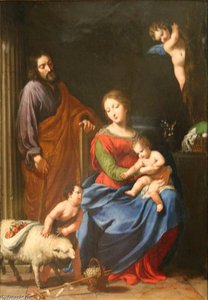
The Madonna and Child (1642) by Jacques Stella

The Madonna and Child

1642 · Oil · Hermitage Museum, Saint Petersburg

The Madonna and Child emerges from the shadows of the seventeenth century, a tender moment captured in oil by the French Baroque painter Jacques De Stella. Born in 1596, the artist brings a sense of profound stillness to this religious scene. The work dates to about 1642, a period when De Stella’s brushwork carries the weight of both Florentine precision and the dramatic light of the Baroque era. He moves…

3
Christ on the Cross and Saint Mary Magdalene (1625) by Jacques Stella

Christ on the Cross and Saint Mary Magdalene

1625 · Oil

The scene unfolds in a moment of profound sorrow, capturing Christ on the Cross and Saint Mary Magdalene. This religious oil painting by Jacques Stella brings the viewer into the immediate presence of the Crucifixion. The pale, illuminated figure of Christ hangs against a dark, nocturnal sky, while Saint Mary Magdalene remains at the foot of the cross, her presence a heavy weight of grief and devotion. The air feels…

4
Christ and the Samaritan Woman (1640) by Jacques Stella

Christ and the Samaritan Woman

1640 · Oil

The scene unfolds in 1640, capturing a profound moment of encounter in Christ and the Samaritan Woman. Jacques Stella brings this biblical narrative to life, focusing on the pivotal meeting between Jesus and the woman at the well. The air seems to hold its breath as the two figures engage, their presence anchored by the stone structure of the well that serves as the heart of their interaction.

5
Self-portrait (1640) by Jacques Stella

Self-portrait

1640 · Oil On Canvas · Museum of Fine Arts of Lyon, Lyon

The painting presents a close-up view of a man, focused on the face and upper body against an undefined, dark background. A single light source originates from the upper left, casting the right side of the subject's features into deep shadow. This lighting highlights the bridge of the nose, the lips, and the texture of the skin. The subject is positioned centrally, creating a direct gaze toward the viewer. He…

6
The Nativity (1639) by Jacques Stella

The Nativity

1639 · Oil On Canvas · Bowes Museum, Barnard Castle

The air inside the stable feels heavy with the scent of hay and the warmth of a recent miracle. A soft, golden light spills through a window to the right, cutting through the dimness to illuminate the central figures. Mary and Joseph lean inward, their bodies forming a quiet, pyramidal shape that draws the eye toward the infant Jesus. The child lies at the heart of this composition, a small…

7
Risen Jesus Christ appearing to his mother (1650) by Jacques Stella

Risen Jesus Christ appearing to his mother

1650 · Oil

The Resurrection is rendered here through a rare and demanding medium: oil on a translucent, polished stone slab, likely agate or onyx. This choice of substrate dictates the work's unique luminosity. The background is not a static void but a swirling, textured expanse of golden-brown, where the natural veins of the stone integrate with the painted figures. Christ emerges as a muscular, luminous presence, draped in flowing pink and red…

8
Jacob's Ladder (1650) by Jacques Stella

Jacob's Ladder

1650 · Painting · Los Angeles County Museum of Art, Los Angeles

In Jacob's Ladder, Jacques Stella captures a moment of profound spiritual intersection. Created about 1650, the work presents the biblical scene of Jacob's Ladder, where the boundary between the earthly and the divine begins to dissolve. The subject matter functions as a symbol of divine communication and transcendence, inviting a sense of wonder at the connection between heaven and earth. This celestial encounter unfolds within a dreamlike atmosphere, where the…

9
MINERVE CHEZ LES MUSES by Jacques Stella

MINERVE CHEZ LES MUSES

Oil On Canvas · The Louvre, Paris

To gaze upon this magnificent depiction of Minerve Chez les Muses is to step directly into the golden age of classical mythology, a moment suspended in an eternal afternoon of intellectual bloom. The scene unfolds with breathtaking richness, presenting Minerva, the embodiment of wisdom and strategic thought, surrounded by her divine companions—the Muses, goddesses patronizing the arts and sciences. It is more than just a painting; it is a vibrant…

10
The Martyrdom of St Stephen (1623) by Jacques Stella

The Martyrdom of St Stephen

1623 · Oil · Fitzwilliam College, Cambridge

Jacques Stella captured the heavy weight of sacrifice in this depiction of The Martyrdom of St Stephen. Created about 1623, the work presents a moment of profound tension. The scene focuses on the saint as he faces his end, surrounded by the physical reality of his persecution. It is a study of devotion held against the violence of a crowd.

The Jacques Stella selection continues, 11 to 45

11The Rest on the Flight into Egypt (1639) by Jacques StellaThe Rest on the Flight into Egypt1639 12The Virgin and Child with Saint John the Baptist and Child Angels (1640) by Jacques StellaThe Virgin and Child with Saint John the Baptist and Child Angels1640 · National Trust 13Salome with the Head of Saint John the Baptist (1637) by Jacques StellaSalome with the Head of Saint John the Baptist1637 · National Trust 14SAINTE CECILE JOUANT DE L'ORGUE by Jacques StellaSAINTE CECILE JOUANT DE L'ORGUEThe Louvre 15Judgment of Solomon by Jacques StellaJudgment of SolomonKunsthistorisches Museum 16King Candaules of Lydia Showing His Wife to Gyges by Jacques StellaKing Candaules of Lydia Showing His Wife to GygesJohn and Mable Ringling Museum of Art 17Virgin and Child by Jacques StellaVirgin and Child 18The Rape of the Sabines by Jacques StellaThe Rape of the Sabines 19Massacre Of The Innocents by Jacques StellaMassacre Of The Innocents 20LOUIS II DE BOURBON, DUC D'ENGHIEN by Jacques StellaLOUIS II DE BOURBON, DUC D'ENGHIENCondé Museum 21La mort de Saint Joseph by Jacques StellaLa mort de Saint JosephMusée de Grenoble 22Sainte Anne conduisant la Vierge au temple by Jacques StellaSainte Anne conduisant la Vierge au temple 23La Vierge donnant la bouillie à l'enfant Jésus, avec un angelot soufflant sur le réchaud by Jacques StellaLa Vierge donnant la bouillie à l'enfant Jésus, avec un angelot soufflant sur le réchaud 24L'Enfance du Christ La Sainte Famille by Jacques StellaL'Enfance du Christ La Sainte Famille 25Repos de la Sainte Famille by Jacques StellaRepos de la Sainte Famille 26LA VIERGE, L'ENFANT JESUS ET SAINT JEAN BAPTISTE by Jacques StellaLA VIERGE, L'ENFANT JESUS ET SAINT JEAN BAPTISTE 27TRIOMPHE DE LOUIS XIII SUR LES ENNEMIS DE LA RELIGION by Jacques StellaTRIOMPHE DE LOUIS XIII SUR LES ENNEMIS DE LA RELIGION 28The Marriage of the Virgin by Jacques StellaThe Marriage of the VirginSzépművészeti Múzeum 29Clelie Passant Le Tibre by Jacques StellaClelie Passant Le Tibre 30French, (1596-1657) by Jacques StellaFrench, (1596-1657) 31The Holy Family by Jacques StellaThe Holy Family 32The Liberality Of Louis Xiii And Cardinal Richelieu by Jacques StellaThe Liberality Of Louis Xiii And Cardinal Richelieu 33Minerva and the muses by Jacques StellaMinerva and the muses 34Le Bapteme Du Christ by Jacques StellaLe Bapteme Du Christ 35La Sainte Famille by Jacques StellaLa Sainte Famille 36Sémiramis Appelée Au Combat by Jacques StellaSémiramis Appelée Au Combat 37Portrait De Jacques Stella Et De Sa Mère by Jacques StellaPortrait De Jacques Stella Et De Sa Mère 38Sainte Famille Avec Saint Jean-baptiste. by Jacques StellaSainte Famille Avec Saint Jean-baptiste.Musée Fabre 39The Liberality Of Titus, Allegory Of The Liberality Of Louis Xiii And Cardinal Richelieu by Jacques StellaThe Liberality Of Titus, Allegory Of The Liberality Of Louis Xiii And Cardinal RichelieuHarvard Art Museums 40Mariage de la Vierge by Jacques StellaMariage de la ViergeMusée des Augustins 41Rest On The Flight Into Egypt by Jacques StellaRest On The Flight Into EgyptMuzeum Palacu Króla Jana Iii w Wilanowie 42Jésus Christ reçoit la Vierge dans le ciel by Jacques StellaJésus Christ reçoit la Vierge dans le cielThe Louvre 43CLELIE PASSANT LE TIBRE by Jacques StellaCLELIE PASSANT LE TIBREThe Louvre 44Solomon Worshipping Idols (1647) by Jacques StellaSolomon Worshipping Idols1647 · Museum of Fine Arts of Lyon 45Solomon Receiving the Queen of Sheba (1650) by Jacques StellaSolomon Receiving the Queen of Sheba1650 · Museum of Fine Arts of Lyon

The subjects that held Jacques Stella's eye

The four subjects that come back most often in these originals, each with its finest example.

The museums that keep Jacques Stella's originals

The 8 museums that hold the most of the paintings on this page.

Museum City Works by Jacques Stella Paintings from this list
The Louvre, ParisThe Louvre Paris 4 MINERVE CHEZ LES MUSES, SAINTE CECILE JOUANT DE L'ORGUE, Jésus Christ reçoit la Vierge dans le ciel
Museum of Fine Arts of Lyon, LyonMuseum of Fine Arts of Lyon Lyon 3 Self-portrait, Solomon Worshipping Idols, Solomon Receiving the Queen of Sheba
Hermitage Museum, Saint PetersburgHermitage Museum Saint Petersburg 2 The Madonna and Child, Madonna and Christ Child, with St John the Baptist and Angels
National Trust, ThamesNational Trust Thames 2 The Virgin and Child with Saint John the Baptist and Child Angels, Salome with the Head of Saint John the Baptist
Bowes Museum, Barnard CastleBowes Museum Barnard Castle 1 The Nativity
Los Angeles County Museum of Art, Los AngelesLos Angeles County Museum of Art Los Angeles 1 Jacob's Ladder
Fitzwilliam College, CambridgeFitzwilliam College Cambridge 1 The Martyrdom of St Stephen
Kunsthistorisches Museum, ViennaKunsthistorisches Museum Vienna 1 Judgment of Solomon

Jacques Stella decade by decade: the original that defines each

Works per decade

Pick a decade to see the original that defines it.

Collectors' questions about Jacques Stella's paintings

Which work is Jacques Stella most famous for?Reveal the answer

The Madonna and Child (1642), Hermitage Museum, Saint Petersburg. Madonna and Christ Child, with St John the Baptist and Angels (1650) and Christ on the Cross and Saint Mary Magdalene (1625) come next.

What age was Jacques Stella when The Madonna and Child was made?Reveal the answer

46 years old: The Madonna and Child dates from 1642, and Jacques Stella was born in 1596.

What are the ten most famous Jacques Stella paintings?Reveal the answer

The Madonna and Child, Madonna and Christ Child, with St John the Baptist and Angels, Christ on the Cross and Saint Mary Magdalene, Christ and the Samaritan Woman, Self-portrait, The Nativity, Risen Jesus Christ appearing to his mother, Jacob's Ladder, MINERVE CHEZ LES MUSES and The Martyrdom of St Stephen. The ranking above gives each one's year and museum.

How many paintings did Jacques Stella leave?Reveal the answer

Our catalog holds 48 works by Jacques Stella, dated from 1623 to 1650.

In which museums do Jacques Stella's masterpieces hang?Reveal the answer

Mostly in The Louvre (Paris), Museum of Fine Arts of Lyon (Lyon) and Hermitage Museum (Saint Petersburg). The museum table above lists them all.

In which years did Jacques Stella paint the most famous works?Reveal the answer

In 1640s: 5 of the 45 works on this page were made then, The Madonna and Child among them.

What are the first and the last famous originals of Jacques Stella?Reveal the answer

On this page, the earliest is The Martyrdom of St Stephen (1623) and the latest Madonna and Christ Child, with St John the Baptist and Angels (1650).

Which subjects did Jacques Stella choose most often?Reveal the answer

Woman (7), Man (5) and Landscape (4), across the 45 works on this page.

Which technique did Jacques Stella use most?Reveal the answer

Oil, for 10 of the 45 works on this page.

To which art movement does Jacques Stella belong?Reveal the answer

Baroque, judging by the originals on this page.

Which Jacques Stella works hang at the The Louvre?Reveal the answer

MINERVE CHEZ LES MUSES, SAINTE CECILE JOUANT DE L'ORGUE and Jésus Christ reçoit la Vierge dans le ciel: the The Louvre, Paris holds 4 of the works on this page.

Jacques Stella: life and work

Jacques de Stella: A Classicist Bridging Florence and Paris

Jacques de Stella (1596-1657) stands as a pivotal figure in 17th-century French art, a painter whose career seamlessly blended the rigorous principles of Florentine classicism with the burgeoning dynamism of Roman influence. Born in Lyon to a family steeped in artistic tradition – his father, François Stella, was a painter and merchant of Flemish origin – Stella’s early life laid the foundation for a remarkable trajectory. Despite his father's untimely death before providing formal training, Stella’s siblings, including sculptor Madeleine and artist François the Younger, fostered an environment rich with creative discourse and artistic practice. This familial legacy, coupled with his uncle Antoine Stella’s own artistic pursuits, propelled him towards a life dedicated to visual expression.

Stella's artistic journey commenced in Lyon, where he honed his skills before embarking on a transformative period in Florence between 1616 and 1621. This sojourn within the court of Cosimo II de Medici proved profoundly influential. Working alongside Jacques Callot, Stella immersed himself in the ideals of Renaissance art, absorbing the meticulous detail, balanced compositions, and profound moral narratives characteristic of Florentine painting. The influence of Florence is undeniably evident throughout his oeuvre, particularly in his masterful use of perspective, drapery, and the depiction of religious figures with a dignified solemnity.

The Roman Years: Poussin’s Shadow and Papal Patronage

Following Cosimo II's death in 1621, Stella relocated to Rome, where he spent the next decade establishing himself as a respected artist. This period witnessed a significant shift in his artistic sensibilities, marked by an increasing engagement with classical antiquity and, crucially, the teachings of Nicolas Poussin. Poussin’s emphasis on light, color, and idealized forms resonated deeply with Stella, shaping his approach to composition and subject matter. Their friendship fostered a shared pursuit of clarity, restraint, and spiritual depth – qualities that would become hallmarks of Stella's style.

Stella’s Roman career was further distinguished by his patronage from Pope Urban VIII, who recognized the artist’s talent and commissioned numerous works, including intricate paintings on stone (onyx, lapis-lazuli, or slate) alongside more traditional panel paintings. These commissions showcased Stella's technical virtuosity and his ability to translate complex narratives into visually compelling forms. His work during this time demonstrated a masterful command of technique, evident in the precise rendering of textures, the subtle gradations of light and shadow, and the harmonious integration of figures within their environments.

Religious Themes and Royal Recognition

Stella’s artistic output was particularly focused on religious subjects, most notably his poignant depictions of the “Childhood of Christ.” Five distinct versions of this iconic scene exist, each offering a subtly different interpretation of the narrative. These paintings are not merely representations of biblical events; they are imbued with a profound sense of tenderness, vulnerability, and spiritual contemplation. The meticulous detail with which Stella portrays the infant Jesus’s interactions with his parents – Mary and Joseph – speaks to his deep understanding of human emotion and his ability to convey complex theological ideas through visual imagery.

In 1634, Stella returned to Lyon before moving to Paris in 1635. His arrival in the capital marked a significant turning point in his career. Presented to King Louis XIII by Cardinal Richelieu, he was granted the prestigious title of ‘Peintre du Roi’ (King's Painter), a position that afforded him royal patronage and a guaranteed pension of 1000 livres. This recognition solidified Stella’s status as one of France’s leading artists, allowing him to continue his artistic pursuits with relative security and freedom.

A Collector and Legacy

Beyond his prolific painting and engraving activities, Jacques Stella was an avid art collector throughout his life. He amassed a remarkable collection of works by Poussin, Raphael, and Michelangelo, alongside drawings by Leonardo da Vinci – demonstrating a deep appreciation for the artistic heritage of the past. His dedication to preserving and studying these masterpieces underscores his commitment to both artistic creation and historical scholarship.

Stella’s career spanned several decades, marked by a remarkable adaptability and a willingness to embrace diverse artistic styles. He died in Paris, leaving behind a substantial body of work that continues to be admired for its elegance, technical skill, and profound spiritual depth. His influence on subsequent generations of French painters is undeniable, cementing his place as a key figure in the transition from Mannerism to Classicism and a vital link between the artistic traditions of Florence and France.