Portrait of Fernand Khnopff

The 69 Most Famous Fernand Khnopff Paintings, a Gallery Selection

Updated November 2026 · ranked by our popularity score (searches, visits and orders for each work) · 70 works by Fernand Khnopff in our catalogue

In short

Of all the originals Fernand Khnopff left, the most famous is The Caress, in the collection of the Royal Museums of Fine Arts of Belgium, Brussels. Close behind it come Posthumous Portrait of Marguerite Landuyt (1896) and Portret van Augustinus Gerardus Hubertus van Rijckevorsel (1828 - ’s-Hertogenbosch - 1891) (1888). Our catalog holds 70 works by Fernand Khnopff; the gallery has kept the 69 the world admires most, each shown with its date, its museum and its story.

1858 – 1921, Dendermonde Symbolism Most works: Royal Museums of Fine Arts of Belgium

Fernand Khnopff's top 10 paintings: the gallery's choice

1
The Caress by Fernand Khnopff

The Caress

Oil On Canvas · Royal Museums of Fine Arts of Belgium, Brussels

Fernand Khnopff's 1896 masterpiece presents a profoundly intriguing scene – an intimate embrace between a nude man and woman, subtly disrupted by the presence of a majestic cheetah. This painting is a quintessential example of Symbolism, a late 19th-century art movement that rejected realism in favor of subjective emotional experience and the exploration of ideas through symbolic imagery.

2
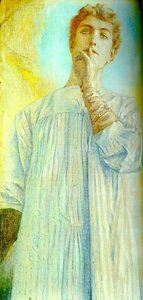
Posthumous Portrait of Marguerite Landuyt (1896) by Fernand Khnopff

Posthumous Portrait of Marguerite Landuyt

1896 · Oil On Canvas

A young woman sits suspended in a moment of profound stillness, her presence filling the frame with a quiet, heavy grace. She wears a white dress that catches the soft, diffused light, its folds rendered with a tactile quality that suggests the weight of fine fabric. Her hand rests gently against her chin, a gesture that pulls the viewer into her private, internal landscape. There is a sense of a…

3
Portret van Augustinus Gerardus Hubertus van Rijckevorsel (1828 - ’s-Hertogenbosch - 1891) (1888) by Fernand Khnopff

Portret van Augustinus Gerardus Hubertus van Rijckevorsel (1828 - ’s-Hertogenbosch - 1891)

1888 · Oil On Panel · Rijksmuseum, Amsterdam

Portret van Augustinus Gerardus Hubertus van Rijckevorsel (1828 - ’s-Hertogenbosch - 1891) is a painting by Fernand Edmond Jean Marie Khnopff. Executed in 1888, this oil on panel work captures the likeness of Augustinus Gerardus Hubertus van Rijckevorsel. The portrait functions as a formal record of the subject, presented in a three-quarter position.

5
Silence by Fernand Khnopff

Silence

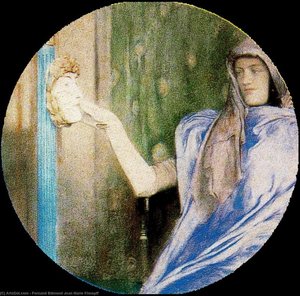
Pastel

The subject is positioned centrally within the frame, creating a sense of immediate presence. He faces slightly to the right, a subtle orientation that suggests a quiet engagement with something just beyond the viewer's immediate field of vision. His hand rests thoughtfully on his chin, a gesture that anchors the composition and emphasizes the stillness of the pose. This central placement draws the eye inward, focusing attention on the contemplative…

6
The Game Warden (1883) by Fernand Khnopff

The Game Warden

1883 · Oil On Canvas · Städel Museum, Frankfurt

In "The Game Warden," Fernand Khnopff presents a scene of quietude and subtle tension. A solitary figure, a game warden, is positioned in the middle ground of a pastoral landscape, holding a rifle. He is dressed in a cool blue-grey jacket that distinguishes him from the surrounding environment. The setting is characterized by a sense of serenity, though a certain melancholy permeates the atmosphere. The landscape itself is composed of…

7
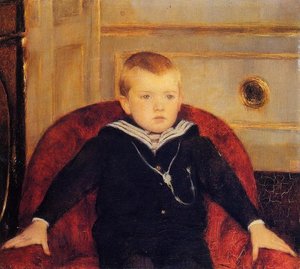
Henri de Woelmont (1884) by Fernand Khnopff

Henri de Woelmont

1884 · Oil On Canvas

The artwork titled Henri de Woelmont is a portrait executed by the Belgian artist Fernand Khnopff. This painting depicts a young boy positioned within an interior setting. The subject is seated in an ornate chair, wearing a sailor suit that features blue tones. The composition focuses on the boy, whose gaze is directed slightly downward.

8
Who Shall Deliver Me? (1891) by Fernand Khnopff

Who Shall Deliver Me?

1891 · Conté Crayon

The gaze of the subject in Who Shall Deliver Me? meets the viewer from a place of profound stillness. This portrait, rendered by the Belgian artist Fernand Khnopff, captures a woman who seems suspended between the physical realm and a dreamlike state. The work, created in 1891, presents a figure of striking presence, her pale skin and vivid hair creating a quiet tension against the muted surroundings. She is identified…

9
Portrait of Madeleine Mabille (1888) by Fernand Khnopff

Portrait of Madeleine Mabille

1888 · Oil · Carnegie Museum of Art, Pittsburgh

The portrait presents a full-length view of Madeleine Mabille, positioned centrally within an interior setting. She is depicted standing in a white gown that falls in smooth, flowing lines toward the floor. The fabric of the dress appears fine and smooth, creating a sense of movement despite the subject's static, upright posture. The color palette is composed of muted tones, specifically creamy whites, soft greys, and pale lavender. A soft,…

10
Acrasia (1892) by Fernand Khnopff

Acrasia

1892 · Oil On Canvas · Fin-de-Siècle Museum, Brussels

In this vertical composition from 1892, we encounter a figure that seems to exist in a state of suspended animation. The subject is a slender female form, draped in translucent, flowing fabric that clings to her skin with a soft, almost nebulous quality. There is a profound sense of stillness here, a quietude that borders on the melancholic. The color palette relies on the warmth of peach, orange, and red…

The Fernand Khnopff selection continues, 11 to 69

11Incense (1898) by Fernand KhnopffIncense1898 · Musée d'Orsay 12Study of a Woman (1896) by Fernand KhnopffStudy of a Woman1896 13日本語 日本婦人の肖像(黒木夫人) English Portrait of a Japanese Woman (Mrs. Kuroki) (1922) by Fernand Khnopff日本語 日本婦人の肖像(黒木夫人) English Portrait of a Japanese Woman (Mrs. Kuroki)1922 · National Museum of Western Art 14Young Girl with a Peacock by Fernand KhnopffYoung Girl with a PeacockMusee des Arts Decoratifs 15Miss Ella Carmichael by Fernand KhnopffMiss Ella CarmichaelPetit Palais 16Study of a woman 1 by Fernand KhnopffStudy of a woman 1 17The Abandoned Town by Fernand KhnopffThe Abandoned Town 18Listening to Music by Schumann (1883) by Fernand KhnopffListening to Music by Schumann1883 · Royal Museums of Fine Arts of Belgium 19The garden (1886) by Fernand KhnopffThe garden1886 · Fin-de-Siècle Museum 20Landscape in Fosset (1890) by Fernand KhnopffLandscape in Fosset1890 · Museum of Fine Arts Ghent (MSK) 21Gabrielle Braun (1886) by Fernand KhnopffGabrielle Braun1886 22In Fosset, Rain (1890) by Fernand KhnopffIn Fosset, Rain1890 23Study of Women (1887) by Fernand KhnopffStudy of Women1887 24Still water (1894) by Fernand KhnopffStill water1894 25Sleeping Medusa (1896) by Fernand KhnopffSleeping Medusa1896 26Landscape with bridge in Fosset by Fernand KhnopffLandscape with bridge in FossetMu.zee 27Edmond Khnopff by Fernand KhnopffEdmond KhnopffRoyal Museum of Fine Arts Antwerp 28The Blood of the Medusa by Fernand KhnopffThe Blood of the Medusa 29Study by Fernand KhnopffStudy 30Girl with a crown of thorns by Fernand KhnopffGirl with a crown of thorns 31Incense by Fernand KhnopffIncense 32The Supreme Vice by Fernand KhnopffThe Supreme Vice 33Hypnos by Fernand KhnopffHypnos 34Study for 'L'idée de justice' by Fernand KhnopffStudy for 'L'idée de justice' 35Caritas aeterna by Fernand KhnopffCaritas aeterna 36A Portrait of a Standing Girl in White by Fernand KhnopffA Portrait of a Standing Girl in White 37Young Woman with Violets by Fernand KhnopffYoung Woman with Violets 38Who Shall Deliver Me by Fernand KhnopffWho Shall Deliver Me 39Portrait of the artist's sister by Fernand KhnopffPortrait of the artist's sister 40With Gregoire Le Roy. My Heart cries for the Past by Fernand KhnopffWith Gregoire Le Roy. My Heart cries for the Past 41Head of a young English Girl by Fernand KhnopffHead of a young English Girl 42With Georges Rodenbach A Dead City by Fernand KhnopffWith Georges Rodenbach A Dead City 43The Temptation of St Anthony by Fernand KhnopffThe Temptation of St Anthony 44The secret by Fernand KhnopffThe secret 45Un gesto de ofrenda by Fernand KhnopffUn gesto de ofrenda 46In Fosset. Twilight (A Fosset. Un Crépuscule) (1890) by Fernand KhnopffIn Fosset. Twilight (A Fosset. Un Crépuscule)1890 · Metropolitan Museum of Art 47In Bruges. A Portal (1904) by Fernand KhnopffIn Bruges. A Portal1904 48Portrait of Augustinus Gerardus Hubertus van Rijckevorsel, Fernand Khnopff, 1888 (1888) by Fernand KhnopffPortrait of Augustinus Gerardus Hubertus van Rijckevorsel, Fernand Khnopff, 18881888 49Roses and Japanese Fan (1885) by Fernand KhnopffRoses and Japanese Fan1885 · Metropolitan Museum of Art 50The Lac D'Amour, Bruges by Fernand KhnopffThe Lac D'Amour, Bruges 51Landscape at Fosset by Fernand KhnopffLandscape at Fosset 52Idleness by Fernand KhnopffIdleness 53Le Lac DAmour Bruges by Fernand KhnopffLe Lac DAmour Bruges 54Femme En Robe Rose by Fernand KhnopffFemme En Robe Rose 55Lunch On The Grass by Fernand KhnopffLunch On The Grass 56Dream Flowers by Fernand KhnopffDream Flowers 57Pensive lady by Fernand KhnopffPensive lady 58Young Girl With A Goldfish by Fernand KhnopffYoung Girl With A Goldfish 59Woman In The Garden; Femme Dans Un Jardin by Fernand KhnopffWoman In The Garden; Femme Dans Un Jardin 60Dame En Rose by Fernand KhnopffDame En Rose 61Portrait of a Young Girl by Fernand KhnopffPortrait of a Young Girl 62L ange de noel by Fernand KhnopffL ange de noel 63Sous Les Orangers by Fernand KhnopffSous Les Orangers 64Marie Monnom (1887) by Fernand KhnopffMarie Monnom1887 · Musée d'Orsay 65Jeanne Kéfer (1885) by Fernand KhnopffJeanne Kéfer1885 · J. Paul Getty Museum 66I Lock my Door upon Myself (1891) by Fernand KhnopffI Lock my Door upon Myself1891 · Neue Pinakothek 67Marguerite Khnopff (1887) by Fernand KhnopffMarguerite Khnopff1887 · Royal Museums of Fine Arts of Belgium 68Hortensia (1884) by Fernand KhnopffHortensia1884 · Metropolitan Museum of Art 69Memories (1889) by Fernand KhnopffMemories1889 · Royal Museums of Fine Arts of Belgium

Fernand Khnopff's famous paintings, period by period

The subjects that held Fernand Khnopff's eye

The four subjects that come back most often in these originals, each with its finest example.

The museums that keep Fernand Khnopff's originals

The 8 museums that hold the most of the paintings on this page.

Museum City Works by Fernand Khnopff Paintings from this list
Royal Museums of Fine Arts of Belgium, BrusselsRoyal Museums of Fine Arts of Belgium Brussels 4 The Caress, Listening to Music by Schumann, Marguerite Khnopff
Metropolitan Museum of Art, New YorkMetropolitan Museum of Art New York 3 In Fosset. Twilight (A Fosset. Un Crépuscule), Roses and Japanese Fan, Hortensia
Rijksmuseum, AmsterdamRijksmuseum Amsterdam 2 Portret van Augustinus Gerardus Hubertus van Rijckevorsel (1828 - ’s-Hertogenbosch - 1891), Portrait of Jonkvrouwe Maria Francisca Louisa Dommer van Poldersveldt, Fernand Khnopff, 1888
Fin-de-Siècle Museum, BrusselsFin-de-Siècle Museum Brussels 2 Acrasia, The garden
Musée d'Orsay, ParisMusée d'Orsay Paris 2 Incense, Marie Monnom
Städel Museum, FrankfurtStädel Museum Frankfurt 1 The Game Warden
Carnegie Museum of Art, PittsburghCarnegie Museum of Art Pittsburgh 1 Portrait of Madeleine Mabille
National Museum of Western Art, TokyoNational Museum of Western Art Tokyo 1 日本語 日本婦人の肖像(黒木夫人) English Portrait of a Japanese Woman (Mrs. Kuroki)

Fernand Khnopff decade by decade: the original that defines each

Works per decade

Pick a decade to see the original that defines it.

Collectors' questions about Fernand Khnopff's paintings

Which work is Fernand Khnopff most famous for?Reveal the answer

The Caress, Royal Museums of Fine Arts of Belgium, Brussels. Posthumous Portrait of Marguerite Landuyt (1896) and Portret van Augustinus Gerardus Hubertus van Rijckevorsel (1828 - ’s-Hertogenbosch - 1891) (1888) come next.

What are the ten most famous Fernand Khnopff paintings?Reveal the answer

The Caress, Posthumous Portrait of Marguerite Landuyt, Portret van Augustinus Gerardus Hubertus van Rijckevorsel (1828 - ’s-Hertogenbosch - 1891), Portrait of Jonkvrouwe Maria Francisca Louisa Dommer van Poldersveldt, Fernand Khnopff, 1888, Silence, The Game Warden, Henri de Woelmont, Who Shall Deliver Me?, Portrait of Madeleine Mabille and Acrasia. The ranking above gives each one's year and museum.

How many paintings did Fernand Khnopff leave?Reveal the answer

Our catalog holds 70 works by Fernand Khnopff, dated from 1883 to 1904.

In which museums do Fernand Khnopff's masterpieces hang?Reveal the answer

Mostly in Royal Museums of Fine Arts of Belgium (Brussels), Metropolitan Museum of Art (New York) and Rijksmuseum (Amsterdam). The museum table above lists them all.

In which years did Fernand Khnopff paint the most famous works?Reveal the answer

In 1880s: 16 of the 69 works on this page were made then, Portret van Augustinus Gerardus Hubertus van Rijckevorsel (1828 - ’s-Hertogenbosch - 1891) among them.

What are the first and the last famous originals of Fernand Khnopff?Reveal the answer

On this page, the earliest is The Game Warden (1883) and the latest In Bruges. A Portal (1904).

Which subjects did Fernand Khnopff choose most often?Reveal the answer

Woman (12), Interior (7) and Portrait (6), across the 69 works on this page.

Which technique did Fernand Khnopff use most?Reveal the answer

Oil On Canvas, for 9 of the 69 works on this page.

To which art movement does Fernand Khnopff belong?Reveal the answer

Symbolism, judging by the originals on this page.

Which Fernand Khnopff works hang at the Royal Museums of Fine Arts of Belgium?Reveal the answer

The Caress, Listening to Music by Schumann and Marguerite Khnopff: the Royal Museums of Fine Arts of Belgium, Brussels holds 4 of the works on this page.

Fernand Khnopff: life and work

Fernand Khnopff: Architect of the Dream

Fernand Edmond Jean Marie Khnopff (1858-1921) stands as a singular figure in Belgian art, a master of Symbolism who crafted intensely personal and often unsettling visions. Born in Grevelingen, Belgium, into a wealthy bourgeois family, his early life was shaped by a complex blend of familial expectations and burgeoning artistic passion – a tension that would profoundly inform his work. Initially destined for a legal career, Khnopff’s true calling emerged through the influence of Xavier Mellery at the Académie Royale des Beaux-Arts in Brussels, where he began to explore the evocative power of painting. His early years were marked by trips to Paris, immersing himself in the works of Delacroix, Ingres, and Millais, laying the groundwork for his distinctive style – a haunting synthesis of realism and ethereal dreamscapes. Khnopff’s artistic journey wasn't simply about replicating reality; it was about capturing the hidden currents of emotion, memory, and the subconscious.

The Language of Symbolism: Themes and Motifs

Khnopff’s art is deeply rooted in the Symbolist movement, yet he forged a unique path within its framework. Unlike many of his contemporaries who embraced overtly mythological or literary themes, Khnopff focused on intensely psychological explorations. His paintings are populated by enigmatic figures – often women – caught in moments of quiet contemplation, veiled desire, and profound isolation. Recurring motifs include the female nude, frequently rendered with an almost sculptural quality; the cheetah, a symbol of both predatory instinct and alluring beauty (most famously depicted in “The Caress”); and interiors that feel simultaneously familiar and unsettlingly alien. His use of muted color palettes – predominantly blues, grays, and browns – contributes to the overall atmosphere of melancholy and introspection. The figures in his works rarely engage directly with the viewer; instead, they seem lost within their own private worlds, inviting us to contemplate the mysteries of human experience.

Key Works: “The Caress” and Beyond

Perhaps Khnopff’s most celebrated work, "The Caress" (1896), exemplifies his signature style. The painting depicts a nude couple, seemingly lost in an unspoken exchange, with a cheetah lurking nearby – a potent symbol of both desire and danger. The scene is bathed in a soft, diffused light, creating a dreamlike atmosphere that defies easy interpretation. Khnopff’s meticulous attention to detail—the texture of the skin, the subtle shifts in expression—grounds the ethereal quality of the work in a palpable sense of realism. Other notable works include “I Lock My Door” (1895), which explores themes of confinement and solitude; "The Mirror" (1897), a haunting meditation on identity and self-reflection; and numerous portraits of his sister, Marguerite, often imbued with an aura of melancholy and timeless beauty. These paintings demonstrate Khnopff’s ability to transform ordinary subjects into vehicles for profound psychological exploration.

Influence and Legacy: Vienna Secession and Gesamtkunstwerk

Khnopff's work exerted a significant influence on the artistic landscape of late 19th-century Europe, particularly within the burgeoning avant-garde movements. His enigmatic style resonated deeply with artists in Vienna, notably Gustav Klimt, who exhibited several of Khnopff’s paintings at the Secession’s first exhibition in 1898. The influence extended beyond painting; Khnopff's designs for theater sets and opera costumes further solidified his reputation as a visionary artist. Later in life, he dedicated himself to creating a “Gesamtkunstwerk” – a total work of art – within his own home and studio in Brussels. This meticulously designed space, incorporating mosaic floors, golden circles, and symbolic furnishings, served as a physical manifestation of his artistic philosophy, reflecting his belief that art should encompass all aspects of human experience.

A Lasting Vision: The Artist’s Temple

Fernand Khnopff died in Brussels in 1921, leaving behind a body of work that continues to captivate and challenge viewers today. His paintings are not merely beautiful images; they are invitations to delve into the depths of the human psyche, to confront our own anxieties and desires, and to contemplate the mysteries of existence. Khnopff’s legacy lies in his ability to create art that is both intensely personal and universally resonant—a testament to the enduring power of Symbolism and the visionary genius of a Belgian master. His work remains a poignant reminder of the beauty and complexity of the human experience, rendered with an unparalleled blend of realism and ethereal dreaminess.