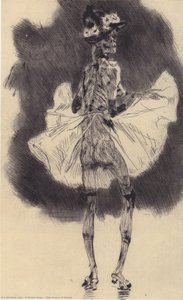
Portrait of Félicien Rops

The 46 Most Famous Félicien Rops Paintings, a Gallery Selection

Updated November 2026 · ranked by our popularity score (searches, visits and orders for each work) · 46 works by Félicien Rops in our catalogue

In short

Of all the originals Félicien Rops left, the most famous is The Entrance to the Ball (1858), in the collection of the musée provincial Félicien Rops, Namur. Close behind it come Satanic Self-Portrait (1860) and Head of an Old Antwerp Woman (1873). Our catalog holds 46 works by Félicien Rops; the gallery has kept the 46 the world admires most, each shown with its date, its museum and its story.

1833 – 1898, Namur Symbolism Most works: musée provincial Félicien Rops

Félicien Rops's top 10 paintings: the gallery's choice

1
The Entrance to the Ball (1858) by Félicien Rops

The Entrance to the Ball

1858 · Oil · musée provincial Félicien Rops, Namur

In "The Entrance to the Ball" by Félicien Rops, the composition is vertically oriented, drawing the eye upward through a narrow, compressed space. The perspective is set at eye level, adopting a side view that places us directly alongside the central figure. This man, perhaps a guest or a servant, is positioned in the foreground near a doorway. The entrance itself is marked by text, providing a specific point of…

2
Satanic Self-Portrait (1860) by Félicien Rops

Satanic Self-Portrait

1860 · Charcoal

Created about 1860, Satanic Self-Portrait by Félicien Rops presents a monochromatic study of the artist himself. The work captures a somber and introspective image of Félicien Rops, rendered in a limited palette of grayscale tones and subtle browns. He is depicted from the waist up, his head slightly bowed in a gesture of melancholy or deep thought. A large, draped garment covers his shoulders, adding a sense of weight to…

3
Head of an Old Antwerp Woman (1873) by Félicien Rops

Head of an Old Antwerp Woman

1873 · Oil On Canvas · musée provincial Félicien Rops, Namur

In the work Head of an Old Antwerp Woman by Félicien Rops, the composition is a medium close-up that focuses on the subject's head and upper torso. The subject is an aged woman positioned slightly off-center within the frame. She is depicted from a direct, eye-level view, creating an intimate proximity between the viewer and the subject. The background remains dark and indistinct, providing no specific details of a domestic…

4
The Lady with the Puppet and the Fan (1873) by Félicien Rops

The Lady with the Puppet and the Fan

1873 · Pastel · musée provincial Félicien Rops, Namur

In "The Lady with the Puppet and the Fan" by Félicien Rops, a vertical portrait captures a woman in profile. She occupies the left and center of the frame, her gaze fixed upon a small, colorful jester-like puppet held in her hand. The scene is set against a background of ochre, gold, and yellow. This warm backdrop provides a sharp contrast to the cool blues and teals of her attire.…

5
In the Wings (1878) by Félicien Rops

In the Wings

1878 · Oil

In the Wings by Félicien Rops presents a vertical, figurative scene executed in a Symbolist style. Created about 1878, the work captures a backstage or theatrical setting defined by a palpable sense of tension and voyeurism. The composition centers on two primary figures positioned within a dark, draped environment.

6
The incantation (1878) by Félicien Rops

The incantation

1878 · Print · musée provincial Félicien Rops, Namur

The incantation is a painting by Félicien Rops. Created about 1878, this work emerges from the artist's period of intense exploration into the shadows of the human psyche. It exists as a singular vision within his body of work, capturing a specific, heavy atmosphere through its deliberate composition.

7
The Lady with the Puppet (1884) by Félicien Rops

The Lady with the Puppet

1884 · Mixed Media

The Lady with the Puppet emerges from the creative mind of Félicien Rops, a Belgian artist who navigates the shadowy realms of Symbolism and Decadence. This specific piece exists as part of a small series of variations on a theme, where the artist explores recurring motifs through a lens of psychological depth. Within this collection, the work captures a singular, suspended moment of interaction between a woman and a miniature…

8
Eggnog (1879) by Félicien Rops

Eggnog

1879 · Pastel · musée provincial Félicien Rops, Namur

Eggnog by Félicien Rops is a small-scale, intimate figurative work created in 1879. The scene captures a private, domestic moment between two figures within an interior setting. A woman stands as a central vertical axis, dressed in light, possibly intimate, undergarments. She holds a small dish or cup, positioned as if in the act of serving. Opposite her, a man is seated in the foreground, providing a diagonal counterweight to…

9
The Farewells of Madness - Better to Bear Laughter Than Tears (1879) by Félicien Rops

The Farewells of Madness - Better to Bear Laughter Than Tears

1879 · Lithograph · musée provincial Félicien Rops, Namur

We are looking at The Farewells of Madness - Better to Bear Laughter Than Tears, a work produced by Félicien Rops around 1879. This piece emerged from the creative period of an artist who was born in 1833 in Namur, Belgium. Rops spent much of his life navigating the shifting intellectual currents of the late nineteenth century until his death in 1898.

10
Cherubim's Song (1879) by Félicien Rops

Cherubim's Song

1879 · Watercolor · musée provincial Félicien Rops, Namur

Cherubim's Song is a work by the Belgian artist Félicien Rops. Created about 1879, this piece belongs to a period in the artist's career where his output was closely associated with the Symbolism and Decadence movements. Rops was born in 1833 in Namur, Belgium, a location that remains central to his biographical history.

The Félicien Rops selection continues, 11 to 46

The subjects that held Félicien Rops's eye

The four subjects that come back most often in these originals, each with its finest example.

The museums that keep Félicien Rops's originals

The 5 museums that hold the most of the paintings on this page.

Museum City Works by Félicien Rops Paintings from this list
musée provincial Félicien Rops, Namurmusée provincial Félicien Rops Namur 11 The Entrance to the Ball, Head of an Old Antwerp Woman, The Lady with the Puppet and the Fan
Royal Museum of Fine Arts Antwerp, AntwerpRoyal Museum of Fine Arts Antwerp Antwerp 5 Landscape in the Ardennes, Beach, Bridge over the River Lesse
Kröller-Müller Museum, OtterloKröller-Müller Museum Otterlo 1 Death at the Ball
Museum of Fine Arts Ghent (MSK), GhentMuseum of Fine Arts Ghent (MSK) Ghent 1 Landscape in Sweden
Hammer Museum, Los AngelesHammer Museum Los Angeles 1 Cupid with a Tambourine

Félicien Rops decade by decade: the original that defines each

Works per decade

Pick a decade to see the original that defines it.

Collectors' questions about Félicien Rops's paintings

Which work is Félicien Rops most famous for?Reveal the answer

The Entrance to the Ball (1858), musée provincial Félicien Rops, Namur. Satanic Self-Portrait (1860) and Head of an Old Antwerp Woman (1873) come next.

What age was Félicien Rops when The Entrance to the Ball was made?Reveal the answer

25 years old: The Entrance to the Ball dates from 1858, and Félicien Rops was born in 1833.

What are the ten most famous Félicien Rops paintings?Reveal the answer

The Entrance to the Ball, Satanic Self-Portrait, Head of an Old Antwerp Woman, The Lady with the Puppet and the Fan, In the Wings, The incantation, The Lady with the Puppet, Eggnog, The Farewells of Madness - Better to Bear Laughter Than Tears and Cherubim's Song. The ranking above gives each one's year and museum.

How many paintings did Félicien Rops leave?Reveal the answer

Our catalog holds 46 works by Félicien Rops, dated from 1858 to 1898.

In which museums do Félicien Rops's masterpieces hang?Reveal the answer

Mostly in musée provincial Félicien Rops (Namur), Royal Museum of Fine Arts Antwerp (Antwerp) and Kröller-Müller Museum (Otterlo). The museum table above lists them all.

In which years did Félicien Rops paint the most famous works?Reveal the answer

In 1880s: 10 of the 46 works on this page were made then, The Lady with the Puppet among them.

What are the first and the last famous originals of Félicien Rops?Reveal the answer

On this page, the earliest is The Entrance to the Ball (1858) and the latest Snow at Thozée (1898).

Which subjects did Félicien Rops choose most often?Reveal the answer

Woman (10), Man (7) and Portrait (3), across the 46 works on this page.

Which technique did Félicien Rops use most?Reveal the answer

Pastel, for 3 of the 46 works on this page.

To which art movement does Félicien Rops belong?Reveal the answer

Symbolism, judging by the originals on this page.

Which Félicien Rops works hang at the musée provincial Félicien Rops?Reveal the answer

The Entrance to the Ball, Head of an Old Antwerp Woman and The Lady with the Puppet and the Fan: the musée provincial Félicien Rops, Namur holds 11 of the works on this page.

Félicien Rops: life and work

A Shadowy Visionary: The Life and Art of Félicien Rops

Félicien Victor Joseph Rops, born in 1833 in the Belgian town of Namur, emerged as a pivotal figure bridging the gap between Realism, Symbolism, and the burgeoning world of modern graphic storytelling. His life, steeped in both bourgeois comfort – his father was a prosperous textile manufacturer – and a restless artistic spirit, unfolded against a backdrop of rapid social and intellectual change. Early training at local academies provided a foundation, but it was his move to Brussels at twenty that truly ignited his creative trajectory. Though briefly enrolled at the University of Brussels, Rops found himself drawn inexorably towards the Académie de Saint-Luc, where he honed his skills not just in painting and drawing, but also in the art of satire through lithography. His early work quickly gained recognition in student magazines like *Le Crocodile* and *L'Uylenspiegel*, establishing him as a gifted caricaturist with a keen eye for societal foibles. These formative years weren’t merely about developing technical proficiency; they were about finding his voice, a voice that would soon become synonymous with challenging conventions and exploring the darker recesses of the human psyche.

Parisian Encounters and the Embrace of Darkness

The year 1862 marked a turning point when Rops relocated to Paris, a city then pulsating with artistic innovation and intellectual ferment. It was here that he encountered etchers Félix Bracquemond and Jules Ferdinand Jacquemart, figures who profoundly influenced his experimentation with intaglio techniques – etching and aquatint. He largely abandoned lithography around 1865, dedicating himself to mastering these more nuanced methods of printmaking. However, the most significant encounter during this period was undoubtedly with Charles Baudelaire in 1864. The poet’s exploration of beauty within decay, of the allure of the forbidden, resonated deeply with Rops's own burgeoning artistic sensibilities. This connection culminated in Rops creating the frontispiece for Baudelaire’s *Les Épaves*, a collection of poems censored from the infamous *Les Fleurs du Mal*. This collaboration wasn’t merely illustrative; it was a meeting of minds, a shared exploration of themes that would define both artists' legacies. It propelled Rops towards an artistic path characterized by provocative subject matter – eroticism, satanic imagery, and sharp social critique – aligning him with the emerging Symbolist and Decadent movements. His commitment to avant-garde circles was further demonstrated through his founding membership in both the Société Libre des Beaux-Arts in Brussels (1868-1876) and Les XX ("the twenty," formed 1883).

A Master of Printmaking and Psychological Depth

Rops’s artistic style is immediately recognizable for its intricate detail, dramatic chiaroscuro – the interplay of light and shadow – and a haunting atmosphere that permeates his work. He wasn't simply depicting scenes; he was conveying psychological states, emotional intensities often veiled in ambiguity. He frequently employed soft-ground etching, a technique rarely utilized by his contemporaries, combining it with mezzotint or aquatint, sometimes adding hand-coloring to further enhance the mood and texture of his plates. Works like “Pornokratès” (1878), a powerfully unsettling depiction of female power and transgression, “Satan Sowing Seeds” (from *Les Sataniques*, 1882), and illustrations for Jules Barbey d’Aurevilly's *Les Diaboliques* exemplify his fascination with the darker aspects of human nature. Beyond these iconic images, Rops also demonstrated a remarkable versatility, producing text comics and sequential drawings for Belgian student magazines – making him a true pioneer of the comic strip form. His illustrations for Octave Uzanne’s “Son Altesse la Femme” (1885) showcase his ability to capture both exquisite beauty and underlying decadence, reflecting the complex anxieties of the fin de siècle.

Legacy and Lasting Influence

Following the dissolution of his marriage, Rops moved permanently to Paris in 1874, establishing a life with Aurélie and Léontine Duluc. Despite deteriorating eyesight beginning in 1892, he continued working tirelessly, maintaining connections within the literary world until his death in 1898. Recognition came in the form of the Légion d'honneur in 1889, acknowledging his significant contributions to the arts. However, Rops’s true legacy lies not just in accolades but in his influence on subsequent generations of artists. Edvard Munch and Max Klinger, for example, were deeply inspired by his innovative printmaking techniques and his fearless exploration of psychological themes. His work continues to resonate today, celebrated for its artistic merit, historical significance, and willingness to confront taboo subjects. Rops was a Freemason, belonging to the Grand Orient of Belgium, reflecting an intellectual curiosity that extended beyond the purely aesthetic. He captured the anxieties of a rapidly changing Europe – industrialization, urbanization, scientific advancements colliding with spiritual uncertainties – and challenged conventional norms, paving the way for future artists to push creative boundaries and explore the complexities of the human condition. He remains a key figure in the Symbolist movement and a visionary pioneer of both graphic art and comics, his shadowy world continuing to captivate and provoke audiences more than a century after his death.

A Pioneer of Sequential Art

  • Early Comic Strips: Rops’s contributions to the nascent field of comic strips are often overlooked, yet they are remarkably significant. His work in publications like *Le Crocodile* and *L'Uylenspiegel* featured sequential drawings with recurring characters and narratives, predating many commonly recognized milestones in the history of comics.
  • Satirical Narratives: These early “comics” weren’t simply humorous; they were often biting social commentary, utilizing satire to critique political figures, societal norms, and religious institutions. This blend of entertainment and social criticism is a hallmark of Rops's artistic approach.
  • Influence on Future Artists: While the direct lineage is difficult to trace definitively, Rops’s experimentation with sequential art undoubtedly laid some groundwork for later developments in the medium, influencing artists who would further refine the form in the 20th century.
  • Text and Image Integration: Rops skillfully integrated text and image, creating a dynamic interplay between words and visuals that was crucial to the development of comic storytelling. His use of speech balloons and captions, though rudimentary by modern standards, demonstrated an understanding of how these elements could enhance narrative clarity.
Félicien Rops’s art is not merely a reflection of his time; it is a timeless exploration of the human condition, a shadowy vision that continues to haunt and inspire.