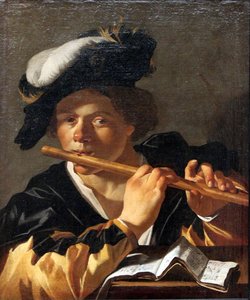
The Shadow and the Light: The Life of Dirck van Baburen
In the annals of the Dutch Golden Age, few names evoke the visceral drama of shadow and sudden illumination quite like Dirck van Baburen. Born around 1595 in Wijk bij Duurstede, his life was a brief but brilliant meteor strike across the canvas of art history. Though his years were tragically short, ending in 1624, he managed to ignite a stylistic revolution that would redefine the northern European aesthetic. As a central pillar of the Utrecht School of Caravaggisti, van Baburen did not merely paint scenes; he orchestrated moments of profound tension, using the stark language of tenebrism to pull viewers into the intimate, often gritty reality of his subjects.
The foundation of his mastery was laid in the studios of Utrecht, under the tutelage of the respected Paulus Moreelse. However, the true metamorphosis of his soul and brush occurred during his transformative pilgrimage to Rome between 1612 and 1615. It was in the sun-drenched yet shadow-strewn streets of the Eternal City that van Baburen encountered the revolutionary spirit of Caravaggio. Through his close association with Bartolomeo Manfredi, a devoted follower of Caravaggio’s methods, the young Dutchman absorbed the secrets of chiaroscuro—the art of using extreme contrasts between light and dark to create volume and psychological depth. This Roman immersion was not merely academic; it was a social and professional ascent, as he secured commissions from prestigious patrons such as Cardinal Scipione Borghese, placing him at the very heart of the Baroque movement.
The Genesis of the Utrecht Caravaggisti
Upon his return to the Netherlands, van Baburen did not arrive as a mere student, but as a vanguard. Alongside contemporaries like Hendrick ter Brugghen and Gerard van Honthorst, he spearheaded a movement that would forever alter the trajectory of Dutch painting. This collective, known as the Utrecht Caravaggisti, sought to transplant the dramatic intensity of Italian Baroque into the local vernacular. Their work was characterized by a departure from the polished, serene landscapes of their predecessors, favoring instead:
- Genre Scenes: Vivid, often boisterous depictions of everyday life, including musicians, drinkers, and peasants, rendered with a startling sense of presence.
- Tenebrism: The use of deep, impenetrable shadows that swallow the background, forcing the viewer’s eye to focus solely on the illuminated figures.
- Emotional Immediacy: A focus on the human condition, capturing fleeting expressions of joy, sorrow, or contemplative stillness.
His technical prowess allowed him to manipulate light as if it were a physical substance, carving figures out of the darkness with a precision that felt almost tactile. Whether depicting religious fervor or the humble activities of a tavern, his brushwork possessed an energy that bridged the gap between the monumental scale of Italian art and the intimate, domestic focus of the Dutch tradition.
Legacy and Historical Significance
The impact of Dirck van Baburen extends far beyond the borders of Utrecht. While his career was cut short in his early thirties, the ripples of his innovation traveled through the decades, influencing the development of the Dutch Baroque and even providing a stylistic precursor to the works of Rembrandt van Rijn. The way Rembrandt would later manipulate light to evoke profound psychological truths owes a significant debt to the groundwork laid by the Utrecht masters.
Today, van Baburen is remembered not just as a follower of an Italian master, but as an architect of a new visual language. He transformed the canvas into a stage where light and shadow perform a perpetual drama, ensuring that his name remains etched in the history of art as a master of the profound, the dramatic, and the deeply human. His ability to find the extraordinary within the ordinary continues to captivate scholars and art lovers alike, serving as a testament to the enduring power of the Caravaggesque spirit.