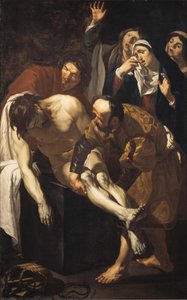
The Crowning with Thorns
Oil On Canvas
WallArt
Baroque
1621
106.0 x 136.0 cm
Alte Pinakothek
Hand Made Oil Reproduction
Hand-painted oil on canvas in your size and frame, made to order by our artists. ( Buy Print
Buy Image)
P118B $10
P118H $10
P118W $10
P438Z $10
P508JH $12
P508YH $12
P805H $10
P805Z $10
P919BZ $10
P919G $10
P919XJ $10
P959ZH $10
P968JZ $12
W106C $8
W218G $10
W218JH $8
W218Y $10
W307PJ $10
W316G $10
W316PJ $8
W316Y $10
W398PJ $8
W4111J $10
W500HY $15
W500JH $15
W692G $12
W849H $8
W940BG $15
W953PJ $8
Pick from our preset sizes that match the artwork's original proportions.
You may enter your own dimensions to fit a specific frame or space. If your selected size does not match the original image's proportions, we will either crop the artwork or extend the painting with additional hand-painted elements. A digital mockup will be sent for your approval before production begins.

Please note that the on-screen preview does not reflect the actual cropping or extension. Only the mockup will accurately show the final composition.
While custom sizes are available, we recommend selecting a dimension from the predefined list to preserve the original proportions.
After order, OriginalUniqueArt.com team will email client for instructions and provide a mockup preview
Worldwide Delivery () in 3/4 weeks instead of standard 5 weeks. (17 August). No compromise on quality.
Free Worldwide Express Shipping
High-Quality Linen Canvas
Full Shipping Insurance
Customs Tax Refund Guarantee
True Color Matching Guarantee
60-Day Return Policy (Defects Only)
100% Money-Back Guarantee
Bulk Discount Offer
The Crowning with Thorns
Reproduction Medium
Reproduction Size
-
Total Price
$ 300
Artwork Description
The Weight of Sacrifice: An Encounter with Dirck van Baburen's Devotion
To stand before a depiction such as The Crowning with Thorns is not merely to observe paint on canvas; it is to step into the crucible of profound human suffering and divine sacrifice. This masterful work, executed by Dirck van Baburen in 1621, captures one of the most emotionally charged moments in Christian iconography—the moment Christ is mocked and subjected to the agonizing indignity of the thorns.
Van Baburen, a key figure within the vibrant Utrecht School of Caravaggisti, channels the dramatic intensity that defined his era. His technique eschews mere narrative illustration for something far more visceral. The composition draws the viewer immediately into the harrowing tableau surrounding the central figure. Notice how the light does not illuminate evenly; rather, it seems to strike with a harsh, theatrical brilliance, carving out forms from deep shadow—a hallmark of Caravaggesque drama that lends an almost unbearable realism to the scene.
Mastery in Shadow and Light: Technical Brilliance
The technical prowess displayed here is breathtaking. Van Baburen utilizes tenebrism with remarkable skill, allowing the surrounding figures—the soldiers, the onlookers—to recede into palpable darkness. This dramatic contrast serves a dual purpose: it heightens the sense of isolation experienced by Christ, and simultaneously focuses all emotional energy onto his suffering form. The visible nails and outstretched arms are rendered with an almost painful clarity, forcing the viewer to confront the physical reality of the ordeal. It is this meticulous handling of texture—the rough wood of the cross, the yielding flesh, the sharp gleam of metal—that elevates the piece from devotional art to a profound study in human endurance.
Symbolism and Emotional Resonance
The symbolism woven throughout The Crowning with Thorns is rich and deeply resonant. The crown itself is not merely an object; it is a potent symbol of mockery, transforming royalty into suffering servitude. Yet, within that suffering lies the promise of salvation. The surrounding figures—some displaying detached curiosity, others perhaps exhibiting fear or pity—create a complex psychological landscape. They are witnesses, each representing a facet of humanity’s reaction to ultimate sacrifice: indifference, horror, and reluctant acknowledgment.
For the collector or decorator, this piece offers more than just religious grandeur; it provides an atmosphere of deep contemplation. It demands that one pause, reflect, and feel the weight of history and theology within a meticulously crafted visual narrative.
A Timeless Presence for Any Space
Reproducing such a powerful work allows us to bring this intense emotional gravity into modern living spaces. Whether placed in a formal study where deep thought is encouraged, or in a gallery setting meant to evoke contemplation, the drama inherent in Van Baburen’s brushwork will command attention. The somber palette and dramatic chiaroscuro ensure that it acts as an anchor of profound artistic weight, transforming any room into a space imbued with historical depth and enduring emotional resonance.
Artist Biography
The Shadow and the Light: The Life of Dirck van Baburen
In the annals of the Dutch Golden Age, few names evoke the visceral drama of shadow and sudden illumination quite like Dirck van Baburen. Born around 1595 in Wijk bij Duurstede, his life was a brief but brilliant meteor strike across the canvas of art history. Though his years were tragically short, ending in 1624, he managed to ignite a stylistic revolution that would redefine the northern European aesthetic. As a central pillar of the Utrecht School of Caravaggisti, van Baburen did not merely paint scenes; he orchestrated moments of profound tension, using the stark language of tenebrism to pull viewers into the intimate, often gritty reality of his subjects.
The foundation of his mastery was laid in the studios of Utrecht, under the tutelage of the respected Paulus Moreelse. However, the true metamorphosis of his soul and brush occurred during his transformative pilgrimage to Rome between 1612 and 1615. It was in the sun-drenched yet shadow-strewn streets of the Eternal City that van Baburen encountered the revolutionary spirit of Caravaggio. Through his close association with Bartolomeo Manfredi, a devoted follower of Caravaggio’s methods, the young Dutchman absorbed the secrets of chiaroscuro—the art of using extreme contrasts between light and dark to create volume and psychological depth. This Roman immersion was not merely academic; it was a social and professional ascent, as he secured commissions from prestigious patrons such as Cardinal Scipione Borghese, placing him at the very heart of the Baroque movement.
The Genesis of the Utrecht Caravaggisti
Upon his return to the Netherlands, van Baburen did not arrive as a mere student, but as a vanguard. Alongside contemporaries like Hendrick ter Brugghen and Gerard van Honthorst, he spearheaded a movement that would forever alter the trajectory of Dutch painting. This collective, known as the Utrecht Caravaggisti, sought to transplant the dramatic intensity of Italian Baroque into the local vernacular. Their work was characterized by a departure from the polished, serene landscapes of their predecessors, favoring instead:
- Genre Scenes: Vivid, often boisterous depictions of everyday life, including musicians, drinkers, and peasants, rendered with a startling sense of presence.
- Tenebrism: The use of deep, impenetrable shadows that swallow the background, forcing the viewer’s eye to focus solely on the illuminated figures.
- Emotional Immediacy: A focus on the human condition, capturing fleeting expressions of joy, sorrow, or contemplative stillness.
His technical prowess allowed him to manipulate light as if it were a physical substance, carving figures out of the darkness with a precision that felt almost tactile. Whether depicting religious fervor or the humble activities of a tavern, his brushwork possessed an energy that bridged the gap between the monumental scale of Italian art and the intimate, domestic focus of the Dutch tradition.
Legacy and Historical Significance
The impact of Dirck van Baburen extends far beyond the borders of Utrecht. While his career was cut short in his early thirties, the ripples of his innovation traveled through the decades, influencing the development of the Dutch Baroque and even providing a stylistic precursor to the works of Rembrandt van Rijn. The way Rembrandt would later manipulate light to evoke profound psychological truths owes a significant debt to the groundwork laid by the Utrecht masters.
Today, van Baburen is remembered not just as a follower of an Italian master, but as an architect of a new visual language. He transformed the canvas into a stage where light and shadow perform a perpetual drama, ensuring that his name remains etched in the history of art as a master of the profound, the dramatic, and the deeply human. His ability to find the extraordinary within the ordinary continues to captivate scholars and art lovers alike, serving as a testament to the enduring power of the Caravaggesque spirit.
Dirck van Baburen
1595 - 1624 , Netherlands
Quick Facts
- Artistic Movement Or Style: Caravaggisti; Utrecht School
- Artists Or Movements Influenced By This Artist: ['Rembrandt van Riijn']
- Artists Who Influenced This Artist:
- Paulus Moreelse
- Bartolomeo Manfredi
- Date Of Birth: Utrecht, Netherlands (1595)
- Date Of Death: 1624
- Full Name: Dirck Jaspersz. van Baburen
- Nationality: Dutch
- Notable Artworks:
- The Procuress
- A philosopher
- St. Francis in Meditation
- Place Of Birth: Wijk bij Duurstede

Glass option is only available in size under 110 CM