The Unique Context of Skagen: An Artistic Haven
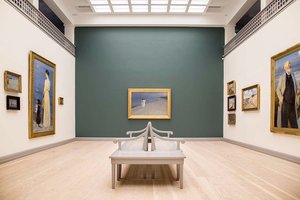 Skagens Museum
Explore Skagens Museum, Denmark – home to the world’s largest collection of masterpieces by the Skagen Painters! Immerse yourself in Impressionism & Naturalism amidst historic spaces and a vibrant artistic legacy.
The late 19th century witnessed a remarkable convergence of artistic talent in the small Danish fishing village of Skagen, nestled on the northernmost tip of Jutland. This wasn’t merely a picturesque locale; it was a crucible where established traditions fractured and new approaches to painting blossomed. Unlike the rigid academic standards prevalent elsewhere in Europe, Skagen offered a liberating environment – a place where artists could embrace plein air painting, capture the raw beauty of everyday life, and experiment with light and color. The village’s unique geography—where the North Sea and Kattegat collide—created dramatic skies and ever-changing atmospheric conditions that proved irresistible to a growing community of painters. Central to this artistic ferment was the Brøndums Hotel, owned by Erik Andersen Brøndum and his wife Ane Hedvig Møller, which became not just lodging but a vibrant hub for discussion, collaboration, and mutual inspiration. It was within this atmosphere that Anna Ancher’s artistic journey began, uniquely positioned as the only member of the Skagen Painters born and raised in this captivating setting.
Anna Ancher’s Early Life & Influences: A Foundation in Light
 Wikipedia: Anna Ancher
Anna Ancher (18 August 1859 – 15 April 1935) was a Danish artist associated with the Skagen Painters, an artist colony on the northern point of Jylland, Denmark. She is considered to be one of Denmark's greatest visual artists. == Background == An...
Born Anna Kirstine Brøndum in 1859, she was immersed in the artistic milieu from a young age. The constant presence of visiting painters at her parents' hotel sparked an early fascination with pictorial art. While societal expectations often limited opportunities for women artists, Anna’s talent was undeniable and nurtured by her family. She received formal training at the Vilhelm Kyhn College of Painting in Copenhagen, but it was during her studies and subsequent exposure to Parisian artistic circles—particularly through contact with Marie Triepcke Krøyer—that she began to forge her own distinctive style. A pivotal experience was her time at the atelier of Pierre Puvis de Chavannes in Paris, where she absorbed influences that would later inform her subtle use of color and composition. However, it wasn’t simply academic instruction; Anna Ancher's true education came from observing the interplay of light on the Skagen landscape and the lives of its inhabitants. She possessed an innate ability to perceive nuances of illumination—the way sunlight filtered through windows, reflected off water, or cast long shadows across a room—and translate these observations onto canvas with remarkable sensitivity.
Mastering the Interior: Themes of Domesticity and Everyday Life
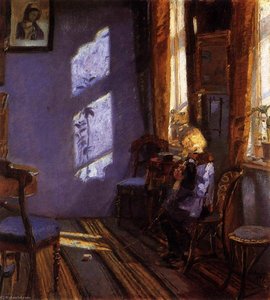 Sunlight in the Blue Room. Helga Ancher Knitting in her Grandmother's Room
Discover "Sunlight in the Blue Room" by Anna Ancher. A luminous Impressionist interior scene capturing Skagen's light & domestic life. Explore this Danish masterpiece!
Anna Ancher distinguished herself from many of her contemporaries by focusing on intimate scenes of domestic life. While others depicted grand historical narratives or sweeping landscapes, she turned her attention to the quiet moments unfolding within the homes of Skagen’s residents—fishermen, their wives, and children. This wasn't a rejection of ambition but rather a deliberate choice to find beauty and significance in the ordinary. Paintings like “The Girl in the Kitchen” (1883-1886) exemplify this approach, portraying a young girl absorbed in her tasks with a sense of dignity and grace. These weren’t idealized representations; Ancher captured the realities of daily life—the simple furnishings, the worn textures, the subtle expressions on faces—with an honesty that resonated deeply with viewers. Her subjects were often women engaged in traditionally feminine activities – knitting, sewing, caring for children – but she imbued them with a quiet strength and individuality.
Light as Subject & Medium: Ancher's Impressionistic Approach
Impressionism was a 19th-century art movement characterized by visible brush strokes, open composition, emphasis on accurate depiction of light in its changing qualities (often accentuating the effects of the passage of time), ordinary subject matter...
Central to Anna Ancher’s artistic vision was her masterful manipulation of light. It wasn’t merely an element *in* her paintings; it *was* the subject itself. Her works are characterized by a luminous quality, achieved through careful observation and a nuanced understanding of color theory. She employed broken brushstrokes—a hallmark of Impressionism—to capture the fleeting effects of sunlight as it shifted across surfaces. “Sunlight in the Blue Room. Helga Ancher Knitting in her Grandmother's Room” is a prime example, showcasing how light transforms an otherwise simple interior into a captivating study of atmosphere and mood. The painting isn’t about the room itself but rather the way light animates it, creating a sense of warmth, intimacy, and tranquility. This dedication to capturing ephemeral moments aligns her with the broader Impressionist movement, though she developed a uniquely Nordic sensibility—a restraint and subtlety that distinguishes her work from its French counterparts. Her painting “Communion in Skagens Church” demonstrates this skill as well, using dramatic lighting to convey a poignant scene of mourning.
Ancher’s Legacy & Place Within the Skagen Painters Colony
Anna Ancher was more than just a participant in the Skagen colony; she was its heart and soul. As the only artist born and raised in Skagen, she possessed an intimate understanding of the local culture and people that informed her work on a profound level. Her marriage to Michael Ancher further solidified her position within the group, creating a powerful artistic partnership. While often overshadowed by her husband’s more overtly dramatic compositions, Anna Ancher's contributions were increasingly recognized during her lifetime. She received accolades such as the Ingenio et Arti medal in 1913 and the Tagea Brandt Rejselegat in 1924, acknowledging her significant impact on Danish art. Today, she is celebrated as one of Denmark’s greatest visual artists—a pioneer who challenged conventional norms and captured the essence of a unique time and place.
Exploring Anchers Hus: Immersing Yourself in Her World
To truly appreciate Anna Ancher's artistry, a visit to Anchers Hus in Skagen is essential. This beautifully preserved home offers a rare glimpse into the lives of Anna and Michael Ancher, showcasing their art alongside the objects that inspired them. Walking through the rooms—the very spaces depicted in her paintings—provides a profound sense of connection to her creative process. The house itself is a testament to the artistic community of Skagen, filled with works by other members of the colony. The Skagens Museum, home to the world’s largest collection of Skagen Painters' masterpieces, further enriches this experience. Here, you can immerse yourself in the vibrant legacy of this remarkable group and gain a deeper understanding of Anna Ancher’s enduring contribution to Danish Impressionism. At OriginalUniqueArt.com, we are proud to offer high-quality reproductions of Anna Ancher's iconic works, allowing you to bring her captivating vision into your own home.