Contemporary Art · 1985
Mask (Yi Eungro, 1985)
Yi Eungro (1904–1989) made Mask. It dates from 1985. It belongs to the Contemporary Art movement. It is made in wood. It is kept at Lee Ungno Museum in Daegu, South Korea. It measures 30 × 4 cm (11.8 × 1.6 in).
- 1985
- Wood
- 30 × 4 cm (11.8 × 1.6 in)
- Lee Ungno Museum, Daegu

 Hand Made Oil Painting
 Send
 Share
 Fact sheet


 Download
 Similars
 Diaporama
 Q&A

 Stats
Mask, in brief
- Title
- Mask
- Artist
- Yi Eungro (1904–1989)
- Artist born in
- Seoul, South Korea
- Date
- 1985
- Medium
- Wood
- Dimensions
- 30 × 4 cm (11.8 × 1.6 in)
- Where to see it
- Lee Ungno Museum, Daegu, South Korea
- Movement
- Contemporary Art
- Period
- Modern
- Subject
- mask, sculpture, face, wood carving, portrait, distorted face
What does Mask depict?
The Soul Within the Wood: A Glimpse into Yi Eungro’s Mask
In the quiet intimacy of Mask, we encounter a profound dialogue between form and raw material. Created in 1985, this evocative sculpture serves as a hauntingly beautiful testament to the late-career explorations of the master Korean-French artist, Yi Eungro. While much of his legacy is anchored in the fluid grace of ink wash landscapes and the delicate precision of traditional Korean motifs, this piece reveals a more visceral, tactile dimension of his creative spirit. The work presents a face carved with an almost primal intensity, where the grain of the wood meets the deliberate, distorted contours of a human expression. It is a piece that does not merely sit in a space; it commands it, inviting the viewer to peer into the very essence of identity and the masks we wear in the theater of existence.
The technique employed here speaks to a mastery of texture and volume. The artist has manipulated the medium to create a striking interplay of light and shadow, particularly within the hollowed recesses of the eyes and the jagged, rhythmic placement of the teeth. There is a deliberate roughness to the surface that honors the organic nature of the wood, yet the anatomical distortions suggest a sophisticated understanding of movement and emotion. This sculptural approach allows the piece to transcend the two-dimensional plane, offering a physical presence that feels both ancient and strikingly modern. For the discerning collector or interior designer, such a work offers a centerpiece of immense character, providing a grounding, earthy element that pairs exquisitely with contemporary minimalist settings or more traditional, curated galleries.
Beyond its physical attributes, Mask carries a heavy symbolic weight. The concept of the mask is universal—a symbol of protection, deception, and the multifaceted nature of the human psyche. By rendering this face with such raw, unpolished features, Yi Eungro strips away the veneer of social artifice to reveal something more fundamental and perhaps more unsettling. The visible teeth and the asymmetrical gaze evoke a sense of primal vulnerability, reminding us of the wilder, untamed aspects of our shared humanity. It is an artwork that resonates on an emotional level, stirring feelings of curiosity, introspection, and even a touch of melancholy.
Integrating a high-quality reproduction of this masterpiece into a collection allows for the preservation of this profound emotional experience within a domestic or professional environment. Whether placed under soft gallery lighting to highlight its carved depths or positioned as a focal point in a study, Mask serves as a constant source of inspiration. It is more than a mere object; it is a window into the historical intersection of Korean tradition and French modernism, captured through the hands of an artist who spent his life bridging two worlds to find a singular, universal truth.
Which museum holds Mask?
Lee Ungno Museum
Daegu, South Korea
A Symphony of Ink and Modernity: The Legacy of Lee Ungno In the heart of Daejeon’s cultural landscape, the Lee Ungno Museum stands as a profound testament to the transformative power of artistic vision. This institution serves as a bridge between eras, offering a rare glimpse into the soul of a man who successfully synthesized the meditative weight of Eastern ink wash painting with the bold, experimental frontiers of Western modernism. To step into this museum is to enter a space where the ancient traditions of Korean calligraphy meet the electric energy of European abstract expressionism, creating a dialogue that resonates across generations.
High-resolution images of Mask

Protected by copyright: these files are for personal reference, not a licence to republish.
Yi Eungro, Mask (1985).
Yi Eungro (1904–1989), Mask, 1985, wood, Lee Ungno Museum, Daegu, South Korea. Image: OriginalUniqueArt.com.
Questions on Mask, answered
Where can I see the original "Mask" by Yi Eungro?
The original "Mask" by Yi Eungro is held at the Lee Ungno Museum, Daegu, South Korea. A reproduction allows the work to be displayed at home.
When was "Mask" made?
What medium is "Mask" by Yi Eungro executed in?
How big is the original "Mask"?
"Mask" measures 4 x 30 cm (1.6 × 11.8 in) in its original form. Original dimensions are a useful reference when choosing a reproduction size.
What does "Mask" by Yi Eungro depict?
Is "Mask" by Yi Eungro in the public domain?
Who created "Mask"?
What art movement does "Mask" by Yi Eungro belong to?
"Mask" is a work of Contemporary Art. The movement indicates the artistic tradition the work is part of.
About the artist, Yi Eungro

1904–1989, South Korea
Yi Eungro
**early life and training** lee ungno, also known as yi eungro, was a korean-born french painter and printmaker born in séoul, south korea in 1904. his early life was marked by a brief stint at the hongseong botong hakyo (홍성보통학교, 홍城초등학교, 洪城普通學校), after which he dedicated himself to studying painting under yeomjae song tae-hoe from 1920. **artistic career in korea and japan** lee ungno's artistic career began in earnest when he moved to seoul in 1922, becoming an apprentice to celebrated calligrapher-painter-photographer haegang kim gyu-jin. he primarily learned to paint the four gentlemen in the 'haegang style.' notably, his inkwash painting of a bamboo, mukjuk (묵죽, 墨竹, ink bamboo), won a prize in the 3rd annual joseon art exhibition.
Also by Yi Eungro
 Untitled1969
 Composition1970
 I Ching 64 Hexagrams Sequence(山風蠱)1974
 People1979
Essays around Mask
 Unveiling the Raw Emotion: The Top 25 Masterpieces by Francis BaconBorn in Dublin and shaped by post-war London, Bacon’s brushstrokes capture the weight of existence through the shadows of the human psyche.
 Unmasking the Grotesque: The Top 25 Masterpieces by James EnsorBorn in the coastal air of Ostend in 1860, Ensor used carnival masks and the grotesque to unmask the human condition through a fever dream …
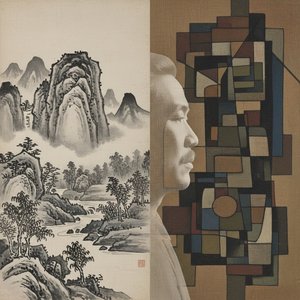 Yi Eungro: Bridging East & West in the Landscape of Korean ModernismExplore the captivating world of Yi Eungro (Lee Ungno), a pivotal figure in Korean modernism. Discover his unique fusion of Eastern and Wes…