Preview
 Send
Send Share
Share
 Details
 Guide
Guide

 Download
 Similars
 X-Ray
X-Ray Diaporama
 Q&A
Q&A Stats
StatsDivision -Unit


 Read More
Giclée / Art Print
Museum-quality giclée or canvas print with fast production and flexible finish options. ( Buy Hand Made Painting Switch to Digital Image)




P118B $10

P118H $10

P118W $10

P438Z $10

P508JH $12

P508YH $12

P805H $10

P805Z $10

P919BZ $10

P919G $10

P919XJ $10

P959ZH $10

P968JZ $12

W106C $8

W218G $10

W218JH $8

W218Y $10

W307PJ $10

W316G $10

W316PJ $8

W316Y $10

W398PJ $8

W4111J $10

W500HY $15

W500JH $15

W692G $12

W849H $8

W940BG $15

W953PJ $8




Pick from our preset sizes that match the artwork's original proportions.

Type the width and the height you need, to fit your frame or your wall. A print can only be cut, never made bigger than the picture, so a size with a different shape loses a part of the image. We send you a digital mockup to approve before we print anything. The picture shown on this page does not show the real cut — only the mockup does.
Worldwide Delivery () in 2 weeks instead of standard 4/5 weeks. (11 November)

Free Worldwide Express Shipping

High-Quality Linen Canvas

Full Shipping Insurance

Customs Tax Refund Guarantee

True Color Matching Guarantee

100-Day Return Policy (Defects Only)

100% Money-Back Guarantee

Bulk Discount Offer
 Glass option is only available in size under 110 CM

Division -Unit
Giclée / Art Print
Reproduction Size
-


Total Price
$ 81
Division -Unit: A Symphony of Color and Spirit
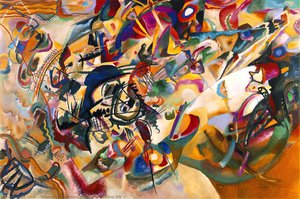
Wassily Kandinsky’s “Division - Unite,” created in 1934 during his formative Parisian period, stands as an emblem of abstract expressionism and a testament to the artist's relentless pursuit of spiritual resonance within visual art. Born in Moscow in 1866, Kandinsky embarked on a transformative artistic odyssey fueled by encounters with Impressionist painting—particularly Claude Monet’s “Haystacks”—and profoundly moved by Wagner’s opera "Lohengrin." These experiences instilled within him an unwavering conviction that art could transcend mere representation and communicate directly with the soul. This conviction would become the cornerstone of his groundbreaking approach to abstraction, forever altering the landscape of modern artistic endeavor. Early influences extended beyond purely visual stimuli; Kandinsky absorbed the vibrant hues and symbolic narratives of Russian folk art, gleaned from expeditions into the Vologda region. He meticulously documented these observations, recognizing their capacity to evoke emotional responses akin to musical harmonies—a concept he would champion throughout his career. This intellectual framework underpinned his artistic explorations, guiding him toward a deliberate rejection of conventional pictorial conventions in favor of forms that prioritized color and composition as primary expressive vehicles. The painting itself presents a striking visual experience: a square grid serves as the foundational structure for an astonishing array of organic shapes—circles, squares, triangles—interwoven with scattered letters. These elements are not uniformly distributed; rather, they cluster and overlap, generating a palpable sense of controlled chaos that belies Kandinsky’s meticulous planning. Diagonal lines intersect the grid, injecting dynamism into the composition and reinforcing the feeling of movement. The color palette is extraordinarily rich and diverse, encompassing reds, greens, blues, yellows, oranges, and purples—applied in both solid blocks and blended areas to create subtle gradations that heighten visual interest. Dominating the background is a pale grey or off-white hue, allowing the vibrant colors of the shapes to command attention and radiate luminosity. Kandinsky’s technique reflects his unwavering commitment to capturing inner experience. Executed primarily with oil paints on canvas—likely stretched taut—the application appears remarkably smooth, minimizing visible brushstrokes and prioritizing tonal harmony. This deliberate restraint underscores Kandinsky's belief that color alone could convey profound emotional significance. The resulting surface possesses a subtle textural quality, suggestive of the paper-like texture of his preparatory sketches, hinting at the artist’s ongoing engagement with traditional drawing methods alongside his pioneering explorations of abstraction. “Division - Unite” embodies Kandinsky’s mature abstract style—characterized by its rejection of representational imagery and its masterful manipulation of color relationships to evoke spiritual contemplation. It aligns seamlessly with the tenets of Abstract Expressionism, a movement that championed spontaneous gesture and emotional intensity as paramount considerations in artistic creation. More than just a visual spectacle, this artwork invites viewers into a realm where form and color coalesce to communicate unspoken truths—a legacy that continues to inspire artists and collectors alike.Composition & Structure
The square grid serves as the central organizing principle of “Division - Unite,” providing a framework for the arrangement of disparate elements while simultaneously fostering a sense of controlled dynamism. Unlike traditional perspectival representations, Kandinsky eschews depth illusion, opting instead for a flattened surface that emphasizes color and form as independent expressive forces. Diagonal lines intersect the grid, injecting movement into the composition and disrupting any potential static equilibrium. This deliberate disruption mirrors Kandinsky’s philosophical conviction that art should transcend rational thought and tap into primal instincts—a core tenet of his spiritual worldview.Color Palette & Harmony
Kandinsky's masterful use of color is arguably the painting's most striking feature. The palette encompasses a spectrum of hues—reds, greens, blues, yellows, oranges, and purples—each carefully positioned to create visual harmony and convey specific emotional resonances. Solid blocks of color coexist with blended areas, generating subtle gradations that enrich the overall tonal range. The dominant off-white background serves as a counterpoint to the vibrant shapes, maximizing their luminosity and enhancing their impact on the viewer’s eye. Kandinsky's meticulous attention to color theory—informed by Goethean aesthetics—demonstrates his profound understanding of how color can stimulate sensory perception and evoke psychological responses.Technique & Materials
The painting was crafted using oil paints on canvas, a medium favored by Kandinsky for its ability to achieve exceptional tonal fidelity and textural nuance. The application technique prioritizes smoothness and tonal consistency, minimizing visible brushstrokes and emphasizing the artist’s commitment to capturing inner experience through visual form. This deliberate restraint underscores Kandinsky's belief that color alone could convey profound emotional significance—a conviction that underpinned his entire artistic practice.Symbolic Significance & Emotional Impact
“Division - Unite” transcends mere aesthetic beauty; it embodies Kandinsky’s aspiration to communicate spiritual truths through abstraction. The scattered letters within the composition serve as visual anchors, grounding the organic shapes in a realm of intellectual contemplation—a reflection of Kandinsky's engagement with philosophical ideas and his belief that art could illuminate hidden dimensions of human consciousness. Ultimately, this painting invites viewers into a meditative state—a testament to Kandinsky’s enduring legacy as one of the foremost pioneers of abstract expressionism and a visionary artist who dared to explore the uncharted territories of visual perception.Historical Context
Created in 1934, “Division - Unite” emerged during Kandinsky's Parisian period—a time marked by profound intellectual ferment and artistic experimentation. The painting reflects the influence of Bauhaus, where Kandinsky taught from 1922 to 1933, and embodies the broader ethos of Abstract Expressionism—a movement that championed spontaneity and emotional intensity as paramount considerations in artistic creation. It stands as a pivotal work within Kandinsky’s oeuvre, solidifying his reputation as one of the most innovative and influential artists of the 20th century.Size & Dimensions
Unknown Date: 1934Questions & Answers
How light is "Division -Unit" overall?
The perceived brightness of "Division -Unit" by Wassily Kandinsky is bright. It can be matched to the light of the intended space.
What mood and emotion does "Division -Unit" by Wassily Kandinsky express?
In "Division -Unit", a serene mood accompanies a spiritual emotion.
How strong are the colors of "Division -Unit"?
The color of "Division -Unit" is muted in saturation and monochromatic in intensity.
Artist Biography
Early Life and Academic Training
Wassily Wassilyevich Kandinsky was born in Moscow to Lidia Ticheeva and Vassily Silvestrovich Kandinsky. His early years were shaped by the sounds of music, as he spent time studying the piano and the cello. These early lessons in rhythm and sound would stay with him long after he left his childhood home.
His path did not lead immediately to a canvas. Instead, he pursued a formal education at the University of Moscow, where he focused on law, economics, and ethnography. He eventually took a position as a lecturer after graduating. It was not until he reached the age of 30 that he began his formal painting studies, shifting his focus from the study of social and legal structures to the physical act of drawing and sketching.
This shift brought him to Munich. There, he sought out more rigorous training at the Anton Ažbe School and the Academy of Fine Arts. He spent his time there learning the mechanics of form and the way light interacts with objects, moving away from his previous academic life to settle into the life of a student of art.
The Transition to Artistic Life
The shift began in 1896 during an exhibition in Moscow. Seeing Claude Monet’s “Haystacks” changed the way he perceived light and color. This encounter with Impressionism sparked a deep, persistent pull toward painting. It was a quiet redirection of a life once focused on the structured world of law and economics. The pull of the canvas proved stronger than the stability of his academic path.
He eventually left his position as a professor of law at Dorpat University to follow this new impulse. By about 1896, he had moved to Munich to begin formal studies in art. He sought out the Anton Ažbe School and the Academy of Fine Arts to learn the mechanics of his chosen craft. The transition was a move from the lecture hall to the studio, trading legal theory for the study of form and pigment.
- The Blue Rider (1903)
The Murnau Period and Expressionism
In 1901, Kandinsky met the artist Gabriele Münter. Their connection grew as they shared a focus on the expressive power of color. By 1909, they had bought a house in Murnau. This setting provided the backdrop for a landscape series, where the shapes of the natural world began to shift. The works from this time carry the weight of his earlier studies, particularly the influence of Russian folk art. He used bright colors against dark backgrounds, a habit that spoke of his roots in the traditions of his youth.
The landscapes of Murnau were not mere copies of the scenery. He looked at the hills and the houses through a lens that favored emotional intensity over literal accuracy. The colors became more assertive, moving away from the quietude of traditional representation. He sought a way to make the canvas pulse with a sense of life, using the landscape as a starting point for something more internal. The brushstrokes grew broader, and the boundaries between objects began to soften.
- Murnau. Landscape with Green House (1909)
The Blue Rider and Abstraction
In Munich, the focus shifted toward a new way of seeing. Kandinsky co-founded the Der Blaue Reiter (The Blue Rider) group, a circle that sought to move beyond the surface of things. This period saw him closely linked with the Expressionism movement, where the goal was to find a visual language for the internal spirit. He began to move away from the recognizable shapes of the landscape, favoring a style that prioritized the emotional weight of color and form. This was a departure from the literal world, leaning instead into the non-objective.
His work became a study in how a line or a hue could act like a musical note. He was a pioneer of the abstract art movement, stripping away the need for a subject to be a recognizable object. Instead, he focused on the interplay of shapes and the way they could communicate without a direct reference to nature. This development of non-representational painting was not a sudden break but a steady movement toward the essence of feeling. The canvas became a space for pure composition, where the arrangement of elements spoke directly to the viewer's intuition.
- 1913: Color Study of Squares and Circles
- 1914: Im Kreis (In the Circle)
- 1923: Composition VIII
- 1926: Several Circles
Teaching and the Bauhaus Years
After his time in Russia, where he served as the first director of the Institute of Artistic Culture in Moscow, Kandinsky moved toward the academic circles of Germany. In 1921, he was invited to attend the Bauhaus in Weimar. This period marked a shift toward a more structured exploration of how color and form interact on the canvas. He spent much of his time there, teaching at the Bauhaus school of art and architecture from 1922 until 1933.
His presence in the classroom was defined by a focus on the mechanics of visual language. He looked at the way a circle or a line could carry weight and meaning without needing to resemble a physical object. This was a time of experimentation with geometry and the psychological impact of specific hues. The work from these years often carries a sense of precision, moving away from the fluid, organic shapes of his earlier years toward a more calculated arrangement of elements.
The era of his teaching came to an abrupt end when the Nazi regime closed the Bauhaus in 1933. This forced a departure from the structured environment of the school and led him toward a new chapter in France. His time in Germany had been a period of deep theoretical development, where the abstract became a way to map the internal landscape of the mind.
Later Years and Final Residence
The closure of the Bauhaus in 1933 prompted a move toward France. He settled there and remained in the country from 1933/1934 until his death. During this time, his connection to his adopted home deepened, and he became a French citizen in 1939.
His final years were spent in this French landscape, continuing to work with the layered impasto techniques that gave his canvases a physical, textured presence. One such piece from this period is An Intimate Party (1942). He passed away on 13 December 1944.
Key Works and Artistic Milestones
Looking closely at his early output, one finds the roots of his shift toward abstraction. In 1903, he painted The Blue Rider, a work where a dark-blue cloaked figure rides a horse through a sparse, verdant landscape. This piece captures a moment of transition, where the recognizable forms of the world begin to lose their grip to the pull of color. His brushwork during this time often used broad strokes, hinting at the non-objective directions his work would eventually take.
As his focus moved toward geometric precision and the interplay of form, his compositions became more structured. In 1923, he produced Composition VIII, a work defined by the interaction of circles and lines. By 1925, his palette had shifted again in Yellow, Red, Blue, where the colors themselves became the primary subject. These years show a steady movement away from the landscapes of his youth toward a language of pure shape and hue. Even in his later years, the experimentation continued; Composition X was created about 1939, showing the continued evolution of his visual vocabulary.
- Abschied (small version) (1903)
- Improvisation. Gorge (1914)
- Im in the Circle (1914)
- Several Circles (1926)
Where to See His Works Today
His canvases are scattered across several major institutions, inviting a close look at how his use of color and form evolved. In Paris, the Centre Pompidou holds many of his paintings, offering a chance to see his shift toward non-objective compositions. The Solomon R. Guggenheim Museum in New York City also maintains a collection of his works, including pieces from his more geometric phases.
In Munich, the Lenbachhaus contains a significant selection of his paintings, reflecting his time with the Blue Rider group. For those looking to see his large-scale, complex arrangements, the Tretyakov Gallery in Moscow houses his monumental "Composition VII." These locations provide different perspectives on his development, from his early expressive landscapes to his later, more structured abstractions.
- Composition VII
- Several Circles
- Yellow, Red, Blue
- An Intimate Party

Wassily Kandinsky
1866 - 1944 , Russian Empire
Quick Facts
- Artistic Movement Or Style:
- Expressionism
- Abstract painting
- Der Blaue Reiter
- Artists Or Movements Influenced By This Artist: ['Abstract expressionism']
- Artists Who Influenced This Artist: ['Claude Monet']
- Full Name: Wassily Wassilyevich Kandinsky
- Nationality: Russian
- Notable Artworks:
- Papeln (Poplars)
- Several Circles
- Composition VIII
- Composition VII
- An Intimate Party
- Place Of Birth: Moscow, Russia
- Date Of Birth: 1866
- Date Of Death: 1944
Related Articles

Mastering Abstraction: The Top 25 Essential Artworks by Wassily Kandinsky
Explore 25 iconic Wassily Kandinsky masterpieces. From Blue Rider to pure abstraction, discover the full collection on OriginalUniqueArt.com.

Mastering Abstraction: The Top 25 Essential Works by Wassily Kandinsky
Explore 25 iconic Kandinsky masterpieces and the birth of abstraction. Discover the full collection online at OriginalUniqueArt.com.

Mastering Abstraction: The Top 25 Essential Works by Wassily Kandinsky
Embark on a journey through the soul of abstraction with our curated guide to Wassily Kandinsky's top 25 masterpieces. Explore the vibrant colors and spiritual forms that defined modern art. Find museum-quality reproductions for your decor. Discover all masterpieces on OriginalUniqueArt.com.

Mastering Abstraction: The Top 25 Essential Artworks by Wassily Kandinsky
Journey through the vibrant soul of abstraction with our curated guide to the top 25 Wassily Kandinsky masterpieces. Explore the stories behind his iconic colors and shapes. Find museum-quality reproductions and decor inspiration. Discover all masterpieces on OriginalUniqueArt.com.

Mastering Abstraction: The Top 25 Essential Works by Wassily Kandinsky
Journey through the soul of abstraction with our curated guide to the top 25 Wassily Kandinsky masterpieces. Explore the vibrant colors and spiritual forms that defined modern art. Find museum-quality reproductions and decor inspiration. Discover all masterpieces on OriginalUniqueArt.com.