Preview
 Send
Send Share
Share
 Details
 Guide
Guide

 Download
 Similars
 X-Ray
X-Ray Diaporama
 Q&A
Q&A Stats
StatsSelf-Educating Caretaker

- 30.0 x 25.0 cm


 Read More
Giclée / Art Print
Museum-quality giclée or canvas print with fast production and flexible finish options. ( Buy Hand Made Painting Switch to Digital Image)




P118B $10

P118H $10

P118W $10

P438Z $10

P508JH $12

P508YH $12

P805H $10

P805Z $10

P919BZ $10

P919G $10

P919XJ $10

P959ZH $10

P968JZ $12

W106C $8

W218G $10

W218JH $8

W218Y $10

W307PJ $10

W316G $10

W316PJ $8

W316Y $10

W398PJ $8

W4111J $10

W500HY $15

W500JH $15

W692G $12

W849H $8

W940BG $15

W953PJ $8




Pick from our preset sizes that match the artwork's original proportions.

Type the width and the height you need, to fit your frame or your wall. A print can only be cut, never made bigger than the picture, so a size with a different shape loses a part of the image. We send you a digital mockup to approve before we print anything. The picture shown on this page does not show the real cut — only the mockup does.
Worldwide Delivery () in 2 weeks instead of standard 4/5 weeks. (7 November)

Free Worldwide Express Shipping

High-Quality Linen Canvas

Full Shipping Insurance

Customs Tax Refund Guarantee

True Color Matching Guarantee

100-Day Return Policy (Defects Only)

100% Money-Back Guarantee

Bulk Discount Offer
 Glass option is only available in size under 110 CM

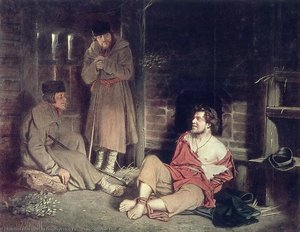
Self-Educating Caretaker
Giclée / Art Print
Reproduction Size
-


Total Price
$ 81
A Quiet Revolution in Realism
In the intimate landscape of nineteenth-century Russian art, few works capture the profound dignity of the human spirit quite like Vasily Grigoryevich Perov’s Self-Educating Caretaker. Painted in 1868, this evocative masterpiece serves as a window into a world where education and enlightenment were not merely academic pursuits, but acts of quiet rebellion against social stagnation. The scene unfolds with a tender, grounded realism, presenting a woman seated upon the earth alongside a young girl. As they sit together, the woman is deeply immersed in a book held within her lap, her focus suggesting a shared journey of discovery. This is not a grand historical tableau, but a deeply personal moment of intellectual nourishment that transcends the humble setting.
Perov, a founding member of the influential Peredvizhniki (The Wanderers) movement, was a master at finding the extraordinary within the ordinary. Through his meticulous technique, he breathes life into the textures of cloth, the soft light of the afternoon, and the subtle expressions of his subjects. The composition is layered with a sense of community; while the central figures anchor our emotional attention, the presence of other figures in the periphery—a person standing near the edge and another glimpsed to the right—creates a lived-in, breathing environment. This spatial depth invites the viewer to step into the scene, making the painting feel less like a static image and more like a captured fragment of a continuous, unfolding life.
Symbolism and the Soul of the Canvas
Beyond its surface beauty, Self-Educating Caretaker is rich with the social commentary that defined Perov’s career. The act of reading in such a setting symbolizes the flickering flame of literacy and self-improvement amidst the hardships of peasant life. There is a profound symbolism in the physical closeness of the woman and the child; it represents the intergenerational transmission of knowledge and the hope for a future unburdened by ignorance. The book itself acts as a talisman of progress, a bridge between the rugged reality of their surroundings and the vast worlds contained within printed pages.
For the discerning collector or interior designer, this piece offers more than just aesthetic value; it provides an emotional anchor for a room. The muted, earthy palette and the soft, naturalistic lighting create a sense of tranquility and timelessness. Whether placed in a study, a library, or a sophisticated living space, the painting radiates a contemplative warmth. It is a work that rewards repeated viewing, offering new layers of psychological depth with every glance. Owning a high-quality reproduction of this work means bringing into one's home a piece of history that celebrates resilience, the pursuit of truth, and the enduring beauty of the human connection.
Questions & Answers
What shape and dimensions is "Self-Educating Caretaker" by Vasily Grigoryevich Perov?
"Self-Educating Caretaker" by Vasily Grigoryevich Perov is a portrait composition measuring 30 x 25 cm in the original.
What feeling does "Self-Educating Caretaker" by Vasily Grigoryevich Perov convey?
The recorded mood of "Self-Educating Caretaker" by Vasily Grigoryevich Perov is nostalgic, and its emotional tone is reflective.
Which artist is "Self-Educating Caretaker" attributed to?
"Self-Educating Caretaker" is attributed to Vasily Grigoryevich Perov.
Artist Biography
A Life Etched in Realism: Vasily Perov and the Soul of Russia
Vasily Grigoryevich Perov, born Vasily Vasiliev in 1834 in the remote Siberian town of Tobolsk, emerged as a pivotal figure in Russian art, a painter whose work became synonymous with critical realism. His life story is itself imbued with the social complexities he would later portray on canvas. Born out of wedlock to Baron Grigory Kridener and Akulina Ivanova, Perov’s early years were marked by an unconventional upbringing that instilled within him a keen sensitivity to societal inequalities. The adoption of the surname “Perov,” derived from the Russian word for ‘feather,’ a nod to his early skill in calligraphy, foreshadowed his dedication to meticulously detailing the world around him—a world often overlooked or deliberately obscured. His formal artistic journey began at the Alexander Stupin Art School in Arzamas, where he honed fundamental skills before progressing to the Moscow School of Painting, Sculpture and Architecture in 1853. This period was crucial in shaping his technical abilities and exposing him to a broader range of artistic influences. Early recognition came with silver and gold medals awarded by the Imperial Academy of Arts for works like “Commissary of Rural Police Investigating” and, most notably, "Sermon in a Village" in 1861—a painting that would propel him into the national spotlight and earn him the opportunity to study abroad.The Voice of the Voiceless: Themes and Techniques
Perov’s artistic vision was deeply rooted in a commitment to portraying Russian society with unflinching honesty. He rejected the idealized depictions favored by many of his contemporaries, instead choosing to focus on the lives of ordinary people—peasants, laborers, the marginalized, and the forgotten. His paintings are not merely representations of reality; they are powerful social commentaries that expose the hardships, injustices, and spiritual emptiness prevalent in 19th-century Russia. “Sermon in a Village,” for example, subtly critiques religious hypocrisy by depicting a disengaged congregation during a church service, while "The Queue at the Fountain" starkly illustrates the daily struggles of rural life. His technique was characterized by meticulous detail, somber color palettes, and a masterful use of light and shadow to create dramatic effect. He wasn’t interested in romanticizing poverty or suffering; rather, he sought to present it with dignity and empathy, forcing viewers to confront uncomfortable truths about their own society. Works like “The Last Journey,” depicting a peasant funeral procession, and "Troika: Apprentice Workmen Carrying Water" are poignant examples of his ability to evoke profound emotional responses through realistic portrayals of everyday life. Perov’s skill extended beyond oil painting; he also excelled in etching, as demonstrated by the powerful monochromatic work “Naushnitsa. Before the storm,” which showcases his mastery of chiaroscuro and intricate detail.Founding a Movement: The Peredvizhniki
Perov’s dedication to realism aligned perfectly with the burgeoning spirit of artistic rebellion that led to the formation of the Peredvizhniki (Wanderers) in 1870. This collective of Russian realist painters broke away from the constraints of the Academy, establishing an independent society dedicated to exhibiting art throughout Russia—reaching audiences beyond the confines of St. Petersburg and Moscow.- The Peredvizhniki aimed to bring art directly to the people,
- to address social issues through their work,
- and to promote a uniquely Russian artistic identity.
Legacy and Enduring Influence
Vasily Perov’s untimely death from tuberculosis in 1882 at the age of 48 marked a significant loss for Russian art. However, his legacy continued to inspire generations of artists who followed in his footsteps. His influence can be seen in the works of Ilya Repin and Vasily Surikov, both masters of realist painting who further developed the tradition he helped establish. Perov’s paintings remain relevant today not only for their artistic merit but also for their enduring social commentary. They serve as a powerful reminder of the hardships faced by ordinary people throughout history and continue to provoke empathy and understanding. His works are now housed in prominent collections, including the Tropinin and Contemporary Moscow Artists Museum, ensuring that his vision continues to resonate with audiences worldwide. Perov’s contribution extends beyond mere artistic skill; he was a social conscience etched onto canvas, a voice for the voiceless, and a pioneer of Russian realism. He left behind a body of work that not only documented his time but also challenged it, forever changing the landscape of Russian art.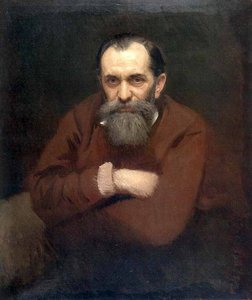
Vasily Grigoryevich Perov
1833 - 1882 , Russia
Quick Facts
- Full Name: Vasily Grigoryevich Perov
- Nationality: Russian
- Date Of Birth: 1833
- Date Of Death: 1882
- Place Of Birth: Tyumen, Russia
- Notable Artworks:
- Sermon in a Village
- The Queue at the Fountain
- Last Journey
- Troika
- Drowned Girl
- Artistic Movement Or Style: Critical Realism
- Artists Or Movements Influenced By This Artist:
- Ilya Repin
- Vasily Surikov
Related Articles

Romantic Realism's Finest: 10 Masterpieces for Your Home | OriginalUniqueArt
Explore 10 defining masterpieces of Romantic Realism! Discover Courbet, Millet & Daumier's powerful paintings—capturing emotion and social realities. Find museum-quality reproductions for your home at OriginalUniqueArt.com.

The Evocative Embrace of Reality: Exploring Romantic Realism in 19th-Century Painting
Explore the captivating world of Romantic Realism! Discover key artists like Courbet & Millet, masterpieces, and the social context behind this influential art movement. Expert insights for collectors at OriginalUniqueArt.
The Poetic Truth of Observation: Exploring 19th-Century Realism in Painting
Explore the captivating world of 19th-century Realism! Discover key artists like Courbet & Millet, masterpieces, and the powerful social commentary behind this influential art movement. Expert insights at OriginalUniqueArt.

Vladimir Makovsky: Realism, Social Commentary & Russian Life in Late 19th-Century Painting
Explore the captivating world of Vladimir Makovsky, a leading Russian realist painter. Discover his insightful depictions of 19th-century life, social commentary & legacy with OriginalUniqueArt.

Vasily Surikov: Historical Epic & Psychological Realism in 19th-Century Russian Painting
Explore the powerful historical paintings of Vasily Surikov, a leading figure of Russian Realism. Discover his dramatic compositions, psychological depth & lasting influence on 19th-century art. Learn about collecting Surikov's masterpieces.