Romanticism
Study, a man's face (Thomas Cole)
Thomas Cole (1801–1848) made Study, a man's face. It belongs to the Romanticism movement.

 Preview

 Hand Made Oil Painting
 Send
 Share
 Fact sheet


 Download
 Similars
 X-Ray
 Diaporama
 Q&A

 Stats
Study, a man's face, in brief
- Title
- Study, a man's face
- Artist
- Thomas Cole (1801–1848)
- Artist born in
- Bolton, United Kingdom
- Movement
- Romanticism
- Subject
- portrait, study, sketch, male face, pencil drawing, monochromatic
What does Study, a man's face depict?
A Glimpse into Character: Thomas Cole's "Study, a Man's Face"
This evocative pencil sketch by Thomas Cole offers an intimate study of an older gentleman, capturing a moment of quiet contemplation. More than just a portrait, it’s a window into the artist’s process and a testament to his keen observational skills. Executed with remarkable economy of line, this work provides a fascinating insight into the mind of one of America's most important landscape painters, revealing a sensitivity that extended beyond grand vistas to the subtle nuances of human expression. The subject, rendered in shades of gray and white against a cream-colored background, exudes an air of wisdom and experience, inviting viewers to ponder his life story.Style & Technique: A Preparatory Sketch
Cole’s “Study, a Man's Face” exemplifies the style of a preparatory sketch or study. It isn't intended as a finished artwork in itself but rather as an exploration of form and likeness before embarking on a larger composition. The technique is characterized by quick, gestural pencil strokes – hatching and cross-hatching are skillfully employed to create shading and suggest volume without resorting to elaborate blending. This direct approach lends the piece a sense of immediacy and authenticity; it feels like a captured moment, a fleeting observation brought to life with remarkable efficiency. The artist’s mastery lies in his ability to convey depth and character using only lines and subtle tonal variations. The materials used – simple pencil on paper – further emphasize the work's raw and unadorned nature.Historical Context & Cole's Artistic Journey
Created during a period of burgeoning American artistic identity, this study reflects Thomas Cole’s broader engagement with portraiture alongside his celebrated landscape paintings. Born in England and later immigrating to the United States, Cole became a pivotal figure in the Hudson River School movement, known for its romantic depictions of the American wilderness. While renowned for his grand allegorical landscapes like "The Course of Empire," this sketch reveals another facet of his artistic practice – a dedication to capturing individual character with precision and sensitivity. It provides valuable insight into how Cole approached portraiture, likely informing his larger works by establishing a foundation of detailed observation.Symbolism & Emotional Resonance
The aged appearance of the subject immediately suggests wisdom, experience, and perhaps even a touch of melancholy. The sketch-like style itself contributes to an emotional impact; it conveys a sense of immediacy and intimacy, as if we are privy to a private moment. The limited color palette reinforces this feeling of quiet contemplation, drawing attention to the interplay of light and shadow across the man’s face. While seemingly simple, the work evokes a profound sense of human dignity and invites viewers to connect with the subject on an emotional level, prompting reflection on the passage of time and the richness of lived experience.High-resolution images of Study, a man's face
Thomas Cole, Study, a man's face. Public domain.
Questions on Study, a man's face, answered
What is "Study, a man's face" about?
"Study, a man's face" by Thomas Cole depicts: portrait, study, sketch, male face, pencil drawing, monochromatic, head, older man.
Is "Study, a man's face" free of copyright?
Regarding copyright, "Study, a man's face" is in the public domain - its copyright has expired.
Who created "Study, a man's face"?
"Study, a man's face" is attributed to Thomas Cole.
What art movement does "Study, a man's face" by Thomas Cole belong to?
"Study, a man's face" by Thomas Cole belongs to the Romanticism movement. This movement provides the stylistic context of the work.
What stage of Thomas Cole's development does "Study, a man's face" represent?
"Study, a man's face" belongs to the Early Period of Thomas Cole's career. This classification relates the work to the artist's development.
Why is the copyright status of "Study, a man's face" what it is?
"Study, a man's face" by Thomas Cole is in the public domain - its copyright has expired. Copyright terms are measured from the artist's death, and Thomas Cole died in 1848.
Where does "Study, a man's face" sit within Thomas Cole's body of work?
"Study, a man's face" shares with Thomas Cole's other works its Romanticism style and the recorded themes: emphasis on observation & detail., likely influenced by academic drawing., preparatory study for larger works., demonstrates cole's drawing skills., illustrates his focus on realism., exploration of individual character., reflects early 19th-century portraiture..
Is "Study, a man's face" typical of what Thomas Cole usually created?
Among Thomas Cole's recorded themes - emphasis on observation & detail., likely influenced by academic drawing., preparatory study for larger works., demonstrates cole's drawing skills., illustrates his focus on realism., exploration of individual character., reflects early 19th-century portraiture. - "Study, a man's face" brings its own focus on portrait, study, sketch, male face, pencil drawing, monochromatic, head, older man.
About the artist, Thomas Cole

1801–1848, United Kingdom
Thomas Cole
The Life and Art of Thomas Cole Born on February 1, 1801, in Bolton le Moors, Lancashire, England, Thomas Cole began his life far from the landscapes that would eventually define his name. His family emigrated to the United States in 1818, seeking a new beginning in a land of vast, unmapped territories. In those early years, he was a man of many trades, working as an engraver and later finding steady work as a portrait painter starting in 1822. He was largely self-taught, developing his eye through observation and the study of books rather than formal academic training.
Also by Thomas Cole
 The Oxbow
 The dream of the architect1840
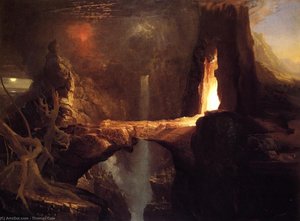 Expulsion. Moon and Firelight1828
 View of Florence from San Miniato1837
Essays around Study, a man's face
 The Soul of the Sketch: Unveiling the Raw Beauty and Creative Intimacy of Artist StudiesDiscover the profound intimacy of artist studies. Explore how raw sketches and preparatory works capture the true soul of Impressionism, fr…
 Defining the American Sublime: The History and Legacy of the Hudson River SchoolMaster the history of the American Sublime and the Hudson River School. Explore the legacy of Cole and Church now.
 Masterpieces of Chaos: The Top 25 Francis Bacon ArtworksExplore the raw power of Francis Bacon's top 25 masterpieces. Discover his iconic works and curated art on OriginalUniqueArt.com.