Introduction
To encounter the work of Francis Bacon is to confront the very limits of human experience. This collection—a curated selection of his twenty-five most compelling paintings—offers a journey into a world where flesh is vulnerable, isolation is profound, and the scream is often just beneath the surface. These are not easy images; they demand attention, provoke discomfort, and linger long after you’ve turned away.
Born in Ireland at the dawn of the 20th century, Bacon's artistic vision matured amidst the wreckage of two World Wars and the burgeoning anxieties of the Cold War. The post-war era was a time of existential questioning, a period where traditional certainties crumbled and artists sought new ways to express the fractured psyche of modernity. Bacon’s paintings became a visual embodiment of this unease—a raw, unflinching exploration of the human condition stripped bare.
He wasn't interested in beauty or idealism; instead, he delved into the darker recesses of the soul, portraying figures contorted by pain, trapped within claustrophobic spaces, and haunted by an unspoken terror. His unique style—a potent blend of distortion, abstraction, and visceral realism—challenged conventional notions of representation and established him as one of the most important artists of the 20th century.
But why do these paintings continue to resonate so powerfully today? In a world still grappling with violence, alienation, and the search for meaning, Bacon’s work feels startlingly relevant. He reminds us of our own fragility, our capacity for both cruelty and compassion, and the inescapable solitude that underlies all human existence. These are images that speak to something fundamental within us—a primal awareness of mortality, vulnerability, and the enduring mystery of being.
Over the following pages, we will explore these twenty-five masterpieces in greater detail, tracing the evolution of Bacon’s style and uncovering the complex emotional landscape that defines his oeuvre. Prepare to be challenged, moved, and perhaps even disturbed—for within these canvases lies a profound reflection of ourselves.
Three Studies for Figures at the Base of a Crucifixion - Francis Bacon
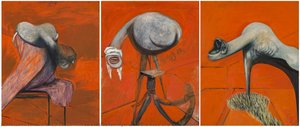 Three Studies for Figures at the Base of a Crucifixion - Francis Bacon
Three Studies for Figures at the Base of a Crucifixion (1944) stands as Francis Bacon’s explosive arrival onto the art world stage, and rightfully claims its place among his most significant achievements. Painted in the immediate aftermath of World War II, this triptych isn't a depiction of war, but rather an embodiment of its lingering psychological trauma – a raw, visceral scream rendered in oil paint.
The distorted figures, set against a searing orange field, are less anatomical studies than archetypes of anguish. Bacon deliberately eschews traditional representation, opting instead for abstracted forms that writhe and contort with silent torment. The influence of Picasso’s early Cubism is present, but filtered through the lens of Bacon's own uniquely unsettling sensibility.
What elevates this work beyond mere Expressionist fervor is its subversion of religious iconography. By employing the triptych format – historically reserved for altarpieces celebrating divine narratives – Bacon presents not salvation, but a harrowing vision of human vulnerability and isolation. The figures’ interactions with mundane objects hint at fragmented memories and futile attempts to find meaning in chaos.
The painting's enduring power lies in its refusal of easy answers. It doesn’t offer comfort or resolution; instead, it forces us to confront the darker aspects of our own existence. In a contemporary setting, this artwork serves as a potent reminder of the fragility of the human psyche and the importance of acknowledging the shadows within ourselves. A truly timeless piece for any collection seeking emotional depth and philosophical resonance.
study after velazquez's portrait of pope innocent x, 1953 - Francis Bacon
 study after velazquez's portrait of pope innocent x, 1953 - Francis Bacon
Imagine a single figure, bathed in an unsettling glow, trapped within a cage of vertical lines—this is the haunting power of Francis Bacon’s Study After Velázquez's Portrait of Pope Innocent X (1953). More than just a reinterpretation of Diego Velázquez’s masterpiece, this painting is a profound exploration of isolation, anxiety, and the fragility of the human form. It secures its position as one of Bacon’s most iconic works.
Bacon doesn't simply copy Velázquez; he dismantles him. The authoritative papal figure is rendered ghostly white, contorted with an unspoken torment. Bold brushstrokes and a dramatic palette—deep purples, blacks, and the jarring shock of yellow—create a visceral sense of unease. The cage-like structure isn’t merely a compositional element; it's a metaphor for confinement, both physical and psychological.
This work emerged during a particularly turbulent period in Bacon’s personal life, reflected in the painting’s somber mood and distorted forms. It exemplifies his ability to translate inner turmoil into a universally resonant visual language. The ghostly face and hands evoke emotional detachment, while the vertical lines suggest both imprisonment and the relentless passage of time.
In a modern setting, this artwork offers more than just aesthetic appeal; it invites contemplation. Its presence can transform a space, fostering an atmosphere of quiet introspection and challenging viewers to confront their own vulnerabilities. A powerful statement piece for those seeking art that resonates with depth and emotional honesty—a true cornerstone of any discerning collection.
Portrait of George Dyer in a Mirror, 1968 - Francis Bacon
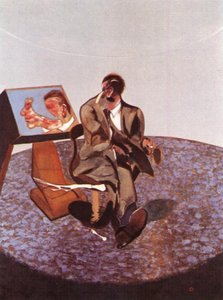 Portrait of George Dyer in a Mirror, 1968 - Francis Bacon
A haunting stillness permeates Francis Bacon’s Portrait of George Dyer in a Mirror (1968), an image that captures not just the likeness of his lover, but the very essence of modern anxiety. This painting isn't merely observed; it is *felt*—a visceral exploration of isolation and the fractured self.
Dyer, formally dressed yet slumped in despair before a television displaying another anguished face, embodies a profound sense of societal constraint juxtaposed with inner turmoil. Bacon’s signature Expressionist style—characterized by distorted forms and a deliberately rough application of paint—amplifies this emotional intensity. The visible brushstrokes aren't imperfections; they are the very texture of vulnerability.
The mirror, a recurring motif in Bacon’s work, functions as more than just a reflective surface. It represents duality, self-perception, and the inescapable cycle of human suffering. The television screen isn’t simply a backdrop; it's another layer of distortion, reflecting back a fragmented image of humanity—a commentary on the anxieties of modern life.
In a contemporary setting, this artwork offers a powerful statement about our own search for identity and meaning. Its somber palette—dominated by grays, browns, and blacks—evokes feelings of melancholy and introspection, yet its raw honesty is undeniably captivating. A truly timeless piece that invites contemplation and elevates any space with its quiet dignity.
Dog - Francis Bacon
 Dog - Francis Bacon
A quiet contemplation emanates from Francis Bacon’s Dog (1952), a work that transcends its subject matter to become a powerful meditation on vulnerability and isolation. This painting, securing its place among his most celebrated pieces, isn't about depicting an animal; it’s about capturing the raw essence of existence.
The solitary dog, rendered with expressive brushstrokes against a geometric backdrop, embodies a sense of primal instinct tempered by profound loneliness. Bacon’s signature style—a fusion of abstraction and figuration—is on full display here, utilizing loose, energetic lines and a deliberately rough application of paint to evoke movement and life.
The composition is striking in its simplicity: the white dog stands out against a grid-like structure overlaid with areas of deep blues, blacks, and reds. This interplay between organic form and rigid architecture creates a visual tension that underscores the animal’s vulnerability. The limited color palette—carefully chosen to heighten emotional resonance—evokes feelings of unease and introspection.
In a contemporary setting, Dog offers a subtle yet powerful statement about our own search for connection in an increasingly fragmented world. Its restrained elegance and quiet dignity can elevate any space, fostering an atmosphere of contemplation and inviting viewers to reflect on the complexities of the human condition—a timeless piece for those seeking art that resonates with depth and emotional honesty.
painting, 1946 - Francis Bacon
 painting, 1946 - Francis Bacon
A sense of unease settles over you as you gaze upon Francis Bacon’s Painting (1946)—a visceral exploration of post-war anxieties rendered in a symphony of muted pinks, blacks, and unsettling reds. This work isn't simply seen; it is *felt*—a raw embodiment of human suffering and societal decay.
At its core lies a distorted figure reminiscent of a crucifixion scene, yet stripped bare of any religious solace. Hanging chains evoke feelings of entrapment, while the mysterious figure below, sheltered by an umbrella, introduces a contrasting element of protection and concealment. Abstracted forms—insect-like creatures and mechanical intrusions—surround them, hinting at transformation and decay.
Bacon’s vigorous brushwork and impasto technique amplify the emotional intensity, creating a textured surface that draws you into the heart of the painting. This piece, born from the aftermath of World War II, challenges traditional notions of representation and invites symbolic interpretation—a commentary on human vulnerability in a fractured world.
Its place among Bacon’s Top 25 works is assured not just for its technical mastery, but for its enduring power to provoke. In a contemporary setting, this artwork serves as a potent reminder of our own fragility and the search for meaning amidst chaos—a timeless piece that invites contemplation and elevates any space with its quiet dignity.
henrietta moraes - Francis Bacon
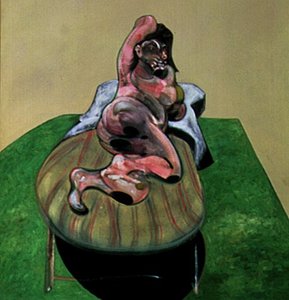 henrietta moraes - Francis Bacon
Unveiled to a select few, Francis Bacon’s Henrietta Moraes is not merely a portrait; it's an excavation of the human form and psyche—a work that solidifies his position as one of the most important artists of the 20th century. This painting, part of a series dedicated to his muse Henrietta Moraes, transcends conventional representation to become a visceral exploration of vulnerability and existence.
The dominant color—a pulsating, almost overwhelming red—immediately commands attention. It isn’t simply a backdrop but an all-encompassing environment that seems to both contain and consume the figure. This use of color is characteristic of Bacon’s technique; he sought not realism, but emotional resonance through bold chromatic choices.
Bacon's brushwork is equally crucial—a dynamic interplay of broad strokes and delicate blending creates textures that are unsettling yet captivating. The distorted form of Moraes, rendered with exaggerated curves and proportions, pushes beyond the physical towards an almost grotesque depiction of physicality. This work emerged during a period of significant social upheaval, reflecting anxieties about existentialism and changing societal norms.
In a contemporary setting, Henrietta Moraes offers a powerful statement about our own search for meaning in a fragmented world. Its raw honesty and emotional intensity elevate any space, inviting contemplation and serving as a timeless testament to the power of art.
Second Version of the triptych - Francis Bacon
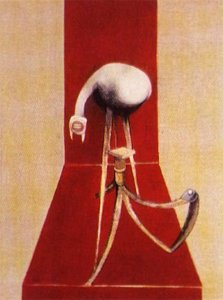 Second Version of the triptych - Francis Bacon
A haunting echo reverberates from Francis Bacon’s Second Version of Triptych (1988)—a work that isn't simply seen, but *felt* in the depths of your being. This painting secures its place among his most celebrated achievements as a raw exploration of the human condition rendered with brutal honesty and poetic sensitivity.
The triptych format—historically reserved for religious altarpieces—is deliberately subverted here, presenting instead a distorted, vaguely humanoid figure perched upon a stark red pedestal. This central form dominates the composition, its elongated body resembling a creature caught between states of being. The single, piercing eye locks onto the viewer, creating an immediate sense of unease.
Bacon’s signature expressionistic style—deeply rooted in Surrealism—rejects traditional representation, prioritizing emotional impact over anatomical accuracy. Executed in oil paint on canvas, the technique showcases his masterful blending of colors and subtle brushwork, creating a smooth texture that belies the turbulent emotions conveyed. The vibrant red pedestal provides a jarring contrast to the pale figure, amplifying the sense of drama.
In a contemporary setting, Second Version of Triptych offers a powerful statement about our own search for meaning in a fragmented world. Its raw honesty and emotional intensity elevate any space, inviting contemplation and serving as a timeless testament to the power of art.
crucifixion, 1965 right - Francis Bacon
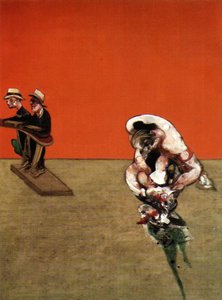 crucifixion, 1965 right - Francis Bacon
Before you stands a vision of modern anguish—Francis Bacon’s Crucifixion (1965), a work that doesn't invite reverence, but demands confrontation. This triptych—a format Bacon returned to repeatedly—presents three harrowing panels that dismantle traditional representations of suffering and thrust viewers into raw physicality.
Painted in the shadow of post-war anxieties, this piece stands as a powerful statement on violence and the fragility of life. Bacon’s style is immediately recognizable for its distorted figures and turbulent brushwork—here exemplified with unsettling force. He employs an aggressive palette dominated by searing reds, imbued with a sense of raw pain.
The composition itself is fragmented and chaotic; forms are blurred and contorted, barely resembling recognizable anatomy. Oil paint is applied in layers, creating a textured surface that amplifies the feeling of unease. Notice the stark contrast between the rigidly posed figure on the left panel—seemingly an observer—and the agonizing figures within the central panels.
In a contemporary setting, Crucifixion remains a potent reminder of our own vulnerabilities and the enduring power of art to confront the darkest corners of human experience. Its raw honesty elevates any space, inviting contemplation and serving as a timeless testament to the complexities of existence.
triptych, may - june, 1973 c - Francis Bacon
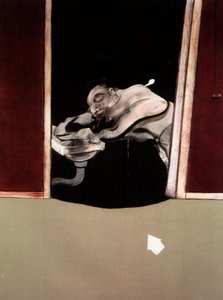 triptych, may - june, 1973 c - Francis Bacon
A requiem in paint—Francis Bacon’s Triptych, May-June 1973 is not merely a depiction of grief, but its visceral embodiment. Created in the immediate aftermath of his lover George Dyer’s tragic suicide, this triptych stands as one of Bacon's most profoundly personal and emotionally charged works.
The three imposing panels—each measuring 78 x 58 inches—present figures emerging from shadowy interiors. Bacon eschews traditional representation, favoring distorted forms and expressive brushwork to externalize the internal turmoil following his loss. His signature use of raw, fleshy tones, often rendered with a seemingly violent application of paint, creates a sense of vulnerability.
The composition is deliberately claustrophobic, trapping the figures within defined spaces that amplify their isolation. Arched doorways—frequent motifs in Bacon’s work—represent thresholds between life and death, consciousness and unconsciousness. The painting isn't about literal depiction; it’s about conveying feeling.
At OriginalUniqueArt, we strive to preserve the emotion and texture of such masterpieces through faithful reproductions. Triptych, May-June 1973 offers a powerful statement about our own vulnerabilities and the enduring power of art—a timeless testament to the complexities of existence that can now grace your home.
head ii, 1958 - Francis Bacon
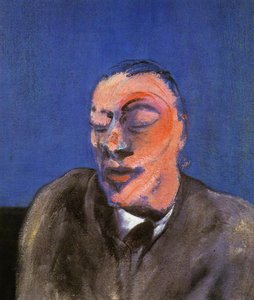 head ii, 1958 - Francis Bacon
A visceral portrait—Francis Bacon’s Head II (1958) isn't simply a depiction of a man, but an evocation of inner turmoil. This work exemplifies the artist’s unique contribution to Expressionism and his enduring fascination with the human condition.
The tightly cropped view focuses on a male head and shoulders rendered with deliberate distortion. Bacon eschews traditional portraiture conventions, opting for abstracted forms where geometric shapes are softened by dynamic brushwork. This compression of space intensifies the psychological impact, drawing the viewer into the subject’s confined emotional world.
The canvas explodes with a striking contrast between intense blues and oranges—a chromatic tension that amplifies the emotional weight. Impasto – the thick application of paint – is central to Bacon's technique; visible brushstrokes add tactile quality and energetic dynamism. The flattened perspective further emphasizes the two-dimensionality, rejecting illusionistic depth.
At OriginalUniqueArt, we faithfully reproduce these masterpieces, preserving the emotion and texture that define Bacon’s legacy. Head II offers a powerful statement about our own vulnerabilities—a timeless testament to the complexities of existence that can now enrich your space with its raw beauty.
Head-VI Arts council of Great Britain, London - Francis Bacon
 Head-VI Arts council of Great Britain, London - Francis Bacon
A genesis of a scream—Francis Bacon’s Head VI (1949) isn't merely a portrait, but an excavation of the human psyche. The central figure, mouth flung open in a silent howl, confronts us with isolation and existential dread.
Born from a reinterpretation of Velázquez’s *Portrait of Pope Innocent X*, Bacon didn’t replicate the past; he transmuted it into something intensely personal. A geometric cage constructed from translucent fabric immediately establishes confinement, amplifying the feeling of trapped anguish. This isn't decorative—it actively contributes to the painting’s suffocating atmosphere.
Bacon employs bold, gestural brushstrokes – thick layers that vibrate with energy—to create a textured surface riddled with movement. Deep purples, browns, and ochres collide in a chaotic yet compelling arrangement. The purple robe adds dramatic intensity, while the blurred background serves not as backdrop but as an active participant in the unsettling narrative.
At OriginalUniqueArt, we faithfully reproduce these masterpieces, preserving the emotion and texture that define Bacon’s legacy. Head VI remains a potent reminder of our own vulnerabilities—a timeless testament to the complexities of existence that can now resonate within your home.
Study for a Pope VI - Francis Bacon
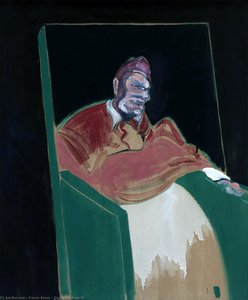 Study for a Pope VI - Francis Bacon
A descent into the human psyche—Francis Bacon’s Study for a Pope VI (1961) isn't merely a portrait, but a visceral excavation of existential anxiety. Emerging from his iconic “Pope” series, this work transcends representation to become an expression of profound distress.
The painting confronts us with a figure seated in a chair, head turned away, mouth agape in a silent scream—a stark contrast to the serene authority typically associated with papal iconography. The genesis of this unsettling piece lies within Bacon's engagement with Velázquez’s *Portrait of Pope Innocent X*, an image he used as both inspiration and provocation.
Bacon’s distinctive style is immediately recognizable: thick, impasto brushstrokes create a surface teeming with texture. Vibrant reds, yellows, and ochres are applied with intensity, contributing to the painting’s unease. The figure's features are deliberately distorted—elongated face, wide eyes, frozen shriek—conveying an emotional state of anguish and isolation.
At OriginalUniqueArt, we faithfully reproduce these masterpieces, preserving the emotion and texture that define Bacon’s legacy. Study for a Pope VI remains a potent reminder of our own vulnerabilities—a timeless testament to the complexities of existence that can now resonate within your home.
Untitled 1 - Francis Bacon
 Untitled 1 - Francis Bacon
A descent into darkness—Francis Bacon’s Untitled 1 (circa 1954) stands as an arresting testament to the artist's singular vision, a chilling exploration of human vulnerability. Painted on a large canvas with oil pigment, it embodies Expressionism, prioritizing subjective emotional experience.
The composition immediately commands attention: a grotesque figure resembling a horse’s head—Bacon’s self-portrait—positioned against an unsettling orange background punctuated by crimson flowers. This central figure emits a palpable scream, conveying profound anguish and terror. Alongside it resides a smaller, amorphous form reinforcing themes of isolation.
Bacon’s distinctive style draws heavily from Cubism, reimagined with textural complexity and visceral impact. Meticulous layering of paint—often multiple coats—creates unease and disorientation. He incorporated unconventional materials like sand and dust, mirroring disintegration and amplifying emotional resonance.
At OriginalUniqueArt, we faithfully reproduce these masterpieces, preserving the emotion that defines Bacon’s legacy. Untitled 1 remains a potent reminder of our own vulnerabilities—a timeless testament to the complexities of existence that can now resonate within your home.
Hombre con Perro - Francis Bacon
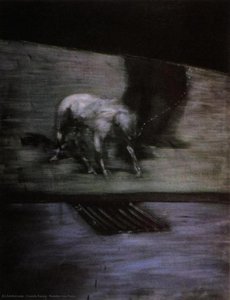 Hombre con Perro - Francis Bacon
A chilling stillness—Francis Bacon’s Homme con Perro (Man with Dog) isn't merely a depiction of two canines; it’s a visceral plunge into the heart of human anxiety. Painted in the stark monochrome of the late 1940s, the artwork immediately confronts the viewer with an atmosphere of profound unease.
The composition itself is deliberately unbalanced, drawing our eye to the dominant presence of the larger dog on the left, while the smaller canine seems trapped. The faintly visible human figure appears detached—an observer rather than a participant in this primal drama. This ambiguity invites speculation about his role and emotional state.
Bacon’s technique is deliberately raw and gestural, eschewing academic precision for intensely personal expression. Loose brushstrokes create a textured surface that writhes with suppressed energy—the paint itself conveying urgency. The forms are aggressively distorted, elongated, mirroring psychological states.
At OriginalUniqueArt, we faithfully reproduce these masterpieces, preserving the emotion that defines Bacon’s legacy. Homme con Perro remains a potent reminder of our own vulnerabilities—a timeless testament to the complexities of existence that can now resonate within your home.
Man in Blue I - Francis Bacon
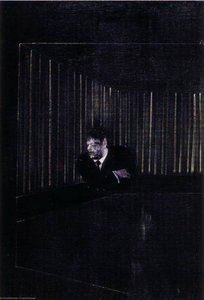 Man in Blue I - Francis Bacon
A descent into psychological landscape—Francis Bacon’s Man in Blue I isn't merely a portrait; it’s an unsettling plunge into the abyss of human consciousness. Painted between 1952 and 1953, this seminal work exemplifies his signature Expressionist style.
The artwork eschews traditional representation, prioritizing emotional intensity over accurate depiction. Dominating the canvas is a figure seated at a desk—a mundane setting transformed into a claustrophobic cage by Bacon’s deliberate compositional choices. Vertical lines bisect the frame, establishing entrapment and restricting movement.
Bacon skillfully employs fragmented lines and blurred shapes, mirroring the disintegration of rational thought. The color palette is strikingly restrained, relying on shades of black, grey, and muted blues—underscoring the painting’s bleak emotional core.
At OriginalUniqueArt, we faithfully reproduce these masterpieces, preserving the emotion that defines Bacon’s legacy. Man in Blue I remains a potent reminder of our own vulnerabilities—a timeless testament to the complexities of existence that can now resonate within your home.
Seated Figure - Francis Bacon
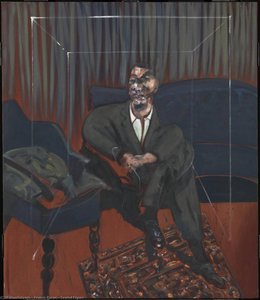 Seated Figure - Francis Bacon
A descent into anguish—Francis Bacon’s Seated Figure isn't merely a portrait; it’s an excavation of the human psyche, a raw glimpse into isolation and existential dread. Painted in 1961, this work immediately confronts the viewer with a figure rendered in agonizing distortion – a slumped man seemingly trapped within a shadowed space.
Bacon’s signature style is powerfully evident: brushstrokes are aggressively applied, creating movement and instability. The muted palette—dominated by browns, greys, blacks, punctuated by flashes of orange and blue—contributes to this unease. Blurred forms amplify disorientation, as if reality itself is fracturing.
At OriginalUniqueArt, we faithfully reproduce these masterpieces, preserving the emotion that defines Bacon’s legacy. Seated Figure remains a potent reminder of our own vulnerabilities—a timeless testament to the complexities of existence that can now resonate within your home.
self-portrait, 1969 - Francis Bacon
 self-portrait, 1969 - Francis Bacon
A visceral portrait of anxiety—Francis Bacon’s Self-Portrait isn't merely a depiction of the artist; it’s an unflinching exploration of isolation and existential dread. Painted in 1969, this work embodies the raw emotionality that defined his career.
The composition is strikingly immediate – a tight crop focusing relentlessly on Bacon’s head. This claustrophobic framing establishes confinement, mirroring the psychological state suggested. The background is a deep blue, amplifying the pallor of his skin and creating an unsettling contrast. His technique is characterized by loose brushstrokes—thick applications layered in swirling patterns.
At OriginalUniqueArt, we faithfully reproduce these masterpieces, preserving the emotion that defines Bacon’s legacy. Self-Portrait remains a potent reminder of our own vulnerabilities—a timeless testament to the complexities of existence that can now resonate within your home.
after the life mask of william blake iii, 1955 - Francis Bacon
 after the life mask of william blake iii, 1955 - Francis Bacon
A visceral echo of Blake—Francis Bacon’s After the Life Mask of William Blake III isn't merely a portrait; it’s an excavation of the human psyche. Painted in 1955, this work embodies the raw emotionality that defined his career.
The composition focuses tightly on a distorted head, rendered in muted grays and blacks. This claustrophobic framing establishes confinement, mirroring the psychological state suggested. Bacon’s technique is deliberately chaotic yet meticulously controlled—loose brushstrokes build layers of paint, suggesting movement and instability.
At OriginalUniqueArt, we faithfully reproduce these masterpieces, preserving the emotion that defines Bacon’s legacy. After the Life Mask of William Blake III remains a potent reminder of our own vulnerabilities—a timeless testament to the complexities of existence that can now resonate within your home.
Pope II - Francis Bacon
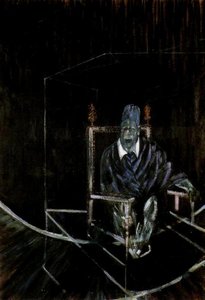 Pope II - Francis Bacon
A haunting presence—Francis Bacon’s Pope II stands as a chilling testament to his mastery of Expressionism and unflinching exploration of human vulnerability. Completed in 1958, this monumental canvas immediately confronts the viewer with an unsettling image: a seated figure enveloped within a cage-like structure.
Bacon deliberately eschews traditional perspective, flattening the image and intensifying the feeling of confinement—a technique characteristic of his broader artistic vision. The monochromatic color scheme amplifies the painting’s emotional impact, stripping away any comforting hues. At OriginalUniqueArt, we faithfully reproduce these masterpieces, preserving the emotion that defines Bacon’s legacy.
Pope II remains a potent reminder of our own vulnerabilities—a timeless testament to the complexities of existence that can now resonate within your home.
STUDIES FROM THE HUMAN BODY (triptych, left) - Francis Bacon
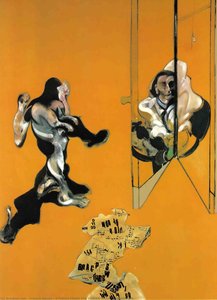 STUDIES FROM THE HUMAN BODY (triptych, left) - Francis Bacon
A descent into existential horror—Francis Bacon’s Studies from the Human Body (Triptych, Left), completed in 1970, isn't merely a painting; it’s an unflinching confrontation with the fundamental anxieties of human existence.
Part of a larger triptych, this single panel embodies his signature style—a masterful fusion of Expressionism and visceral observation. Bacon deliberately eschews traditional perspective, opting for bold brushstrokes and a palette dominated by unsettling yellows and oranges—colors chosen to amplify the painting's emotional intensity.
At OriginalUniqueArt, we faithfully reproduce these masterpieces, preserving the emotion that defines Bacon’s legacy. Studies from the Human Body remains a potent reminder of our own vulnerabilities—a timeless testament to the complexities of existence that can now resonate within your home.
Figures in movement, Private - Francis Bacon
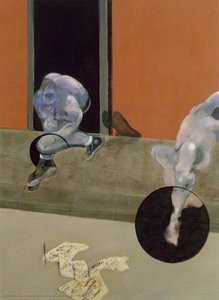 Figures in movement, Private - Francis Bacon
Imagine a hushed room, late afternoon light casting long shadows—Francis Bacon’s Figures in Movement doesn't offer spectacle; it invites introspection.
Painted in 1973, this black and white work confronts the viewer with an unsettling intimacy. Two nude male forms are intertwined on a simple ground plane, their limbs tangled in a way that suggests both struggle and connection. The stark contrast of tones amplifies the sense of claustrophobia and raw emotion.
At OriginalUniqueArt, we faithfully reproduce these masterpieces, preserving the emotion that defines Bacon’s legacy. Figures in Movement remains a potent reminder of our own vulnerabilities—a timeless testament to the complexities of existence that can now resonate within your home.
Reclining Woman - Francis Bacon
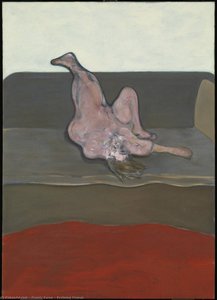 Reclining Woman - Francis Bacon
Imagine a quiet room, the weight of unspoken anxieties hanging in the air—Francis Bacon’s Reclining Woman doesn't offer comfort; it invites confrontation.
Painted in 1961, this work isn’t merely a depiction of a nude figure; it’s a raw and unsettling exploration of the human condition. The woman, lying supine on what appears to be a couch or bed, occupies almost the entirety of the canvas, her limbs stretched outwards creating an unsettling sense of imbalance.
At OriginalUniqueArt, we faithfully reproduce these masterpieces, preserving the emotion that defines Bacon’s legacy. Reclining Woman remains a potent reminder of our own vulnerabilities—a timeless testament to the complexities of existence that can now resonate within your home.
two figures lying on a bed with attendants, 1968 a - Francis Bacon
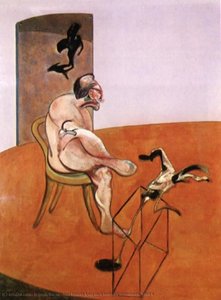 two figures lying on a bed with attendants, 1968 a - Francis Bacon
Imagine a room steeped in silence, heavy with unspoken anxieties—Francis Bacon’s Two Figures Lying on a Bed with Attendants doesn't offer solace; it demands confrontation.
Painted in 1968, this triptych isn’t merely a depiction of two men; it’s an excavation of the human psyche. The figures, sprawled on a bed within a stark white void, are grotesquely distorted and overlapping, their faces rendered as masks devoid of recognizable features.
At OriginalUniqueArt, we faithfully reproduce these masterpieces, preserving the emotion that defines Bacon’s legacy. Two Figures Lying on a Bed with Attendants remains a potent reminder of our own vulnerabilities—a timeless testament to the complexities of existence that can now resonate within your home.
Figure in a Landscaspe - Francis Bacon
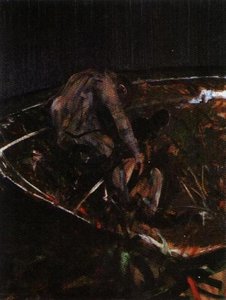 Figure in a Landscaspe - Francis Bacon
Imagine a silence that holds both beauty and despair—Francis Bacon’s Figure in a Landscape doesn't offer answers; it invites contemplation.
Painted around 1945, this work isn’t merely a depiction of a solitary figure; it’s a visceral exploration of human vulnerability. The subject, rendered in deliberately distorted forms and slumped on the ground, creates an immediate sense of isolation.
At OriginalUniqueArt, we faithfully reproduce these masterpieces, preserving the emotion that defines Bacon’s legacy. Figure in a Landscape remains a potent reminder of our own vulnerabilities—a timeless testament to the complexities of existence that can now resonate within your home.
Three Figures and Portrait - Francis Bacon
 Three Figures and Portrait - Francis Bacon
Imagine a room steeped in silence, heavy with unspoken anxieties—Francis Bacon’s Three Figures and Portrait doesn't offer solace; it demands confrontation.
Painted in 1975, this work isn’t merely a depiction of three individuals; it’s an excavation of the human psyche. The figures, distorted and fragmented within a claustrophobic space, embody the core tenets of Bacon's mature style: vulnerability, isolation, and inescapable dread.
At OriginalUniqueArt, we faithfully reproduce these masterpieces, preserving the emotion that defines Bacon’s legacy. Three Figures and Portrait remains a potent reminder of our own vulnerabilities—a timeless testament to the complexities of existence that can now resonate within your home.
Conclusion
As the light fades, we leave behind these canvases—not as relics of a distant past, but as living forces that continue to pulse with raw emotion and unsettling beauty.
Francis Bacon’s work is not easily categorized or comfortably understood. It challenges us, provokes us, and ultimately invites us to confront the complexities of our own existence. These paintings are mirrors reflecting our deepest fears and vulnerabilities—a testament to the enduring power of art to illuminate the human condition.
At OriginalUniqueArt, we believe that these masterpieces should not remain confined within museum walls. They deserve a place in our homes, our offices, our personal sanctuaries—spaces where their energy can continue to inspire and move us. Explore our full collection and discover the artwork that speaks to your soul.