De Stijl · 1917
Composition (Theo van Doesburg, 1917)
Theo van Doesburg (1883–1931) made Composition. It dates from 1917. It belongs to the De Stijl movement. It is made in acrylic on canvas. It is kept at Cincinnati Art Museum in Cincinnati, United States. It measures 27 × 27 cm.
- 1917
- Acrylic On Canvas
- 27 × 27 cm
- Cincinnati Art Museum

 Preview

 Hand Made Oil Painting
 Send
 Share
 Fact sheet


 Download
 Similars
 X-Ray
 Diaporama
 Q&A

 Stats
Composition, in brief
- Title
- Composition
- Artist
- Theo van Doesburg (1883–1931)
- Artist born in
- Utrecht, Netherlands
- Date
- 1917
- Medium
- Acrylic On Canvas
- Dimensions
- 27 × 27 cm
- Where to see it
- Cincinnati Art Museum, Cincinnati, United States
- Movement
- De Stijl
- Subject
- geometric abstraction, primary colors, optical illusion, minimalism, bauhaus influence, composition
What does Composition depict?
Composition (The Cow) – Theo van Doesburg
Theo van Doesburg’s “Composition,” painted in 1917, stands as a cornerstone of De Stijl and Neo-Plasticism—a movement that irrevocably altered the trajectory of modern art. More than just pigment on canvas; it embodies a radical reimagining of visual perception and an unwavering commitment to distilling artistic expression to its purest form.
Style & Technique: The painting’s aesthetic is defined by geometric abstraction, prioritizing horizontal and vertical lines over organic contours. Van Doesburg meticulously applied black, white, and mustard yellow squares—the foundational colors of De Stijl—creating a deceptively simple yet profoundly complex visual experience. Unlike traditional oil paintings characterized by brushstrokes and textural variation, “Composition” presents a flawlessly flat surface, achieved through precise layering and meticulous attention to detail. This deliberate rejection of illusionistic representation underscores the movement’s philosophical aim: to transcend subjective experience and capture an objective reality rooted in mathematical harmony.
Historical Context & Influence: Born Christian Emil Marie Küpper in Utrecht, Netherlands, Van Doesburg emerged from the artistic milieu influenced by Impressionism and Post-Impressionism. However, his encounter with Wassily Kandinsky’s *Rückblicke* proved transformative, propelling him toward a more conceptual approach. Inspired by Kandinsky's exploration of spirituality through color and form, Van Doesburg established De Stijl in 1917 alongside Piet Mondrian—a collaborative effort that cemented the movement’s core tenets.
Symbolism & Optical Illusion: The painting’s arrangement isn’t merely decorative; it actively engages the viewer's perception. Employing the Müller-Lyer illusion – where converging lines create an apparent distortion of distance – Van Doesburg subtly manipulates visual cues to evoke a sense of dynamism and ambiguity. This technique reflects De Stijl’s belief in harnessing optical phenomena to communicate universal truths, mirroring the movement’s broader ambition to express spiritual concepts through geometric abstraction.
Emotional Impact & Legacy: “Composition” transcends mere visual representation, conveying an underlying feeling of serenity and balance—a testament to Van Doesburg's unwavering dedication to achieving aesthetic harmony. Its minimalist elegance continues to inspire artists and designers today, demonstrating the enduring power of reductive artistic principles. The painting’s influence extends beyond painting into architecture and design, shaping the visual language of subsequent generations.
Size: 12 x 16 cm
Date: 1917
Which museum holds Composition?
Cincinnati Art Museum
Cincinnati, United States
A Sanctuary of Visionary Splendor Nestled within the verdant, tranquil embrace of Eden Park, the Cincinnati Art Museum stands as a profound testament to enduring artistic passion and civic devotion. As the first purpose-built art museum west of the Alleghenies, it was born from an ambitious spirit that sought to cultivate beauty and intellectual curiosity within a burgeoning American city. The museum’s architectural grandeur, anchored by James W.


High-resolution images of Composition

Theo van Doesburg, Composition (1917), Cincinnati Art Museum. Public domain.
Questions on Composition, answered
Where is "Composition" by Theo van Doesburg on display today?
You can see the original "Composition" at the Cincinnati Art Museum, Cincinnati, United States.
What is the creation date of "Composition" by Theo van Doesburg?
The creation of "Composition" by Theo van Doesburg is dated 1917.
What is "Composition" made with?
Theo van Doesburg used the acrylic on canvas technique for "Composition". The technique defines the material nature of the original work.
How big is the original "Composition"?
The original "Composition" by Theo van Doesburg measures 27 x 27 cm.
What does "Composition" by Theo van Doesburg depict?
The themes present in "Composition" by Theo van Doesburg include geometric abstraction, primary colors, optical illusion, minimalism, bauhaus influence, composition, grid pattern. Together they summarize the artwork's subject matter.
Can the image of "Composition" by Theo van Doesburg be freely reproduced?
The copyright answer for "Composition" by Theo van Doesburg: the work is in the public domain - its copyright has expired. This determines whether reproductions of the image may be freely made.
Who is the artist behind "Composition"?
"Composition" is attributed to Theo van Doesburg.
Which artistic current is "Composition" by Theo van Doesburg part of?
"Composition" by Theo van Doesburg belongs to the De Stijl movement. This movement provides the stylistic context of the work.
Which period of Theo van Doesburg's career does "Composition" belong to?
"Composition" represents the Mature Period of Theo van Doesburg.
About the artist, Theo van Doesburg

1883–1931, Netherlands
Theo van Doesburg
The Architect of Abstraction: A Life in Geometric Harmony Theo van Doesburg, born Christian Emil Marie Küpper in 1883 in Utrecht, Netherlands, was more than a painter; he was a revolutionary force who reshaped the very foundations of modern art. His journey began amidst the lingering echoes of Impressionism and Post-Impressionism, initially mirroring styles reminiscent of Vincent van Gogh – both in subject matter and emotional intensity. However, this early phase served as a crucial prelude, a necessary stepping stone toward the radical transformation that would define his enduring legacy. A pivotal moment arrived in 1913 with his encounter with Wassily Kandinsky’s *Rückblicke*.
Also by Theo van Doesburg
 Counter composition XV1925
 Rhythm of a Russian Dance
 Troelstra1910
 Study for Composition VIII (The Cow)1918

Essays around Composition
 Neoplasticism: A Radical Geometry of Utopian Vision – Origins, Principles, and Enduring InfluenceExplore the revolutionary Neoplasticism movement – De Stijl – with OriginalUniqueArt. Discover Mondrian & van Doesburg's principles, influe…
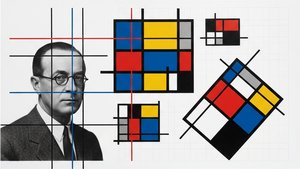 Theo van Doesburg: Pioneering De Stijl & the Evolution of Neo-PlasticismExplore the revolutionary De Stijl movement & Neo-Plasticism with our expert guide. Discover Piet Mondrian, Theo van Doesburg, and the last…
 Mastering Abstraction: The Top 25 Iconic Artworks by Piet MondrianExplore 25 iconic Piet Mondrian masterpieces of Neoplasticism. Discover the beauty of De Stijl on OriginalUniqueArt.com.