High Renaissance · 1499
Self Portrait (Raphael, 1499)
Raphael (1483–1520) made Self Portrait. It dates from 1499. It belongs to the High Renaissance movement. It is made in chalk. It measures 38 × 26 cm.
- 1499
- Chalk
- 38 × 26 cm

 Preview

 Hand Made Oil Painting
 Send
 Share
 Fact sheet


 Download
 Similars
 X-Ray
 Diaporama
 Q&A

 Stats
Self Portrait, in brief
- Title
- Self Portrait
- Artist
- Raphael (1483–1520)
- Artist born in
- Urbino, Italy
- Date
- 1499
- Medium
- Chalk
- Dimensions
- 38 × 26 cm
- Movement
- High Renaissance
- Period
- Renaissance
- Subject
- self-portrait, raphael, renaissance, artist, chalk drawing, introspection
What does Self Portrait depict?
Self Portrait by Raphael: A Glimpse into the Artist's Soul
Raphael’s "Self-Portrait," created around 1499 and residing in the Uffizi Gallery, Florence, is more than just a likeness; it's an intimate window into the mind of one of the High Renaissance's most celebrated masters. This chalk drawing, measuring 38 x 26 cm, offers a rare glimpse into Raphael’s self-perception during his formative years, revealing a young artist poised on the cusp of greatness.
Style and Technique: Early Mastery
The artwork exemplifies Raphael's early style, heavily influenced by his apprenticeship under Perugino. The choice of chalk as a medium lends an immediate sense of delicacy and immediacy to the portrait. Unlike oil paintings that allow for layering and blending, chalk demands precision and directness. Raphael’s masterful handling of the material showcases his ability to capture subtle nuances in expression and texture with remarkable skill. Notice how he uses varying degrees of pressure to create tonal shifts, defining the contours of his face and the fall of his hair. The unfinished quality of certain areas—particularly around the hairline and collar—hints at this being a study or preparatory sketch rather than a fully realized finished work.
Historical Context: A Young Artist Ascending
This self-portrait was created during a pivotal period in Raphael’s career, shortly before his move to Florence. He had already established himself as a successful artist in Umbria but sought new artistic influences and opportunities in the vibrant cultural hub of Florence. The portrait reflects this transitional phase—a young man confident in his abilities yet eager to learn and evolve. The High Renaissance was characterized by a renewed interest in classical art and humanism, and Raphael’s work embodies these ideals through its emphasis on balance, harmony, and idealized beauty. This self-portrait can be seen as an early declaration of his artistic ambitions within this flourishing cultural landscape.
Symbolism and Emotional Impact: Introspection and Confidence
The portrait's symbolism is subtle yet profound. Raphael’s direct gaze conveys a sense of quiet confidence and introspection. The simple attire—a dark cap and robe—suggests a focus on his craft rather than worldly status. His expression is serious, almost contemplative, hinting at the intellectual depth that would characterize his later works. While not overtly emotional, the portrait evokes a feeling of serene self-assurance – a young man fully aware of his talent and potential. The lack of background further emphasizes Raphael's face, drawing the viewer’s attention to his expression and creating an intimate connection with the artist across centuries.
Legacy: A Timeless Reflection
Raphael’s "Self-Portrait" remains a treasured masterpiece, offering invaluable insight into the life and artistic development of one of history's greatest painters. It serves as a testament to his early mastery of technique and foreshadows the brilliance that would define his career. The portrait continues to inspire artists and art enthusiasts alike, reminding us of the power of self-reflection and the enduring legacy of Renaissance artistry.
High-resolution images of Self Portrait

Raphael, Self Portrait (1499). Public domain.
Questions on Self Portrait, answered
When was "Self Portrait" made?
"Self Portrait" dates from 1499. The date places the work within Raphael's career and its era.
What medium is "Self Portrait" by Raphael executed in?
Raphael used the chalk technique for "Self Portrait". The technique defines the material nature of the original work.
What are the dimensions of the original "Self Portrait" by Raphael?
"Self Portrait" measures 38 x 26 cm in its original form. Original dimensions are a useful reference when choosing a reproduction size.
What does "Self Portrait" by Raphael depict?
"Self Portrait" by Raphael depicts: self-portrait, raphael, renaissance, artist, chalk drawing, introspection, uffizi gallery.
Can the image of "Self Portrait" by Raphael be freely reproduced?
Regarding copyright, "Self Portrait" is in the public domain - its copyright has expired.
Who is the artist behind "Self Portrait"?
The artist behind "Self Portrait" is Raphael. The work is catalogued under Raphael's name.
Which artistic current is "Self Portrait" by Raphael part of?
"Self Portrait" by Raphael belongs to the High Renaissance movement. This movement provides the stylistic context of the work.
Where does "Self Portrait" fall in Raphael's career?
"Self Portrait" represents the Early Period of Raphael.
How old was Raphael when creating "Self Portrait" in 1499?
When "Self Portrait" was created in 1499, Raphael - born in 1483 - was 16 years old.
About the artist, Raphael

1483–1520, Italy
Raphael
The Life and Identity of Raphael Raphael, known to history by several names including Raffaello Sanzio, Raffaello Santi, and Raffaello Sanzio da Urbino, was a central figure of the Italian High Renaissance. His life was defined by a dual mastery of painting and architecture, a versatility that allowed him to move seamlessly between the intimate scale of a portrait and the monumental demands of papal construction. He was born in Urbino, Italy, on April 6, 1483, into a world of intellectual and artistic activity. His career was marked by an immense productivity that required the management of a large workshop to meet the needs of his patrons.
Also by Raphael
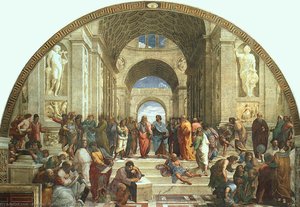 School of Athens1511
 The Sistine Madonna1513
 The Transfiguration1520
 Marriage of the Virgin1504

Essays around Self Portrait
 Masterpieces of Raphael: The Top 25 Essential Artworks of the High RenaissanceExplore 25 iconic Raphael masterpieces of the High Renaissance. Discover timeless beauty and curated art on OriginalUniqueArt.com.
 The Introspective Gaze: Exploring Psychological Depth and Inner Truth in PortraitureExplore the profound psychological depth of master portraiture through expert analysis. Discover the true essence of the human spirit today.
 Pietro Perugino: Umbrian Master of Serenity & Precursor to Raphael's High RenaissanceExplore the life & art of Pietro Perugino, a pivotal Renaissance master and Raphael’s influential teacher. Discover his serene compositions…