Preview
 Send
Send Share
Share
 Details
 Guide
Guide

 Download
 Similars
 X-Ray
X-Ray Diaporama
 Stats
StatsCoronilla (recto)
 Acrylic On Canvas
- WallArt
- Cubism
 1929
1929 61.0 x 51.0 cm
 Fitzwilliam College
 Read More
Giclée / Art Print
Museum-quality giclée or canvas print with fast production and flexible finish options. ( Buy Hand Made Painting Switch to Digital Image)




P118B $10

P118H $10

P118W $10

P438Z $10

P508JH $12

P508YH $12

P805H $10

P805Z $10

P919BZ $10

P919G $10

P919XJ $10

P959ZH $10

P968JZ $12

W106C $8

W218G $10

W218JH $8

W218Y $10

W307PJ $10

W316G $10

W316PJ $8

W316Y $10

W398PJ $8

W4111J $10

W500HY $15

W500JH $15

W692G $12

W849H $8

W940BG $15

W953PJ $8




Pick from our preset sizes that match the artwork's original proportions.

Type the width and the height you need, to fit your frame or your wall. A print can only be cut, never made bigger than the picture, so a size with a different shape loses a part of the image. We send you a digital mockup to approve before we print anything. The picture shown on this page does not show the real cut — only the mockup does.
Worldwide Delivery () in 2 weeks instead of standard 4/5 weeks. (23 October)

Free Worldwide Express Shipping

High-Quality Linen Canvas

Full Shipping Insurance

Customs Tax Refund Guarantee

True Color Matching Guarantee

100-Day Return Policy (Defects Only)

100% Money-Back Guarantee

Bulk Discount Offer
 Glass option is only available in size under 110 CM

Coronilla (recto)
Giclée / Art Print
Reproduction Size
-


Total Price
$ 81
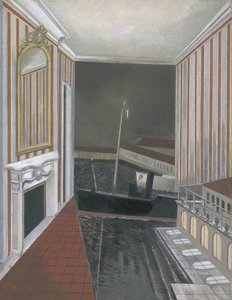
A Realm of Silent Geometry: Paul Nash’s “Coronilla (recto)”
Paul Nash's "Coronilla (recto)," painted in 1929, isn’t merely a depiction of a landscape; it’s an immersion into a meticulously constructed dreamscape. This work, housed within the quiet confines of an art gallery or museum setting – suggested by the subtle details of the wall and floor tiles – embodies the core tenets of British Modernism while simultaneously hinting at the burgeoning currents of Surrealism. The painting immediately draws the eye with its deliberate austerity: a muted palette dominated by ochre yellows, cool grays, and earthy browns creates an atmosphere of contemplative stillness, inviting prolonged observation. Yet, within this apparent simplicity lies a complex interplay of geometric forms and subtly suggestive imagery that speaks to the artist’s profound engagement with both the natural world and the burgeoning anxieties of the modern age.The Language of Line and Form
Nash's technique is characterized by an almost architectural precision. Vertical and horizontal lines, rendered with confident brushstrokes, intersect and overlap, establishing a clear sense of spatial depth – not through traditional perspective, but rather through a carefully orchestrated arrangement of shapes. These lines aren’t merely delineating forms; they actively construct the scene, creating a feeling of contained dynamism. The dominant geometric motifs—elongated rectangles, sharp angles, and subtly curving arcs—suggest both the solidity of the earth and the ethereal quality of memory or dream. The artist's use of planar shapes, reminiscent of Cubist principles, further emphasizes this duality, blurring the boundaries between reality and abstraction. It’s a deliberate choice that reflects Nash’s desire to move beyond representational accuracy and explore the underlying structure of perception itself.Roots in Myth and Landscape
To fully appreciate “Coronilla (recto),” it's crucial to understand Nash’s artistic lineage. Early influences, particularly the Romantic landscapes of J.M.W. Turner and the mystical visions of William Blake, are palpable throughout his oeuvre. The painting echoes these traditions through its evocative use of light and shadow, and its exploration of archetypal imagery. The title itself – “Coronilla” – is intriguing, referencing a crown or a series of peaks, perhaps alluding to ancient hillforts like those found in the Thames Valley, which held significant symbolic weight for Nash. These historical references aren’t simply decorative; they ground the painting within a broader narrative of British identity and its relationship to the land. The arrangement of forms subtly evokes these ancient structures, suggesting a dialogue between the past and the present.A Portrait of Inner Space
Beyond its formal qualities, “Coronilla (recto)” possesses a powerful emotional resonance. The muted colors and restrained composition create an atmosphere of quiet introspection—a sense that we are being invited to contemplate not just a landscape, but also the inner workings of the mind. The painting’s stillness is deceptive; it feels as though something is about to emerge from the depths of its geometric architecture. It's a work that rewards repeated viewing, revealing new layers of meaning with each encounter. The overall effect is one of serene melancholy, a poignant reminder of the beauty and fragility of the natural world, and perhaps, a subtle meditation on the passage of time.Reproductions and Beyond
OriginalUniqueArt offers meticulously crafted hand-painted reproductions of “Coronilla (recto),” allowing art lovers to experience Nash’s vision in exquisite detail. These reproductions capture not only the painting's formal qualities but also its evocative atmosphere, ensuring that this iconic work of British Modernism remains accessible for generations to come. Consider incorporating a reproduction into your home or office – it will serve as a constant source of inspiration and contemplation, a testament to the enduring power of Paul Nash’s artistic genius.Questions & Answers
Which artist and which style stand behind "Coronilla (recto)"?
"Coronilla (recto)" was created by Paul Nash in the Cubism style. Artist and movement identify the work's tradition.
How do I discover artworks close to "Coronilla (recto)" by Paul Nash?
Artworks similar to "Coronilla (recto)" by Paul Nash are gathered on the artwork's Similars page.
What was Paul Nash's age when "Coronilla (recto)" was created?
Paul Nash was 40 years old when creating "Coronilla (recto)" in 1929. The age is computed from the artist's birth year, 1889.
Artist Biography
Early Life and Influences
- Born: Kensington, United Kingdom (1889)
- Died: 1946
- Paul Nash was born on May 11, 1889, in London. His father, William Harry Nash, was a barrister, and his mother, Caroline Maude, displayed signs of mental illness from an early age. The family moved to Iver Heath, Buckinghamshire, when Paul was young, a move intended to benefit his mother's health.
- Education: He attended the Parsons School of Art and later the Slade School of Fine Art. While proficient in landscape painting, he struggled with figure drawing.
- Early Influences: Nash was heavily influenced by William Blake and J.M.W. Turner, evident in his early works. He also drew inspiration from landscapes featuring ancient historical elements like burial mounds and Iron Age hill forts.
Artistic Style and Development
- Style: Paul Nash's style blended modernism with traditional techniques. He utilized bold colors, geometric shapes, and abstract forms, distinguishing him from contemporaries.
- Surrealist Leanings: While not strictly a Surrealist, Nash was influenced by the movement, particularly after seeing a Giorgio de Chirico exhibition in 1928. His work incorporated symbolic landscapes with everyday objects.
- War Art: During World War I and II, Nash served as an official war artist. His depictions of battlefields were notable for their haunting beauty and exploration of the impact of conflict on the landscape. Notable works include "The Menin Road."
- "Aerial Creatures": A series produced during WWII featuring anthropomorphic depictions of aircraft crashed in landscapes, demonstrating his evolving style and symbolism.
Major Achievements and Recognition
- Pioneer of British Modernism: Nash played a crucial role in shaping British modern art, bridging traditional landscape painting with modernist aesthetics.
- War Art Legacy: His wartime paintings are considered iconic representations of the conflict's impact on both soldiers and the environment.
- Unit One Group: He co-founded Unit One in 1933 alongside Ben Nicholson and Barbara Hepworth, a significant group within the British art scene.
- Writer and Designer: Beyond painting, Nash was also a respected writer on art and designed applied arts such as stage scenery, fabrics, and posters.
Influences and Legacy
- Influence on Subsequent Artists: Nash's unique style and use of color influenced generations of artists who followed.
- Connection to Romanticism: His work is often linked to the English Romantic tradition, particularly through his connection to William Blake and J.M.W. Turner.
- Exploration of Man vs. Nature: A recurring theme in Nash's later works was the relationship between humanity and nature, explored through symbolic imagery.
- Continued Relevance: His paintings continue to be celebrated for their beauty, symbolism, and historical significance, remaining relevant to contemporary audiences.
Exhibitions and Collections
- Ruskin Gallery: Nash's work has been exhibited at the Ruskin Gallery in the United Kingdom.
- Tate Britain: His pieces can be found within the Tate Britain’s collection.
- Imperial War Museum: Several of his war art pieces are housed in the Imperial War Museum.
- York Art Gallery: His work is also part of the York Art Gallery's collection.
- Government Art Collection: A selection of Nash’s artworks are displayed within the Government Art Collection.

Paul Nash
1889 - 1946 , United Kingdom
Quick Facts
- Full Name: Paul Nash
- Nationality: British
- Date Of Birth: 1889
- Date Of Death: 1946
- Place Of Birth: Kensington, United Kingdom
- Notable Artworks: ['The Menin Road']
- Artistic Movement Or Style: Surrealism, Modernism
- Artists Who Influenced This Artist:
- William Blake
- J.M.W. Turner
- Wolfgang Lettl
- Artists Or Movements Influenced By This Artist: ['Modern artists']
Related Articles

Cézanne's Masterpieces: 25 Iconic Artworks to Transform Your Space
Journey through 25 iconic artworks by Paul Cézanne – a master of Impressionism and Post-Impressionism. Explore his landscapes, still lifes, and the stories behind these timeless masterpieces. Discover museum-quality reproductions & curated decor at OriginalUniqueArt.com.

Geometric Abstraction's 10 Defining Masterpieces | Art for Your Home - OriginalUniqueArt
Explore 10 defining masterpieces of Geometric Abstraction! Discover Kandinsky, Mondrian & Malevich’s iconic works. Find museum-quality art reproductions and curated decor ideas to elevate your home at OriginalUniqueArt.com.

Beyond Form & Color: Geometric Abstraction's Evolution in 20th/21st Century Art
Explore the evolution of geometric abstraction from Cubism to contemporary art. Discover key artists like Malevich & Mondrian, investment insights, and expert collecting advice at OriginalUniqueArt.

Paul Klee's Masterpieces: Explore 25 Iconic Paintings & Prints | OriginalUniqueArt
Journey through Paul Klee's 25 most iconic paintings & prints. Explore his abstract style, Bauhaus influence, and vibrant color palettes. Find museum-quality art reproductions & decor ideas at OriginalUniqueArt.com. Discover all masterpieces online.

Neo-Abstract Art: The High-Impact Evolution of Modern Visual Energy and Geometric Sophistication
Discover the power of Neo-Abstract art. Explore how bold geometric forms and high-impact visual energy are redefining modern design. Learn to curate sophisticated, high-energy spaces with the latest trends in contemporary abstraction and structural color.