
 Preview
 Send
Send Share
Share
 Details
 Guide
Guide

 Download
 Similars
 X-Ray
X-Ray Diaporama
 Stats
StatsThe Lamb
 Oil
Oil- WallArt
- Expressionist Abstraction
 1920
1920- Modern
 40.0 x 31.0 cm
 Städel Museum
 Read More
Hand Made Oil Reproduction
Hand-painted oil on canvas in your size and frame, made to order by our artists. ( Switch to Print Switch to Digital Image)




P118B $10

P118H $10

P118W $10

P438Z $10

P508JH $12

P508YH $12

P805H $10

P805Z $10

P919BZ $10

P919G $10

P919XJ $10

P959ZH $10

P968JZ $12

W106C $8

W218G $10

W218JH $8

W218Y $10

W307PJ $10

W316G $10

W316PJ $8

W316Y $10

W398PJ $8

W4111J $10

W500HY $15

W500JH $15

W692G $12

W849H $8

W940BG $15

W953PJ $8




Pick from our preset sizes that match the artwork's original proportions.

Type the width and the height you need, to fit your frame or your wall. This is hand-painted, so for a size with a different shape the artist can paint a bit more around the picture, or cut a bit — you choose. We send you a digital mockup to approve before the painting starts. The picture shown on this page does not show the real result — only the mockup does.
After order, OriginalUniqueArt.com team will email client for instructions and provide a mockup preview
Worldwide Delivery () in 3/4 weeks instead of standard 5 weeks. (21 October). No compromise on quality.

Free Worldwide Express Shipping

High-Quality Linen Canvas

Full Shipping Insurance

Customs Tax Refund Guarantee

True Color Matching Guarantee

100-Day Return Policy (Defects Only)

100% Money-Back Guarantee

Bulk Discount Offer
 Glass option is only available in size under 110 CM

The Lamb
Reproduction Medium
Reproduction Size
-


Total Price
$ 300
A Vision of Sacred Abstraction
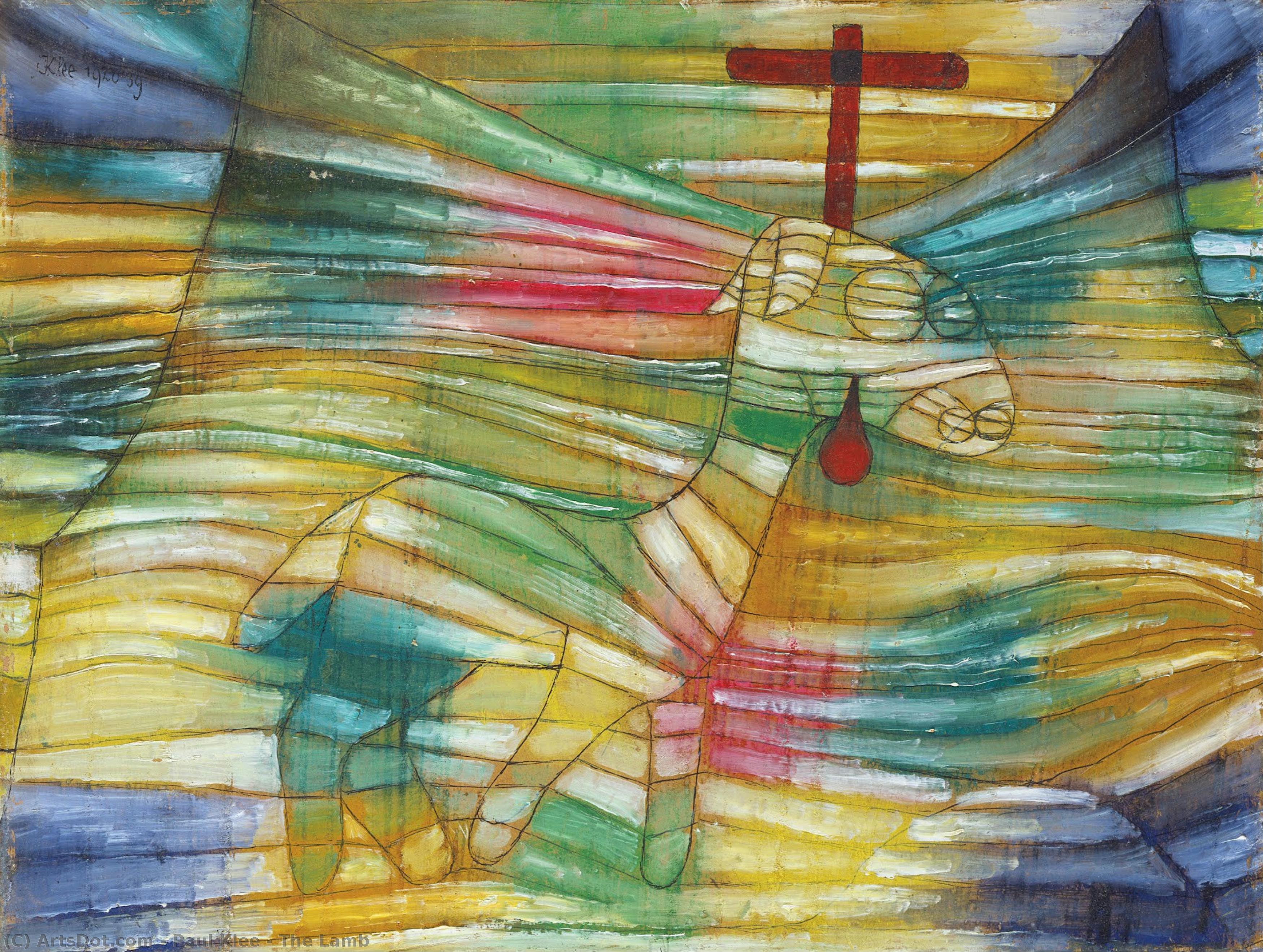
In the quiet, transformative landscape of early twentieth-century modernism, few works capture the intersection of spiritual devotion and geometric innovation as poignantly as Paul Klee’s “The Lamb,” completed in 1920. This mesmerizing piece transcends the boundaries of mere representation, inviting the viewer into a meditative space where the boundaries between the earthly and the divine begin to blur. At first glance, the eye is drawn to the vibrant, almost mosaic-like arrangement of colors that dance across the canvas. Klee does not simply paint a subject; he constructs a cosmos. The composition centers around a simplified silhouette of a lamb, cradled within the protective embrace of two large, stylized hands. Above this tender scene, a subtle cross motif emerges, anchoring the work in a profound religious symbolism that speaks to the Agnus Dei—the Lamb of God—and the themes of sacrifice and innocence.
The brilliance of Klee’s vision lies in his ability to marry the raw emotion of Expressionism with the rigorous, structural precision of Cubism. The artwork is a masterclass in controlled fragmentation. Rather than utilizing smooth transitions or traditional shading, Klee employs a technique reminiscent of stained glass, where distinct segments of color—ranging from deep blues and purel greens to warm yellows and soft pinks—are delineated by bold, black lines. This grid-like structure creates a rhythmic, pulsating energy that guides the viewer’s gaze through a labyrinth of shapes. The rectangular and triangular forms do not merely decorate the surface; they mirror the fractured nature of human experience, suggesting that even within a broken world, there is an underlying, divine order waiting to be perceived.
Symbolism and the Soul of the Canvas
To behold “The Lamb” is to engage in a silent dialogue with the artist’s inner mysticism. While Klee’s approach to religious imagery was often personal rather than dogmatic, his work here vibrates with a deep-seated spirituality. The lamb, with its closed eyes and the delicate presence of a cross, serves as a powerful emblem of purity and the transformative power of suffering. There is a palpable sense of reverence in the way the hands cradle the figure, evoking feelings of divine care, protection, and compassion. For the collector or the admirer of fine art, this piece offers more than visual beauty; it provides an emotional sanctuary, a moment of stillness in an increasingly chaotic world.
For interior designers and curators of sophisticated spaces, "The Lamb" represents a versatile masterpiece of intellectual and aesthetic depth. Its vibrant yet balanced palette allows it to serve as a profound focal point in a contemporary setting, adding both color and contemplative weight to a room. Whether displayed as a high-quality reproduction in a minimalist gallery or as a soulful addition to a curated private collection, the painting’s ability to evoke wonder remains undiminished. It is an invitation to look beyond the surface, to find beauty in the fragmented, and to rediscover the sacred within the abstract.
Questions & Answers
What is "The Lamb" about?
"The Lamb" by Paul Klee depicts: religious symbolism, hand gestures, geometric abstraction, color palette, stained glass effect, lamb imagery, cross motif.
What size should I print "The Lamb" for my room?
The recommended pairing for "The Lamb" by Paul Klee: a small print in a living room.
Which artist is "The Lamb" attributed to?
"The Lamb" was created by Paul Klee. The information on this page describes Paul Klee's original work.
Artist Biography
A Life of Line and Lyricism
Born in Münchenbuchsee, Switzerland, on December 18, 1879, Paul Klee entered a world shaped by the rhythms of music. His father, Hans Wilhelm Klee, was a German music teacher, and his mother, Ida Marie, was a Swiss singer. This early immersion in sound provided a foundation for a visual language that often mirrored musical arrangement. While he initially pursued the violin with great talent, eventually deciding that modern music lacked the creative pull he craved, he turned his focus toward the Academy of Fine Arts in Munich. His studies there between 1898 and 1901 were marked by an early mastery of drawing, though he famously struggled with color during those first cold winters.
The transition from a draftsman to an abstract thinker was not immediate. Klee’s early years involved exploring the boundaries of Symbolism and Art Nouveau, often working in black and white or through experimental techniques like needle drawing on blackened glass. A significant shift occurred in 1914 during a visit to Tunisia. The intense light of North Africa allowed him to detach color from physical description, using it instead as an independent force. This period provided the necessary push toward abstraction, moving his work away from mere representation and toward a more personal, symbolic vocabulary.
The Bauhaus Years and Political Shadows
Klee’s career reached a period of intense theoretical and creative activity during his time at the Bauhaus. From 1920 to 1930, he joined the faculty of this influential school of design and architecture, working alongside figures like Wassily Kandinsky. It was here that much of his prolific output occurred, particularly small-scale watercolors and drawings on paper. His teaching allowed him to explore the relationship between color and form with scientific precision, a subject he documented extensively in his notebooks. These writings, which examined the mechanics of design, are now regarded as essential texts for understanding modern composition.
The stability of this era was abruptly interrupted by the rise of National Socialism. In 1933, Klee was dismissed from his position at the Academy of Fine Arts in Düsseldorf because the Nazi regime classified his work as “degenerate.” Forced to return to his native Bern, his later years were marked by a shift in tone. As political turmoil grew and his own health declined, his lines became heavier, turning into black bars, and his forms grew more generalized. The whimsicality of his earlier years gave way to a more somber, melancholic perspective, reflecting the gravity of the era.
A Lasting Visual Language
The breadth of Klee’s output is immense, totaling some 10,000 works that range from delicate sketches to larger, more structured compositions. His ability to blend influences from Cubism, Expressionism, and Surrealism resulted in a style that felt both childlike and deeply intellectual. He utilized a variety of media, including:
- Zinc-plate etchings
- Watercolor on gauze and paper
- Lithographs
- Charcoal and pencil drawings
His work remains a study in balance, where titles often provided the necessary context for his often cryptic imagery. Whether through the use of simple stick figures or complex, colorful grids, he sought to express the inner world of ideas rather than the surface of reality. He died on June 29, 1940, in Muralto, Switzerland, leaving behind a body of work that bridged the gap between the figurative and the abstract.

Paul Klee
1879 - 1940 , Switzerland
Quick Facts
- Artistic Movement Or Style:
- Expressionism
- Cubism
- Surrealism
- Artists Who Influenced This Artist:
- Pablo Picasso
- Georges Braque
- Robert Delaunay
- Vincent van Gogh
- Paul Cézanne
- Full Name: Paul Klee
- Nationality: German and Swiss
- Notable Artworks:
- Hammamet with Its Mosque
- Ships in the Dark
- Walpurgis Night
- The Protector
- Place Of Birth: Münchenbuchsee, Switzerland
- Date Of Birth: 1879
- Date Of Death: 1940
Related Articles

Beyond Form & Color: Geometric Abstraction's Evolution in 20th/21st Century Art
Explore the evolution of geometric abstraction from Cubism to contemporary art. Discover key artists like Malevich & Mondrian, investment insights, and expert collecting advice at OriginalUniqueArt.

Neo-Abstract Art: The High-Impact Evolution of Modern Visual Energy and Geometric Sophistication
Discover the power of Neo-Abstract art. Explore how bold geometric forms and high-impact visual energy are redefining modern design. Learn to curate sophisticated, high-energy spaces with the latest trends in contemporary abstraction and structural color.
Luminous Masterpieces: The Captivating Beauty and Timeless Elegance of Stained Glass Artworks
Embark on a visual journey through the luminous world of stained glass art. Discover the exquisite craftsmanship, historical significance, and captivating beauty of masterworks from Art Nouveau to the Gothic era, curated for the discerning fine art enthusiast.
Beyond Form & Color: Geometric Abstraction's Enduring Legacy in Art History
Explore the captivating world of geometric abstraction! Discover its origins, key artists like Malevich & Mondrian, and why this movement remains highly valued by art collectors today. Expert insights at OriginalUniqueArt.

Geometric Abstraction's 10 Defining Masterpieces | Art for Your Home - OriginalUniqueArt
Explore 10 defining masterpieces of Geometric Abstraction! Discover Kandinsky, Mondrian & Malevich’s iconic works. Find museum-quality art reproductions and curated decor ideas to elevate your home at OriginalUniqueArt.com.


