Switch to Print
 Read More







































 For artworks or reproductions larger than 105 cm (approximately 41 inches) on any side, the frame will be shipped as a kit, disassembled. This method ensures safe delivery and prevents damage during transport.


A Celestial Symphony in Oil
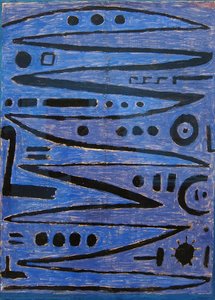
In the ethereal realm of Paul Klee’s “Arctic Dew,” the boundaries between reality and imagination dissolve into a luminous dance of color and rhythm. Created in 1920, this mesmerizing work serves as an invitation to a dreamscape where the frozen stillness of the North Pole meets the vibrant energy of the aurora borealis. Klee, a master of synthesizing diverse modern movements, does not merely depict a landscape; he orchestrates a visual symphony. The painting is anchored by rhythmic, undulating lines that bisect the canvas, creating a dynamic equilibrium between a celestial upper world and a tranquil, reflective lower expanse. It is a piece that captures the very essence of atmospheric serenity, making it an extraordinary focal point for any collection seeking to evoke wonder.
The brilliance of this masterpiece lies in its masterful manipulation of light and warmth. While the subject matter suggests an arctic vista, Klee eschews the traditional coldness of ice for a palette rich with ochre, sun-drenched yellows, soft pinks, and deep reds. These warm hues are harmoniously balanced by cooler whispers of blue and purple, creating a sense of depth that mimics the glowing layers of the Northern Lights. The technique involves a meticulous application of oil paint on canvas, where subtle layering produces an inner luminosity. This interplay of light suggests a world in flux—a moment of "thaw" where the suns above and their reflections below create a mirror-like dialogue between the heavens and the earth.
Symbolism and the Language of Abstraction
To gaze upon “Arctic Dew” is to engage with Klee’s profound philosophical approach to art. As a pivotal figure of the Bauhaus era, Klee viewed line and color as fundamental elements of a universal language. In this work, his signature blend of Expressionism, Cubism, and Surrealism allows him to move beyond mere representation. The simplified geometric shapes and flowing curves do not aim for topographical accuracy; instead, they symbolize the organic fluidity of nature. The presence of two suns—one radiant in the sky and its twin reflected in the melted ice below—speaks to themes of duality, reflection, and the cyclical nature of life and light.
For the discerning collector or interior designer, this painting offers more than just aesthetic beauty; it provides an emotional anchor. The composition’s flattened perspective and ambiguous depth invite the viewer to lose themselves in its rhythmic movement, evoking feelings of tranquility, purity, and a quiet, contemplative isolation. Whether placed in a contemporary gallery setting or as a sophisticated accent in a curated living space, a high-quality reproduction of “Arctic Dew” brings with it the spirit of 20th-century innovation and the timeless magic of an imagined, luminous world.
Questions & Answers
When was "Arctic Dew" made?
The creation of "Arctic Dew" by Paul Klee is dated 1920.
Which artist is "Arctic Dew" attributed to?
The artist behind "Arctic Dew" is Paul Klee. The work is catalogued under Paul Klee's name.
How can I get a print of "Arctic Dew" by Paul Klee?
"Arctic Dew" is available as a fine art print on cotton canvas or archival canvas paper. Orders are placed on its Fine Art Print page, in the size of your choice.
More about this painting
 Preview
 Send
Send Share
Share
 Details
 Guide
Guide

 Download
 Similars
 X-Ray
X-Ray Diaporama
 Q&A
Q&A Stats
Stats