

 Preview
 Send
Send Share
Share
 Details
 Guide
Guide

 Download
 Similars
 X-Ray
X-Ray Diaporama
 Stats
StatsBear Hunt
 Baroque
 1630
1630 205.0 x 345.0 cm
 Hermitage Museum
 Read More
The artwork displayed on this page is protected by copyright law, which means we cannot legally create or sell an identical reproduction. This protection is enforced under international agreements such as the Berne Convention and by national laws, including those outlined by the U.S. Copyright Law - Title 17.
This method fully complies with copyright regulations because it does not involve copying or duplicating the protected artwork. Instead, it is a creative reinterpretation - a new painting that is influenced by the original but not identical to it.
Giclée / Art Print
Museum-quality giclée or canvas print with fast production and flexible finish options. ( Buy Hand Made Painting Switch to Digital Image)




































Pick from our preset sizes that match the artwork's original proportions.

Type the width and the height you need, to fit your frame or your wall. A print can only be cut, never made bigger than the picture, so a size with a different shape loses a part of the image. We send you a digital mockup to approve before we print anything. The picture shown on this page does not show the real cut — only the mockup does.
Worldwide Delivery () in 2 weeks instead of standard 4/5 weeks. (28 October)

Free Worldwide Express Shipping

High-Quality Linen Canvas

Full Shipping Insurance

Customs Tax Refund Guarantee

True Color Matching Guarantee

100-Day Return Policy (Defects Only)

100% Money-Back Guarantee

Bulk Discount Offer
 Glass option is only available in size under 110 CM

Bear Hunt
Giclée / Art Print
Reproduction Size
-


Total Price
$ 81
Detailed Composition
The scene depicts a intense moment of action, with several dogs and a bear as the main subjects. The dogs are various breeds, all focused on the bear, which appears to be in a defensive posture. The background features a cloudy sky, adding to the dramatic effect of the scene. The use of light and shadow creates a sense of depth and realism, characteristic of Baroque art.The painting is rich in detail, from the fur textures of the animals to the expressions on their faces. This level of detail demonstrates the artist's commitment to creating a realistic and engaging scene.
Artistic Significance
Paul De Vos was known for his detailed animal paintings, and Bear Hunt is one of his most notable works. The painting's composition and subject matter suggest that it was likely commissioned for its narrative appeal or as a depiction of a historical event.For more information on Paul De Vos and his works, visit /art/list/?Filter=8Y3LQ4-Paul-De-Vos-Bear-Hunt. To explore other notable paintings at The Hermitage, including works by Michelangelo Buonarroti such as Crouching Boy, visit /art/list/?Filter=crouching+boy,crouching.
- Artist: Paul De Vos
- Painting Title: Bear Hunt
- Museum: The Hermitage
Questions & Answers
Is there a guide for "Bear Hunt" by Paul de Vos?
The guide to "Bear Hunt" is the artwork's Guide page - a printable factsheet showing the artwork with its caption, credit line and identity table (artist, dates, medium, original size, collection).
Can "Bear Hunt" by Paul de Vos, held at the Hermitage Museum, be legally reproduced?
The original "Bear Hunt" is at the Hermitage Museum, and the work is still protected by copyright.
What size is "Bear Hunt" by Paul de Vos in real life?
The original "Bear Hunt" by Paul de Vos measures 205 x 345 cm.
Artist Biography
The Master of the Flemish Wild: The Life and Legacy of Paul de Vos
In the golden age of the Flemish Baroque, where grand mythological dramas and sweeping portraits often commanded the halls of European nobility, a more intimate yet equally profound artistry was taking root. Paul de Vos emerged as a singular voice within this vibrant era, turning his gaze away from the heavens and toward the earth. While his contemporaries sought to immortalize gods and kings, De Vos found his muse in the raw, pulsing energy of the natural world. His canvases became windows into the wild, capturing the tension of the hunt and the quiet dignity of still life with a precision that commanded respect from the very masters who defined his age.
Born in Hulst, Netherlands, De Vos’s destiny was inextricably linked to the artistic heartbeat of Antwerp. Moving to this bustling metropolis as a young child, he was thrust into an environment where creativity was the city's primary currency. His formal education was a rigorous journey through the prestigious Guild of St. Luke, studying under masters such as Denijs van Hove, David Remeeus, and Eduard Snayers. This deep immersion in the Antwerp tradition provided him with more than just technical skill; it granted him entry into an elite circle of innovators. The influence of his brother-in-law, the legendary Frans Snyders, and the monumental presence of Peter Paul Rubens acted as both a foundation and a challenge, pushing De and Vos to refine a style that was uniquely his own.
A Symbiosis of Technique and Nature
The true brilliance of De Vos lies in his ability to marry the dramatic flair of the Baroque period with an almost scientific devotion to anatomical accuracy. His work is characterized by a remarkable sense of movement; one can almost hear the rustle of leaves or the sudden, sharp breath of a predator in mid-pursuit. Unlike the often overwhelming scale of Rubens’s compositions, De Vos mastered a more restrained yet equally impactful aesthetic. He utilized luminous colors—warm yellows and earthy ochres—to create an atmospheric depth that breathed life into his subjects.
His technical prowess was so highly regarded that he became a sought-after collaborator for the giants of his time. The historical record reveals a profound professional respect between De Vos and Peter Paul Rubens, with the latter famously entrusting De Vos with the execution of animal figures within larger, more complex compositions. This partnership allowed De Vos to contribute to some of the most significant works of the 17th century, blending his specialized talent for wildlife with the grand narrative structures of the Baroque masters. His ability to render the texture of fur, the glint in a predator's eye, and the delicate decay of a still life arrangement set him apart as a specialist of unparalleled skill.
Historical Significance and Artistic Endurance
The legacy of Paul de Vos extends far beyond the borders of 17th-century Flanders. He played a crucial role in elevating animal painting from mere decorative accompaniment to a respected genre of fine art. By focusing on the intrinsic beauty and drama of the natural world, he provided a different kind of spectacle—one that resonated with the burgeoning interest in natural history and the visceral reality of life and death.
Today, his contributions are recognized as a vital component of the Flemish Baroque tapestry. His work serves as a testament to the era's ability to find profound meaning in the smallest details of existence. Through his mastery of light, color, and motion, De Vos ensured that the creatures of the wild would forever hold a place of honor in the annals of art history. His paintings remain enduring studies in:
- Dynamic Composition: The use of tension and movement to guide the viewer's eye through hunting scenes.
- Anatomical Precision: A meticulous dedication to the realistic depiction of fauna.
- Atmospheric Mastery: The creation of depth and mood through a sophisticated palette of warm, natural tones.
- Collaborative Excellence: His role in shaping the visual language of the Antwerp school alongside Rubens and Van Dyck.

Paul de Vos
1916 - 2006 , Netherlands
Quick Facts
- Full Name: Paul de Vos
- Nationality: Flemish
- Date Of Birth: 1916
- Date Of Death: 2006
- Place Of Birth: Hulst, Netherlands
- Notable Artworks:
- Diana the Huntress
- Peacock and Cock Fighting
- Artistic Movement Or Style: Baroque
- Artists Who Influenced This Artist:
- Anthony van Dyck
- Peter Paul Rubens
- Artists Or Movements Influenced By This Artist: ['Rembrandt']
Related Articles
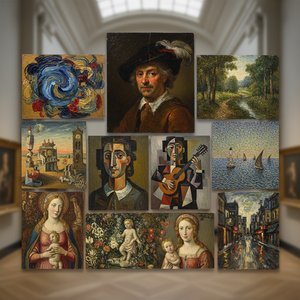
Oil on Board Masters: 10 Paintings That Redefined Art | OriginalUniqueArt
Explore 10 legendary 'Oil on Board' masterpieces by Van Gogh, Monet & more! Discover art history, iconic styles like Impressionism, and find museum-quality reproductions to elevate your home decor. Explore the full collection online at OriginalUniqueArt.com.

Goya's Masterpieces: Explore 25 Iconic Paintings & Art Prints | OriginalUniqueArt
Delve into the world of Francisco Goya with OriginalUniqueArt. Explore 25 iconic paintings – from 'The Third of May' to his haunting Black Paintings. Discover the stories, techniques & emotions behind these Spanish masterpieces. Find museum-quality art reproductions for your home at OriginalUniqueArt.com!

About Us
Discover our story! We bring world-class art into your life through expert curation, personalized creations, and free previews. Trusted by individuals and businesses since 2000.

Paul Klee's Masterpieces: Explore 25 Iconic Paintings & Prints | OriginalUniqueArt
Journey through Paul Klee's 25 most iconic paintings & prints. Explore his abstract style, Bauhaus influence, and vibrant color palettes. Find museum-quality art reproductions & decor ideas at OriginalUniqueArt.com. Discover all masterpieces online.

Cézanne's Masterpieces: 25 Iconic Artworks to Transform Your Space
Journey through 25 iconic artworks by Paul Cézanne – a master of Impressionism and Post-Impressionism. Explore his landscapes, still lifes, and the stories behind these timeless masterpieces. Discover museum-quality reproductions & curated decor at OriginalUniqueArt.com.


