Send
Send Share
Share
 Details
 Guide
Guide

 Download
 Similars
 Diaporama
 Stats
StatsLiverpool Skyladders
 Installation Art
- Installation
- Contemporary Installation
 2008
2008- Contemporary
 National Museums Liverpool
 Read More
The artwork displayed on this page is protected by copyright law, which means we cannot legally create or sell an identical reproduction. This protection is enforced under international agreements such as the Berne Convention and by national laws, including those outlined by the U.S. Copyright Law - Title 17.
As a respectful and legal alternative, we offer custom, hand-painted artworks inspired by the original. Our skilled and professional artists carefully study the original's style, mood, and artistic essence to create a new, unique piece that evokes the same feeling - while remaining an original creation in its own right.
This method fully complies with copyright regulations because it does not involve copying or duplicating the protected artwork. Instead, it is a creative reinterpretation - a new painting that is influenced by the original but not identical to it.
Hand Made Oil Reproduction
Hand-painted oil on canvas in your size and frame, made to order by our artists. ( Switch to Print Switch to Digital Image)




































Pick from our preset sizes that match the artwork's original proportions.

Type the width and the height you need, to fit your frame or your wall. This is hand-painted, so for a size with a different shape the artist can paint a bit more around the picture, or cut a bit — you choose. We send you a digital mockup to approve before the painting starts. The picture shown on this page does not show the real result — only the mockup does.
After order, OriginalUniqueArt.com team will email client for instructions and provide a mockup preview
Worldwide Delivery () in 3/4 weeks instead of standard 5 weeks. (24 October). No compromise on quality.

Free Worldwide Express Shipping

High-Quality Linen Canvas

Full Shipping Insurance

Customs Tax Refund Guarantee

True Color Matching Guarantee

100-Day Return Policy (Defects Only)

100% Money-Back Guarantee

Bulk Discount Offer
 Glass option is only available in size under 110 CM

Liverpool Skyladders
Reproduction Medium
Reproduction Size
-


Total Price
$ 300
A Monument to Collective Dreams: Unpacking Liverpool Skyladders
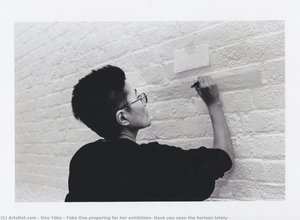
Yoko Ono’s Liverpool Skyladders isn't merely an installation; it’s a poignant and deeply layered meditation on participation, memory, and the yearning for connection. Created in 2008 for the Liverpool Biennial, this sprawling assemblage of ladders – donated by members of the public – transforms the bombed-out remains of St Luke’s Church into a space brimming with both chaotic abundance and quiet contemplation. The piece draws heavily from Ono's own artistic lineage, specifically her 1968 performance artwork, *SKY EVENT*, dedicated to John Lennon, a work that sought to elevate the viewer’s perspective, literally reaching for the sky. The church itself, scarred by wartime bombing, provides a powerful counterpoint; the ladders, symbols of upward mobility and aspiration, are placed within this ruin, suggesting a hopeful reconstruction – not just of physical space, but perhaps of collective memory and shared experience.
- Historical Context: The Biennial’s focus on “International 08” underscored the importance of global dialogue and community engagement. Liverpool, with its rich history as a port city and a site of significant social change, provided an ideal backdrop for Ono's invitation to contribute to the artwork.
- Fluxus Roots: The piece’s origins in *SKY EVENT* are crucial to understanding its ethos. Fluxus, the artistic movement Ono co-founded, championed ephemeral art, participatory experiences, and a rejection of traditional notions of authorship – all qualities vividly present in Liverpool Skyladders.
The Language of Ladders: Symbolism and Materiality
Each ladder within the installation carries its own story, inscribed with handwritten notes and messages from its donor—a testament to the deeply personal nature of Ono’s work. These individual narratives coalesce into a larger tapestry of human connection, reflecting on memories, hopes, and dreams. The sheer number of ladders – an overwhelming visual density – creates a sense of both claustrophobia and boundless possibility. The materials themselves are deliberately unassuming: primarily wood and metal, suggesting accessibility and universality. Yet, the varying sizes and conditions of the ladders—some weathered and worn, others gleaming with recent polish—add layers of texture and intrigue, hinting at the passage of time and the diverse backgrounds of those who contributed to the piece.
Technique & Composition: The arrangement is not meticulously planned; rather, it appears organically grown, mirroring Ono’s approach to artmaking. The ladders are supported by scaffolding, allowing for their precarious verticality and emphasizing their upward trajectory. The soft, diffused lighting within the church creates a contemplative atmosphere, highlighting the textures of the wood and metal while subtly obscuring details, inviting viewers to engage with the piece on an emotional level.A Reflection in the Light: Artistic Style & Emotional Impact
Liverpool Skyladders firmly resides within the realm of contemporary installation art. It’s a genre characterized by its embrace of unconventional materials and spaces, its focus on process over product, and its ability to evoke powerful emotional responses through sensory experience. The piece transcends mere visual spectacle; it invites viewers to become active participants in its creation—to consider their own place within the collective narrative represented by the ladders. The overall effect is one of poignant beauty – a celebration of human generosity, resilience, and the enduring power of dreams.
Beyond the Ruins: The Legacy of Sky Event
Ono’s intention with *Liverpool Skyladders* extends far beyond its physical manifestation within St Luke's Church. It is an echo of *SKY EVENT*, a performance piece designed to disrupt conventional perceptions of space and time, inviting participants to “reach for the sky.” The ladders themselves become symbolic extensions of this gesture—a tangible reminder that even in the face of destruction and loss, there remains the possibility of aspiration and renewal. The fact that the artwork was created through public donation further reinforces this message – a testament to the collective imagination and the enduring human desire to connect with something larger than oneself.
Questions & Answers
What feeling do the colors of "Liverpool Skyladders" by Ono Yōko create?
The neutrals palette of "Liverpool Skyladders" by Ono Yōko goes together with its reflective emotional tone. Color is one of the ways a work conveys feeling.
How intense are the colors in "Liverpool Skyladders" by Ono Yōko?
The color intensity of "Liverpool Skyladders" is balanced. Intensity describes how strong the colors appear.
What is the creation date of "Liverpool Skyladders" by Ono Yōko?
The creation of "Liverpool Skyladders" by Ono Yōko is dated 2008.
Artist Biography
A Life Interwoven with Art and Activism
Yoko Ono, born in Tokyo in 1933, is a figure whose artistic journey transcends easy categorization. Her upbringing within an aristocratic Japanese family provided a foundation of privilege, yet her life was dramatically reshaped by the upheaval of World War II, experiences that instilled a profound sensitivity to human suffering and a commitment to peace—themes that would become central to her art. From a young age, Ono demonstrated a natural inclination towards creative expression, initially through piano studies, but soon expanding into broader artistic explorations. The family’s relocation to New York City in 1952 proved pivotal, immersing her in the burgeoning avant-garde scene and setting the stage for a career that would challenge conventional notions of art itself. Her early education at Sarah Lawrence College provided intellectual grounding, yet it was the vibrant downtown art world that truly ignited her artistic spirit.Embracing the Avant-Garde: Fluxus and Conceptual Beginnings
Ono quickly found herself drawn to the radical experimentation of the 1960s New York art scene, becoming a key member of the Fluxus movement. This international collective sought to dismantle traditional artistic boundaries, embracing chance, performance, and everyday life as legitimate sources of creative inspiration. Influenced by composers like John Cage—whose embrace of silence and indeterminacy profoundly impacted her approach—and artists such as La Monte Young, Ono began developing a unique artistic vocabulary centered on conceptualism. Her early works weren’t paintings or sculptures in the traditional sense; they were *events*, *happenings*, and instructional pieces designed to provoke thought and engage the audience directly. These performances often defied categorization, prioritizing ideas over aesthetics and blurring the line between artist and spectator. A prime example is her series of “Instruction Paintings,” which presented simple directives for viewers to complete, transforming them from passive observers into active participants in the artwork’s creation. This emphasis on participation foreshadowed a key element that would define much of her later work.Expanding Artistic Boundaries: From Performance to Peace
Ono's artistic output is remarkably diverse, spanning conceptual art, performance art, music, filmmaking, and tireless peace activism. Her “instructional pieces,” most notably compiled in *Grapefruit* (1964), are perhaps her most iconic contribution to conceptual art. These poetic prompts—ranging from the whimsical (“Imagine a raindrop”) to the profound (“Think of something you want to change”)—invite audiences to actively engage their imaginations and complete the artwork within their own minds. Installations like “Liverpool Skyladders” demonstrate her commitment to public art, creating monumental structures that interact with urban spaces and invite contemplation. The "Wish Tree" series, where visitors write wishes on tags and tie them to branches, embodies themes of hope, collective intention, and a yearning for peace—a recurring motif throughout her career. This desire for global harmony became increasingly prominent following her relationship with John Lennon, beginning in 1966. Their marriage in 1969 was met with intense media scrutiny, but it also provided a powerful platform for their shared activism. Together, they staged iconic protests against the Vietnam War, including the famous “Bed-Ins for Peace,” and formed the Plastic Ono Band, releasing critically acclaimed albums like *Wedding Album* and *Double Fantasy*, which earned them a Grammy Award in 1980.A Lasting Legacy of Innovation and Advocacy
Following the tragic death of John Lennon in 1980, Yoko Ono dedicated herself to preserving his legacy through initiatives like Strawberry Fields in Central Park and the Imagine Peace Tower in Iceland—a beacon of hope erected as a tribute to peace. She continues to create art and advocate for causes close to her heart: peace, environmental sustainability, and human rights. Her pioneering work has profoundly influenced generations of artists across various disciplines, challenging conventional norms and expanding the possibilities of artistic expression. Ono’s emphasis on conceptualism, audience participation, and social engagement remains remarkably relevant in contemporary art practice. She is recognized not only as a groundbreaking artist but also as a courageous activist who used her platform to promote positive change, leaving an indelible mark on both the art world and the global landscape. Her work reminds us that art can be more than just something to look at; it can be a catalyst for dialogue, healing, and transformation. Yoko Ono’s influence continues to resonate today, inspiring artists and activists alike to envision a more peaceful and equitable world.
Ono Yōko
1933 - , Japan
Quick Facts
- Artistic Movement Or Style: Conceptual art, Fluxus
- Artists Or Movements Influenced By This Artist:
- Performance art
- Avant-garde music
- Artists Who Influenced This Artist:
- John Cage
- La Monte Young
- Date Of Birth: 1933
- Full Name: Yoko Ono
- Nationality: Japanese
- Notable Artworks:
- Grapefruit
- Liverpool Skyladders
- Wish Tree
- Hichiko Happo
- Place Of Birth: Tokyo, Japan
Related Articles

The Enduring Form: Exploring Themes & Techniques in Sculpture Across Historical Periods
Explore the rich history of sculpture from ancient masterpieces to contemporary innovations. Discover key techniques, influential artists & investment potential for discerning art collectors.

The Enduring Form: Sculpture Across History, Technique & Emotional Resonance
Explore the rich history of sculpture with OriginalUniqueArt. Discover key techniques, influential artists & investment potential for discerning collectors. Expert insights into valuing and collecting timeless masterpieces.
The Enduring Legacy of Bronze Sculpture: History, Techniques & Contemporary Interpretations
Explore the rich history & enduring appeal of bronze sculpture. Learn about casting techniques, iconic artists, collecting tips, & contemporary interpretations. Expert insights for discerning art collectors.

Bronze Sculptures That Defined Art History | OriginalUniqueArt
Journey through art history with our Top 10 bronze sculptures! Explore masterpieces by Rodin, Michelangelo & more. Discover stories behind iconic statues and find museum-quality reproductions for your home decor at OriginalUniqueArt.com.

Bronze Age to Modern Masters: 10 Sculptures That Redefined Art | OriginalUniqueArt
Journey through art history with 10 legendary bronze sculptures – from Michelangelo's David to Rodin’s Thinker. Explore the stories, techniques & timeless beauty of these masterpieces. Find museum-quality reproductions & elevate your home decor on OriginalUniqueArt.com.