Preview
 Send
Send Share
Share
 Details
 Guide
Guide

 Download
 Similars
 X-Ray
X-Ray Diaporama
 Stats
StatsFoxgloves
 Painting
- Neo-Romanticism
 1920
1920- Modern
 77.0 x 99.0 cm
 Bergen Kunstmuseum
 Read More
Hand Made Oil Reproduction
Hand-painted oil on canvas in your size and frame, made to order by our artists. ( Switch to Print Switch to Digital Image)




P118B $10

P118H $10

P118W $10

P438Z $10

P508JH $12

P508YH $12

P805H $10

P805Z $10

P919BZ $10

P919G $10

P919XJ $10

P959ZH $10

P968JZ $12

W106C $8

W218G $10

W218JH $8

W218Y $10

W307PJ $10

W316G $10

W316PJ $8

W316Y $10

W398PJ $8

W4111J $10

W500HY $15

W500JH $15

W692G $12

W849H $8

W940BG $15

W953PJ $8




Pick from our preset sizes that match the artwork's original proportions.

Type the width and the height you need, to fit your frame or your wall. This is hand-painted, so for a size with a different shape the artist can paint a bit more around the picture, or cut a bit — you choose. We send you a digital mockup to approve before the painting starts. The picture shown on this page does not show the real result — only the mockup does.
After order, OriginalUniqueArt.com team will email client for instructions and provide a mockup preview
Worldwide Delivery () in 3/4 weeks instead of standard 5 weeks. (21 October). No compromise on quality.

Free Worldwide Express Shipping

High-Quality Linen Canvas

Full Shipping Insurance

Customs Tax Refund Guarantee

True Color Matching Guarantee

100-Day Return Policy (Defects Only)

100% Money-Back Guarantee

Bulk Discount Offer
 Glass option is only available in size under 110 CM

Foxgloves
Reproduction Medium
Reproduction Size
-


Total Price
$ 300
A Symphony of Verdant Life
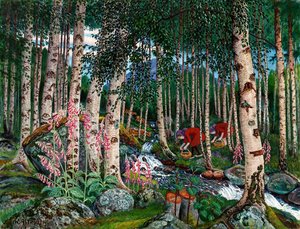
In the heart of the Norwegian landscape, where the mist clings to the valleys of Vestlandet, Nikolai Astrup captured a world that feels simultaneously grounded in reality and touched by magic. His 1920 masterpiece, Foxgloves, is far more than a mere botanical study; it is an immersive journey into a thriving, breathing ecosystem. The canvas unfolds as a lush forest sanctuary, where the dense canopy of healthy green leaves creates a cathedral of light and shadow. Within this verdant expanse, life moves in a quiet, rhythmic dance. A fox slips through the undergrowth, a silent observer of the scene, while a horse and dog add a sense of pastoral companionship to the wilder elements of the woods. The presence of people, scattered near the gentle flow of a passing river, suggests a harmonious coexistence between humanity and the untamed natural world.
The composition is anchored by the vibrant, bell-shaped blooms of the foxgloves themselves, which rise through the foliage like silent sentinels. There is an enchanting tension held within these flowers; while they possess an undeniable elegance and beauty, their inherent toxicity adds a layer of mysterious depth to the landscape. This duality—the marriage of the beautiful with the potent—is a hallmark of Astrup’s visionary approach, inviting the viewer to look closer at the subtle dangers and wonders hidden within the greenery.
The Mastery of Neo-Romantic Vision
Technically, Foxgloves exemplifies the unique style that Astrup developed away from the burgeoning movements of Cubism and Modernism. Instead of pursuing abstraction, he leaned into a form of magical realism, utilizing an intense and saturated color palette to elevate his surroundings. His technique breathes life into the textures of the bark, the translucency of the leaves, and the reflective surface of the river. The brushwork is deliberate yet fluid, capturing the "dark sunlight" that characterizes the Norwegian summer—a light that feels heavy with moisture and life.
For the discerning collector or interior designer, this piece offers a profound emotional resonance. It does not merely decorate a wall; it transforms a room into a portal to another time and place. The painting evokes a sense of nostalgia for a simpler, more connected era, making it an ideal centerpiece for spaces designed for contemplation, warmth, and organic elegance. Whether placed in a sunlit library or a contemporary living space, the deep greens and earthy tones of Foxgloves provide a grounding, restorative energy that celebrates the enduring spirit of the natural world.
Questions & Answers
Toward which tone does "Foxgloves" lean?
"Foxgloves" leans toward a green to violet spectrum tone.
What is "Foxgloves" about, and what atmosphere does it have?
"Foxgloves" by Nicolai Astrup combines foxgloves, forest scene, nature, landscape, animals, norway, flora with a natural atmosphere.
What stage of Nicolai Astrup's career does "Foxgloves" (1920) belong to?
The 1920 date places "Foxgloves" in the Mature Period of Nicolai Astrup's development.
Artist Biography
A Visionary of the Norwegian Wilds
Nikolai Astrup stands as a singular figure in Norwegian art history—a painter whose deeply felt connection to the landscapes and traditions of Vestlandet cemented his place among the most distinctive neo-romantic artists of his time. Born on August 30, 1880, in the coastal village of Kalvåg, within the rugged Bremanger region, Astrup’s early life was steeped in the atmospheric beauty of the fjords and mountains. As the eldest son of a parish priest, his upbringing was marked by a certain familial piety, yet his heart was irrevocably drawn to the vibrant, living pulse of the natural world. This profound connection to his ancestral roots would eventually propel him toward a style characterized by intense color palettes and an unwavering dedication to portraying the everyday life and folklore of rural Norway.
His journey toward artistic mastery was not a straight path but rather a soulful exploration of both tradition and modernity. While initial inclinations suggested a life in theological studies, Astrup’s passion for drawing led him away from the Trondheim Cathedral School and toward the burgeoning art scene in Kristiania (Oslo). It was here, under the influential tutelage of Harriet Backer, that he began to hone his technical skills. A brief but transformative stint in Paris further enriched his vision, exposing him to the avant-garde movements of the era and fostering connections with fellow artists like Christian Krohg. These encounters with Impressionistic techniques and a broader European perspective provided him with the tools to eventually weave tradition and innovation into a singular, cohesive artistic language.
The Soul of Jølster and the Magic of Realism
In 1902, Astrup made the pivotal decision to return to his childhood home in Jølster, settling on the property of Sandalstrand. This return was more than a homecoming; it was an immersion into a lifelong muse. Alongside his wife, Engel Sunde, he raised eight children amidst the demanding economic realities of rural life, yet this very hardship fueled his creative drive. He became a master of capturing the magical realism of the Norwegian landscape, where the lush greenery of summer and the stark, quiet solitude of winter were rendered with an almost supernatural intensity. His work often transcends mere representation, utilizing a vibrant, colorful palette to evoke the mystical atmosphere of the mountains and the seasonal shifts of the fjords.
Astrup’s technique was as much about emotion as it was about observation. He was a skilled printmaker and horticulturalist, qualities that informed his complex approach to composition. In his woodcuts and paintings, one can observe how he modified moods through subtle changes in color and the strategic addition or deletion of motifs. His oeuvre is celebrated for its ability to capture the sublime—that breathtaking intersection of beauty and awe. Whether depicting a serene winter scene like Mill Water or the hauntingly beautiful monochrome landscapes of Naked Trees, Astrup’s work invites the viewer into a world where the boundaries between the physical landscape and the spiritual realm are beautifully blurred.
Legacy of a National Visual Language
Beyond his individual canvases, Nikolai Astrup’s historical significance lies in his pioneering effort to capture a national visual language. He did not merely paint scenery; he documented the very essence of the Norwegian identity, celebrating the traditional way of life and the folklore that defined the region of Vestlandet. His ability to blend the local with the universal allowed his work to resonate far beyond the borders of Norway, even if he remained largely unknown to much of the international community during his lifetime. He remains a cornerstone of Norwegian modernism, an artist who found the infinite within the intimate.
The enduring impact of his life and work can be summarized through these defining elements:
- Artistic Innovation: The seamless integration of Impressionistic brushwork with Neo-Romantic themes.
- Cultural Preservation: A dedicated focus on the traditions, customs, and landscapes of the Jølster region.
- Technical Mastery: An extraordinary command over color and printmaking that allowed for deep emotional resonance.
- Ecological Connection: His life at Sandalstrand served as an early manifestation of a deep-seated respect for the natural environment and conservation.
Though his life was tragically short, ending in 1928 at the age of forty-seven, the legacy of Nikolai Astrup continues to flourish. His paintings remain vibrant windows into a lost era, offering a timeless glimpse into the heart of the Norwegian wilderness.
Nicolai Astrup
1880 - 1928
Quick Facts
- Artistic Movement Or Style: Neo-Romanticism
- Artists Or Movements Influenced By This Artist: ['Scandinavian Art']
- Artists Who Influenced This Artist: ['Christian Krohg']
- Date Of Birth: 1880
- Date Of Death: 1928
- Full Name: Nikolai Johannes Astrup
- Nationality: Norwegian
- Notable Artworks:
- The Eager Suitor
- Naked Trees
- Girl Spinning
- Place Of Birth: Bremanger, Norway
Related Articles

Magic Realism Explained: Navigating the Enigmatic Intersection of Reality and the Extraordinary
Explore the profound depths of Magic Realism. Discover how this captivating movement blends everyday reality with the extraordinary through an expert art-historical lens. Perfect for collectors and enthusiasts seeking to understand the masters of the enigmatic.

Romantic Realism's Finest: 10 Masterpieces for Your Home | OriginalUniqueArt
Explore 10 defining masterpieces of Romantic Realism! Discover Courbet, Millet & Daumier's powerful paintings—capturing emotion and social realities. Find museum-quality reproductions for your home at OriginalUniqueArt.com.
The Poetic Truth of Observation: Exploring 19th-Century Realism in Painting
Explore the captivating world of 19th-century Realism! Discover key artists like Courbet & Millet, masterpieces, and the powerful social commentary behind this influential art movement. Expert insights at OriginalUniqueArt.

Echoes of Society: Exploring Social Realism's Enduring Legacy in Art
Explore the powerful world of Social Realism art! Discover key artists, masterpieces & its profound social commentary. Expert insights into this influential movement's history and enduring legacy.
The Enigmatic Realm of Magic Realism: Exploring Subconscious Narratives & Reality's Edge
Explore the captivating world of Magic Realism! Discover its origins, key artists like García Márquez & Colunga Marín, and how it blends reality with the fantastical. Expert insights & high-quality art reproductions at OriginalUniqueArt.