

 Preview
 Send
Send Share
Share
 Details
 Guide
Guide

 Download
 Similars
 X-Ray
X-Ray Diaporama
 Stats
StatsConversation Booklet
 Acrylic On Canvas
- WallArt
- Contemporary Realism
 1818
1818 16.0 x 9.0 cm
 Beethoven-Haus Bonn
 Read More
Hand Made Oil Reproduction
Hand-painted oil on canvas in your size and frame, made to order by our artists. ( Switch to Print Switch to Digital Image)




P118B $10

P118H $10

P118W $10

P438Z $10

P508JH $12

P508YH $12

P805H $10

P805Z $10

P919BZ $10

P919G $10

P919XJ $10

P959ZH $10

P968JZ $12

W106C $8

W218G $10

W218JH $8

W218Y $10

W307PJ $10

W316G $10

W316PJ $8

W316Y $10

W398PJ $8

W4111J $10

W500HY $15

W500JH $15

W692G $12

W849H $8

W940BG $15

W953PJ $8




Pick from our preset sizes that match the artwork's original proportions.

You may enter your own dimensions to fit a specific frame or space. If your selected size does not match the original image's proportions, we will either crop the artwork or extend the painting with additional hand-painted elements. A digital mockup will be sent for your approval before production begins.
Please note that the on-screen preview does not reflect the actual cropping or extension. Only the mockup will accurately show the final composition.
While custom sizes are available, we recommend selecting a dimension from the predefined list to preserve the original proportions.
After order, OriginalUniqueArt.com team will email client for instructions and provide a mockup preview
Worldwide Delivery () in 3/4 weeks instead of standard 5 weeks. (10 October). No compromise on quality.

Free Worldwide Express Shipping

High-Quality Linen Canvas

Full Shipping Insurance

Customs Tax Refund Guarantee

True Color Matching Guarantee

100-Day Return Policy (Defects Only)

100% Money-Back Guarantee

Bulk Discount Offer
 Glass option is only available in size under 110 CM

Conversation Booklet
Reproduction Medium
Reproduction Size
-


Total Price
$ 300
A Window into the Soul: Unveiling Beethoven's Intimate Notebook
Imagine a world saturated with sound, yet rendered silent by an encroaching darkness. Ludwig van Beethoven, one of history’s most profound musical innovators, navigated this paradox with extraordinary resilience and unwavering creativity. The “Conversation Booklet” – a collection of meticulously handwritten notes spanning 1818-1824 – offers an unprecedented glimpse into the mind of this tormented genius, revealing not just his compositional process but also his deeply human struggles, anxieties, and moments of profound connection. More than simply a shopping list or a series of errands, these pages are fragments of a soul wrestling with deafness, loneliness, and the relentless pursuit of artistic expression.
Preserved within the Beethoven-Haus in Bonn, this unassuming volume – bound in simple brown leather – is a treasure trove for scholars and art enthusiasts alike. It’s a testament to Beethoven's meticulous nature, his constant need to organize and document his world, even as his auditory perception diminished. The notes themselves are written in German, often in a hurried, almost frantic script, reflecting the urgency of the tasks at hand – from ordering sugar and spices to sketching musical ideas and lamenting the state of his affairs. The pages aren’t pristine; they bear the marks of use: smudges, creases, and faint stains—evidence of a life lived intensely and documented with unwavering dedication.
Decoding the Language of Necessity
Beyond the mundane details – requests for walking sticks, mentions of chamber pots, and observations about local merchants – lie glimpses into Beethoven’s creative process. The booklet contains musical fragments, sketched melodies, and even brief analyses of his own compositions. One can trace the evolution of ideas as he scribbles down fleeting thoughts, often followed by a crossed-out notation or a decisive stroke indicating a change in direction. The notes reveal a man constantly experimenting, refining, and pushing the boundaries of musical form. Interestingly, many entries are punctuated with seemingly random observations – a description of a swimming belt from Verona, a reflection on the price of flour—suggesting that even in moments of intense creative focus, Beethoven remained acutely aware of his surroundings and the practicalities of daily life.
The booklet’s significance extends beyond its purely biographical value. It provides invaluable insight into the social and intellectual context of Beethoven's time. The references to contemporary events, musical trends, and personal relationships paint a vivid picture of Bonn in the early 19th century. Furthermore, it highlights the challenges faced by artists struggling with disabilities – Beethoven’s deafness forced him to rely on alternative methods of communication and documentation, shaping his approach to both music and life.
Symbolism and Emotional Resonance
The “Conversation Booklet” is not merely a record of transactions; it's imbued with profound symbolism. The act of writing itself becomes a form of self-expression, a way for Beethoven to grapple with his inner turmoil and external challenges. The meticulousness of the notes reflects his desire for control in a world increasingly dominated by chaos and uncertainty. The seemingly random observations—the swimming belt, the price of flour—can be interpreted as metaphors for the complexities of human existence: fleeting pleasures, mundane necessities, and the constant struggle to find meaning amidst the everyday.
The emotional impact of this document is undeniable. It offers a rare opportunity to connect with Beethoven on a deeply personal level, witnessing his vulnerability, his frustrations, and his unwavering determination. It’s a poignant reminder that even the greatest geniuses are ultimately human beings grappling with their own limitations and seeking solace in the pursuit of beauty.
A Reproduction for Reflection
Reproductions of Beethoven's “Conversation Booklet” offer a unique opportunity to bring this extraordinary document into your home or studio. Each carefully crafted print captures the texture, imperfections, and handwritten details of the original, allowing you to experience the intimacy and emotional resonance of this remarkable artifact. Whether displayed as a statement piece in a study or incorporated into an interior design scheme, this reproduction serves as a constant reminder of Beethoven’s extraordinary life and enduring legacy—a testament to the power of creativity, resilience, and the human spirit.
Questions & Answers
Which artist is "Conversation Booklet" attributed to?
"Conversation Booklet" is attributed to Ludwig Van Beethoven.
What underlying hue runs through "Conversation Booklet" by Ludwig Van Beethoven?
"Conversation Booklet" leans toward a green to violet spectrum tone.
What size should I print "Conversation Booklet" for my room?
In a living room, "Conversation Booklet" is suggested at a large print size.
What is the creation date of "Conversation Booklet" by Ludwig Van Beethoven?
"Conversation Booklet" by Ludwig Van Beethoven was created in 1818.
Which room is "Conversation Booklet" by Ludwig Van Beethoven recommended for, given its colors?
With its neutrals palette, "Conversation Booklet" by Ludwig Van Beethoven is recommended for a living room. The colors are part of the reason for this suggestion.
At what age did Ludwig Van Beethoven make "Conversation Booklet"?
Ludwig Van Beethoven made "Conversation Booklet" at the age of 48. The artist was born in 1770 and the work is dated 1818.
How can "Conversation Booklet" by Ludwig Van Beethoven be used in home decor?
"Conversation Booklet" by Ludwig Van Beethoven is recommended for reflective, ideally in a living room. Use and space together guide where a reproduction fits.
Artist Biography
early life and musical beginnings
ludwig van beethoven, a renowned german composer and pianist, was born in bonn, germany, in 1770. displaying his musical talent at a young age, he began studying music under various teachers before moving to vienna, where he would spend most of his life.- sonata for piano and violoncello (a major) op. 69, 1st movement (available at OriginalUniqueArt.com)
- beethoven's manuscript of the missa solemnis (viewable at wikipedia)
- three opus 1 piano sonatas, patronized by karl alois, prince lichnowsky

Ludwig Van Beethoven
1770 - 1827 , Germany
Quick Facts
- Full Name: Ludwig van Beethoven
- Nationality: German
- Date Of Birth: 1770
- Date Of Death: 1827
- Place Of Birth: Bonn, Germany
- Notable Artworks:
- Moonlight Sonata
- Symphony No 9
- Artistic Movement Or Style: Classical Romantic
- Artists Who Influenced This Artist:
- Franz Joseph Haydn
- Christian Gottlob Schulze
- Artists Or Movements Influenced By This Artist:
- Johannes Brahms
- Robert Schumann
Related Articles
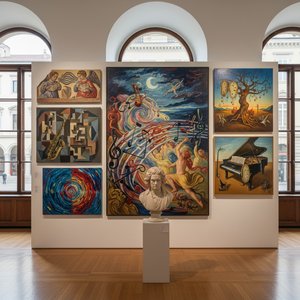
Harmonies on Canvas: Exploring the Visual Representation of Music in Art History
Explore the fascinating history of music's visual representation in art! From ancient symbolism to modern abstraction, discover how artists have captured sound and emotion on canvas. Expert insights & stunning examples.

Anton von Werner: Imperial Painter, Historical Witness & Shifting German Identity
Explore the life & work of Anton von Werner, Imperial Germany's leading painter. Discover his dramatic depictions of war, unification, and court life – a fascinating insight into 19th-century German history & art.

German Expressionism's 10 Defining Masterpieces | Art for Your Home
Explore 10 defining German Expressionism masterpieces – from Munch's 'The Scream' to Kandinsky’s abstracts. Discover the artists, stories & bold colors behind this powerful art movement. Find museum-quality reproductions at OriginalUniqueArt.com.
The Northern Awakening: Artistic Innovation & Cultural Transformation in the German Renaissance
Explore the artistic innovation of the German Renaissance! Discover Dürer, the Danube School & Reformation art. Learn about techniques, materials & lasting influence. Find museum-quality reproductions at OriginalUniqueArt.
Neue Sachlichkeit: The Unflinching Realism and Social Critique of German New Objectivity
Explore the raw realism of Neue Sachlichkeit. Discover how German New Objectivity artists like Otto Dix and George Grosz captured the turbulent Weimar Republic through unflinching social critique and precise detail. A definitive guide for art historians and collectors.


