Baroque
St. Peter (Jusepe de Ribera)
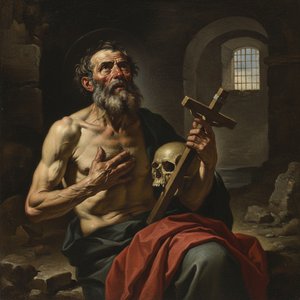
Jusepe de Ribera (1591–1652) made St. Peter. It belongs to the Baroque movement. It is made in oil on canvas. It is kept at Museo del Prado in Madrid, Spain.
- Oil On Canvas
- Museo del Prado, Madrid

 Preview

 Hand Made Oil Painting
 Send
 Share
 Fact sheet


 Download
 Similars
 X-Ray
 Diaporama
 Q&A

 Stats
St. Peter, in brief
- Title
- St. Peter
- Artist
- Jusepe de Ribera (1591–1652)
- Artist born in
- Xàtiva, Spain
- Medium
- Oil On Canvas
- Where to see it
- Museo del Prado, Madrid, Spain
- Movement
- Baroque
- Period
- Early Modern
- Subject
- man, beard, book, keys, cloak, brown
What does St. Peter depict?
The Portrait of St. Peter by Jusepe de Ribera
In this oil painting on canvas, Jusepe de Ribera presents us with a portrait of St. Peter. The subject, a central figure among the apostles of Jesus and recognized as the first Pope, is rendered with a profound sense of presence. Ribera focuses on the man himself, capturing the weight of his role and the character of his lived experience. There is a quiet intensity in the way the figure is presented, inviting a closer look at the weathered details of his countenance.
The work is a significant example of the Baroque style. Through this approach, the artist emphasizes the spiritual and human dimensions of the apostle. The depiction avoids idealization, opting instead for a directness that feels immediate. By focusing on the specific attributes of the saint, Ribera allows the subject to command the space, presenting a figure that is both a religious icon and a man of flesh and bone.
Composition and Visual Elements of the Portrait
The composition is built upon a stable pyramidal structure, with the head of St. Peter forming the apex of the form. He is presented from the waist up, his body turned slightly toward the viewer's left. In his right hand, he holds a book and a set of keys, objects that anchor the figure within the frame. This arrangement directs the eye upward toward his weathered features, creating a sense of quiet, grounded presence.
A strong light source enters from the left, illuminating his face and upper body while casting the rest of the figure into deep shadow. This light creates a sharp contrast against a background that is nearly black, pushing the subject forward into the viewer's space. The color palette is restrained, dominated by warm earth tones—ochre, brown, and gold—which emphasize the textures of his skin and the heavy folds of his clothing.
Technique and Artistic Style of the Work
The work is defined by a profound use of tenebrism, where the subject emerges from a nearly black background into a sharp, focused light. This dramatic chiaroscuro creates a sense of volume, pulling the figure forward and emphasizing the physical presence of the man. Such a heavy interplay of light and shadow reflects the influence of Caravaggio, grounding the religious subject in a palpable, earthly reality. The light source, positioned to the left, carves out the contours of the face and the weathered texture of the skin, casting deep shadows that heighten the emotional weight of the portrait.
Ribera’s approach to the medium is tactile and deliberate. He employs a technique of layering paint to build up depth, allowing the viewer to sense the physical weight of the drapery and the coarse nature of the beard. Visible brushstrokes are not hidden; instead, they contribute to the overall effect, lending a sense of immediacy to the rendering of the fabric and the aged features. Strong, defined lines delineate the eyes, nose, and mouth, providing a structural clarity that balances the more fluid, organic shapes of the figure. The result is a composition that feels both intensely personal and physically substantial.
Other Works by Jusepe de Ribera
The artist's exploration of this particular subject matter is reflected in several other significant pieces within our collection and major institutions. We hold St. Simeon 1 in our catalog, a work that speaks to the same profound human experience found in this portrait. Another notable piece in our collection is The Repentance of Saint Peter, which is currently housed in the Museum of Fine Arts, Lyon.
Beyond our own holdings, Ribera's preoccupation with the themes of remorse and spiritual weight is evident in other historical examples. The work known as Penitent St. Peter, dated about 1630, is held at the Kunsthistorisches Museum in Vienna. This piece shares a similar intensity in its depiction of the apostle's character. Additionally, The Tears of Saint Peter, which dates to 1612, is part of the collection at the Metropolitan Museum of Art in New York. These works collectively illustrate the artist's ability to capture the complexities of faith and the physical reality of the human condition through his characteristic use of light and shadow.
Which museum holds St. Peter?
Museo del Prado
Madrid, Spain
The History of Museo del Prado The origins of the Museo del Prado are tied to the Royal Collection of Spain, tracing back to the 18th century. What began as a vision for a Natural History Cabinet under Ferdinand VII eventually shifted toward a dedicated sanctuary for painting and sculpture. This transition transformed a scientific endeavor into a repository for the Spanish Crown's most significant treasures.


High-resolution images of St. Peter
Jusepe de Ribera, St. Peter, Museo del Prado. Public domain.
Questions on St. Peter, answered
Where is "St. Peter" by Jusepe de Ribera on display today?
The original "St. Peter" by Jusepe de Ribera is held at the Museo del Prado, Madrid, Spain. A reproduction allows the work to be displayed at home.
What is "St. Peter" made with?
"St. Peter" is executed in oil on canvas.
What subjects appear in "St. Peter" by Jusepe de Ribera?
The themes present in "St. Peter" by Jusepe de Ribera include man, beard, book, keys, cloak, brown, gold, skin. Together they summarize the artwork's subject matter.
Is "St. Peter" by Jusepe de Ribera in the public domain?
The copyright answer for "St. Peter" by Jusepe de Ribera: the work is in the public domain - its copyright has expired. This determines whether reproductions of the image may be freely made.
Who created "St. Peter"?
"St. Peter" was created by Jusepe de Ribera. The information on this page describes Jusepe de Ribera's original work.
Which artistic current is "St. Peter" by Jusepe de Ribera part of?
"St. Peter" by Jusepe de Ribera belongs to the Baroque movement. This movement provides the stylistic context of the work.
What stage of Jusepe de Ribera's development does "St. Peter" represent?
Within Jusepe de Ribera's career, "St. Peter" falls in the Mature Period. The phase helps compare it with the artist's other works.
What explains the copyright situation of "St. Peter" by Jusepe de Ribera?
The copyright status of "St. Peter" - in the public domain - its copyright has expired - follows from the artist's death in 1652.
Did "St. Peter" stay in its artist's homeland?
Yes - the artwork is kept in the artist's home country. "St. Peter" is held in Spain, while Jusepe de Ribera was born in Spain.
About the artist, Jusepe de Ribera

1591–1652, Spain
Jusepe de Ribera
A Life Forged in Shadow and Light Jusepe de Ribera, known to many as Lo Spagnoletto – “the Little Spaniard” – was a towering figure of the Baroque era, an artist whose canvases pulsed with dramatic intensity and unflinching realism. Born in Xàtiva, Spain, in 1591, his journey took him far from his Valencian origins, ultimately establishing him as one of the most significant painters in 17th-century Naples, a city then under Spanish rule. Ribera’s life was not merely a chronicle of artistic development; it was a narrative woven with hardship, ambition, and an unwavering commitment to portraying the human condition in all its raw complexity. While early biographical details remain shrouded in some mystery, we know he arrived in Italy around 1607, initially settling in Rome before gravitating towards Naples in 1616 – a city that would become both his artistic home and the crucible for his unique style.
Also by Jusepe de Ribera
 Magdalena Ventura with Her Husband and Son1631
 The Clubfoot
 St. Onuphrius1637
 The Duel of Women (The Duel of Isabella de Carazzi and Diambra de Pettinella)1636
Essays around St. Peter
 Mastering the Shadows: The Dramatic Power of Chiaroscuro and Tenebrism in Baroque Fine ArtExplore the profound drama of chiaroscuro and tenebrism. Discover how masters like Caravaggio used light and shadow to sculpt emotion and v…
 Masterpieces of Light: The Top 25 Artworks by Duccio di BuoninsegnaJourney through the divine elegance of Duccio di Buoninsegna. Explore 25 iconic Sienese masterpieces, from the Maestà to the Rucellai Madon…
 Jusepe de Ribera: Dramatic Realism & Spiritual Intensity in the Spanish Golden AgeExplore the powerful Baroque paintings of Jusepe de Ribera, master of tenebrism and dramatic realism. Discover his spiritual intensity, inf…