Preview
 Send
Send Share
Share
 Details
 Guide
Guide

 Download
 Similars
 X-Ray
X-Ray Diaporama
 Stats
StatsOdalisque


 Read More
Giclée / Art Print
Museum-quality giclée or canvas print with fast production and flexible finish options. ( Buy Hand Made Painting Switch to Digital Image)




P118B $10

P118H $10

P118W $10

P438Z $10

P508JH $12

P508YH $12

P805H $10

P805Z $10

P919BZ $10

P919G $10

P919XJ $10

P959ZH $10

P968JZ $12

W106C $8

W218G $10

W218JH $8

W218Y $10

W307PJ $10

W316G $10

W316PJ $8

W316Y $10

W398PJ $8

W4111J $10

W500HY $15

W500JH $15

W692G $12

W849H $8

W940BG $15

W953PJ $8




Pick from our preset sizes that match the artwork's original proportions.

Type the width and the height you need, to fit your frame or your wall. A print can only be cut, never made bigger than the picture, so a size with a different shape loses a part of the image. We send you a digital mockup to approve before we print anything. The picture shown on this page does not show the real cut — only the mockup does.
Worldwide Delivery () in 2 weeks instead of standard 4/5 weeks. (22 October)

Free Worldwide Express Shipping

High-Quality Linen Canvas

Full Shipping Insurance

Customs Tax Refund Guarantee

True Color Matching Guarantee

100-Day Return Policy (Defects Only)

100% Money-Back Guarantee

Bulk Discount Offer
 Glass option is only available in size under 110 CM

Odalisque
Giclée / Art Print
Reproduction Size
-


Total Price
$ 81
A Vision of Exotic Beauty: The Allure of Lefebvre’s Odalisque
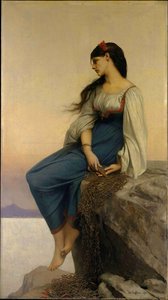
In the quiet, amber-hued sanctuary of Jules Joseph Lefebvre’s 1874 masterpiece, Odalisque, time seems to suspend itself in a moment of eternal repose. This evocative painting serves as a profound emblem of Impressionistic idealism and a cornerstone of academic excellence during the Belle Époque. At first glance, the viewer is drawn into an intimate, dimly lit interior where a nude woman reclines gracefully upon a bed draped in opulent, crimson fabrics. The scene is far more than a mere study of the human form; it is a deliberate sensory journey. Through the strategic placement of scattered oranges and the warm, glowing light that dances across the skin, Lefebvre invites us into a world of Middle Eastern-inspired aesthetics, where every texture—from the soft sheen of silk to the matte skin of ripe fruit—whispers of luxury and exoticism.
Lefebvre’s technical mastery is most evident in his sophisticated use of chiaroscuro. By orchestrating a dramatic interplay between deep shadows and luminous highlights, he sculpts the woman’s silhouette with a three-dimensional vitality that feels almost tactile. The color palette is a masterclass in warmth; the orange and gold tones of the room create an atmosphere of sultry comfort, while the vibrant red of the sheets provides a passionate focal point. This meticulous attention to detail—the way light catches the curve of a shoulder or reflects off a glass bottle—demonstrates a technique that bridges the gap between the rigorous precision of Academicism and the soft, sensory exploration found in Impressionism.
Historical Resonance and the Art of Elegance
To understand Odalisque is to understand the cultural heartbeat of late nineteenth-century France. During this era, there was a profound fascination with Orientalism—a romanticized, often dreamlike perception of the East. Lefebvre, a student of the esteemed Léon Cogniet and a winner of the prestigious Prix de Rome, utilized these themes to create works that were both intellectually grounded in classical tradition and emotionally resonant with the contemporary desire for escapism. Unlike the stark realism that dominated much of the period, Lefebvre’s approach was one of refined elegance. He sought not just to document a figure, but to idealize it, capturing a sense of ethereal grace that elevates the subject from a mere person to a symbol of timeless beauty.
For the discerning collector or interior designer, this painting offers more than just visual splendor; it provides an emotional anchor for a space. The painting’s ability to evoke feelings of serenity, warmth, and quiet contemplation makes it a versatile centerpiece for high-end decor. Whether placed in a sunlit gallery or a moody, sophisticated study, a high-quality reproduction of Odalisque brings with it the prestige of the Belle Époque. It is an invitation to slow down, to appreciate the subtle gradations of light, and to lose oneself in the enduring mystery of Lefebvre’s vision—a piece that continues to captivate the soul long after the first glance.
Questions & Answers
What subjects appear in "Odalisque" by Jules Joseph Lefebvre?
"Odalisque" by Jules Joseph Lefebvre depicts: nude figure, orientalism, interior scene, luxury goods, romantic art, female portrait, classical composition.
How can "Odalisque" by Jules Joseph Lefebvre be used in home decor?
"Odalisque" by Jules Joseph Lefebvre is recommended for accent, ideally in a living room. Use and space together guide where a reproduction fits.
What is a reproduction of "Odalisque" by Jules Joseph Lefebvre recommended for?
A reproduction of "Odalisque" by Jules Joseph Lefebvre is recommended for accent. This suggestion follows from the work's subject, mood and colors.
Artist Biography
The Master of Academic Elegance
Jules Joseph Lefebvre stands as a luminous figure in the history of nineteenth-century French art, a painter whose brush possessed the rare ability to capture both the physical perfection of the human form and a profound sense of ethereal grace. Born in Tournai in 1834, Lefebvre’s journey was one of disciplined mastery and artistic devotion. Moving to Paris at the young age of sixteen, he immersed himself in the rigorous atmosphere of the École nationale supérieure desBeaux-Arts. Under the guidance of the esteemed Léon Cogniet, Lefebvre did not merely learn technique; he inherited a tradition of classical excellence that would define his entire oeuvre. His early triumphs, most notably winning the prestigious Prix de Rome in 1861, signaled the arrival of an artist destined to become a cornerstone of the academic movement.
The essence of Lefebvre’s work lies in what critics often call "academic elegance." He possessed an unparalleled skill for rendering the female figure, treating the skin with a luminous quality that seemed to glow from within. His compositions were rarely about mere provocation; instead, they sought to elevate the subject through soft light and a delicate, harmonious color palette. In masterpieces such as Chloé, one can observe how he blends classical poise with an atmospheric connection to nature, creating a sense of timelessness that transcends the era in which it was painted. Whether depicting mythological figures or contemporary portraits, his work maintains a consistent reverence for beauty and a meticulous attention to the subtle textures of fabric and flesh.
A Legacy of Influence and Instruction
Beyond his individual canvases, Lefebvre’s historical significance is deeply rooted in his role as an educator and mentor. His studio became a crucible for the next generation of great painters, bridging the gap between traditional French academicism and the emerging movements of the late nineteenth century. His influence stretched far across borders, shaping the hands and eyes of students who would go on to define American Impressionism and European modernism. Among his most notable pupils were:
- Fernand Khnopff, whose Symbolist explorations carry echoes of Lefebvre’s atmospheric sensitivity;
- Edmund C. Tarbell, a key figure in the Boston School;
- Félix Vallotton, who would later push the boundaries of graphic art and composition;
- Kenyon Cox, who carried the torch of classical figurative excellence to the United States.
This pedagogical legacy ensured that while styles shifted toward Impressionism and beyond, the foundational principles of draftsmanship and light—the very pillars of Lefebvre’s own practice—remained vital. His prolific presence at the Paris Salon, with seventy-two works exhibited between 1855 and 1898, solidified his status as a pillar of the art establishment. Through works like the evocative Lady Godiva and the dignified Portrait of James A. Campbell, Lefebvre captured the spirit of an age, leaving behind a body of work that continues to enchant viewers with its sophisticated blend of realism, romanticism, and unparalleled technical virtuosity.

Jules Joseph Lefebvre
1834 - 1912 , France
Quick Facts
- Full Name: Jules Joseph Lefebvre
- Nationality: French
- Date Of Birth: 1834
- Date Of Death: 1912
- Place Of Birth: Tournai, France
- Notable Artworks:
- Lady Godiva
- Portrait of James A. Campbell
- La Cigale
- Artistic Movement Or Style: Academic Art
- Artists Who Influenced This Artist: ['Léon Cogniet']
- Artists Or Movements Influenced By This Artist: ['Romanticism']
Related Articles
Academic Realism's Finest: 10 Masterpieces for Art Lovers & Home Decor
Explore 10 defining Academic Realism masterpieces by Bouguereau, Gérôme & Cabanel. Discover the stories behind these iconic paintings and bring timeless art into your home with museum-quality reproductions from OriginalUniqueArt.com. Explore the full collection online!

Romantic Realism's Finest: 10 Masterpieces for Your Home | OriginalUniqueArt
Explore 10 defining masterpieces of Romantic Realism! Discover Courbet, Millet & Daumier's powerful paintings—capturing emotion and social realities. Find museum-quality reproductions for your home at OriginalUniqueArt.com.

Jules Lefebvre: Master of Academic Realism & the Pursuit of Belle Âme
Explore the captivating figure paintings of Jules Lefebvre (1836-1911), a renowned French academic artist and educator. Discover his masterpieces, signature style, and lasting influence on art history. Shop high-quality reproductions at OriginalUniqueArt.

Academic Realism: Technique, History & Enduring Influence on Art
Explore the captivating world of Academic Realism! Discover key artists, techniques & its lasting impact on art history. Expert insights & high-quality reproductions at OriginalUniqueArt.

The Beauty of Perfection: A Journey Through the Rigor and Radiance of Academic Realism
Explore the profound elegance of Academic Realism. Discover how meticulous observation, anatomical precision, and the pursuit of ideal beauty created a timeless legacy of technical mastery and emotional depth in the world's most revered art academies.