 Preview
 Send
Send Share
Share
 Details
 Guide
Guide

 Download
 Similars
 X-Ray
X-Ray Diaporama
 Stats
StatsHunters Infantry

 Read More
Giclée / Art Print
Museum-quality giclée or canvas print with fast production and flexible finish options. ( Buy Hand Made Painting Switch to Digital Image)




































Pick from our preset sizes that match the artwork's original proportions.

Type the width and the height you need, to fit your frame or your wall. A print can only be cut, never made bigger than the picture, so a size with a different shape loses a part of the image. We send you a digital mockup to approve before we print anything. The picture shown on this page does not show the real cut — only the mockup does.
Worldwide Delivery () in 2 weeks instead of standard 4/5 weeks. (26 October)

Free Worldwide Express Shipping

High-Quality Linen Canvas

Full Shipping Insurance

Customs Tax Refund Guarantee

True Color Matching Guarantee

100-Day Return Policy (Defects Only)

100% Money-Back Guarantee

Bulk Discount Offer
 Glass option is only available in size under 110 CM

Hunters Infantry
Giclée / Art Print
Reproduction Size
-


Total Price
$ 81
A Glimpse into 19th-Century Military Life: "Hunters Infantry" by Josep Cusachs i
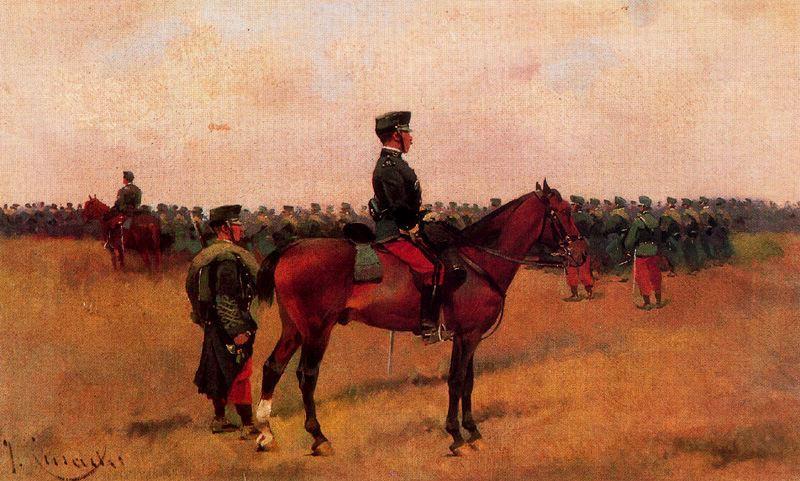
This captivating artwork, “Hunters Infantry” by Josep Cusachs i (1851-1908), offers a poignant window into the world of 19th-century military life. The painting depicts an inspection or parade scene featuring infantry and cavalry personnel, rendered with a distinctive softened realism that evokes both formality and quiet contemplation. Cusachs i, known for his depictions of military subjects and royal portraits, masterfully captures a moment suspended in time, inviting viewers to reflect on the discipline, duty, and perhaps even the nostalgia associated with this era. The muted color palette and hazy atmosphere contribute significantly to the painting's overall mood, creating an impressionistic quality that transcends mere representation.Style & Technique: Softened Realism and Atmospheric Perspective
The style of “Hunters Infantry” is best described as representational with a softened realism. Cusachs i avoids sharp details and photographic precision, instead prioritizing the overall *impression* of the scene. Oil paints on canvas were likely used to achieve this effect, with visible brushstrokes subtly blended to create a smooth surface. The artist’s skillful use of atmospheric perspective – blurring distant objects to suggest depth – further enhances the hazy, dreamlike quality of the work. Lines are soft and blurred rather than sharply defined, contributing to the overall sense of quietude. Notice how the shapes are organic and flowing, particularly in the depiction of the horse and landscape, contrasting with the simplified forms used for the soldiers.Historical Context & Symbolism
Created during a period marked by significant military advancements and shifting political landscapes in Europe, “Hunters Infantry” likely reflects the societal importance placed on armed forces and national identity. The painting’s subdued tones and lack of overt drama suggest a more introspective view of military life than some contemporary depictions. The central figure – the soldier on horseback – embodies authority and control, while the receding figures in the background symbolize the vastness of the military structure and the collective duty it represents. While specific symbolic elements are not overtly stated, the overall composition evokes feelings of formality, discipline, and a sense of quiet reverence for those who served. The pale pinkish-beige sky adds to this feeling of nostalgia and perhaps even melancholy.Emotional Impact & Artistic Legacy
“Hunters Infantry” is more than just a depiction of military personnel; it's an exploration of human experience within a structured environment. The painting’s muted colors, soft lines, and diffused lighting create a contemplative atmosphere that encourages viewers to pause and reflect on the themes of duty, honor, and perhaps even loss. Cusachs i’s work, alongside artists like José Cusachs y Cusachs and Josep Tapiró Baró, contributed significantly to the portrayal of military life in 19th-century Spanish art. Owning a hand-painted reproduction of “Hunters Infantry” allows you to bring this evocative scene into your home or office, adding a touch of historical elegance and artistic depth to any space.Questions & Answers
How does "Hunters Infantry" by Josep Cusachs i connect Realism to the artist's home country?
"Hunters Infantry" was created by Josep Cusachs i, born in France, within the Realism movement. The artist's origin links the work to Realism as practiced by artists from France.
Which artistic current is "Hunters Infantry" by Josep Cusachs i part of?
"Hunters Infantry" is a work of Realism. The movement indicates the artistic tradition the work is part of.
How strong are the colors of "Hunters Infantry"?
The color of "Hunters Infantry" is clear color presence in saturation and vivid in intensity.
Artist Biography
Josep Cusachs i: A Pioneer of Cavalry Art and Royal Portraiture
Josep Cusachs i (1851 – 1908) stands as a significant figure in late nineteenth-century Spanish art, particularly renowned for his captivating depictions of cavalry scenes and meticulously crafted royal portraits. Born in Montpellier, France, Cusachs’s artistic journey began amidst the burgeoning Impressionist movement but swiftly established him as a staunch defender of Realism, forging a distinctive style that blended observation with emotional depth. His unwavering commitment to capturing the essence of his subjects—often military officers and members of the Spanish aristocracy—secured his place in art history.- Early Life & Artistic Training:
- Influences: Impressionism vs. Realism
- Notable Paintings & Techniques:
- Royal Patronage and Legacy:
- Historical Significance: Reflecting the Era’s Spirit
Early Life & Artistic Training
Cusachs’s formative years were spent in Montpellier, where he received a comprehensive artistic education. While Impressionism exerted considerable influence on European art circles at the time—characterized by fleeting light and vibrant color palettes—Cusachs resolutely rejected this trend. Instead, he embraced Realism, prioritizing accurate representation of form and texture as championed by artists like Gustave Courbet and Jean-François Millet. This decision wasn’t merely stylistic; it reflected a broader philosophical stance rooted in documenting the realities of everyday life and portraying individuals with honesty and nuance.Influences: Impressionism vs. Realism
Despite his rejection of Impressionistic ideals, Cusachs's artistic sensibilities were undeniably shaped by the movement’s pioneering spirit. The exploration of light and color—albeit tempered by a grounding in observation—found its way into his compositions. However, it was Courbet’s unflinching realism that truly solidified Cusachs’s approach. Courbet’s insistence on depicting subjects without idealization served as an inspiration for Cusachs's dedication to portraying figures with psychological complexity and capturing the palpable atmosphere of his scenes. This duality—embracing Impressionistic techniques while adhering to Realist principles—became a hallmark of Cusachs’s oeuvre.Notable Paintings & Techniques
Cusachs’s artistic prowess shone through in numerous paintings that exemplify his mastery of technique and unwavering attention to detail. His depictions of cavalry regiments, meticulously rendered with painstaking accuracy, are particularly noteworthy. He skillfully employed chiaroscuro—the dramatic interplay of light and shadow—to sculpt figures and convey a sense of dynamism and grandeur. Furthermore, Cusachs excelled at capturing the subtleties of human emotion through expressive brushstrokes and nuanced color choices. Pieces like “Portrait of the daughter of cusachs” demonstrate his ability to infuse paintings with an emotional resonance that transcends mere visual representation.Royal Patronage and Legacy
Cusachs enjoyed considerable acclaim during his lifetime, securing commissions from prominent members of the Spanish royal family. These portraits—characterized by their dignified poses and subtle psychological insight—became treasured additions to royal collections and cemented Cusachs’s reputation as a portrait artist of distinction. His work reflects the spirit of the era—a period marked by aristocratic grandeur and artistic ambition—providing valuable insights into the cultural landscape of Spain at the turn of the century.Historical Significance: Reflecting the Era’s Spirit
Josep Cusachs i's contribution to Spanish art extends beyond his individual achievements; he embodies the broader artistic currents of his time. By championing Realism alongside Impressionistic influences, he challenged prevailing aesthetic conventions and paved the way for a more truthful and psychologically perceptive approach to painting. His legacy continues to inspire artists today, reminding us that profound beauty can be found in unwavering commitment to observation and emotional honesty—qualities that define Cusachs’s enduring artistic significance.
Josep Cusachs i
1851 - 1908 , France
Quick Facts
- Full Name: Josep Cusachs i
- Nationality: Spanish
- Date Of Birth: 1851
- Date Of Death: 1908
- Place Of Birth: Montpellier, France
- Notable Artworks: ['Portrait of the daughter of cusachs']
- Artistic Movement Or Style: Realism
Related Articles

19th Century Masterpieces: 10 Paintings That Defined an Era | OriginalUniqueArt
Journey through 19th century art with OriginalUniqueArt! Explore 10 iconic paintings – from Monet & Renoir to Courbet – and discover the stories behind Romanticism, Realism & Impressionism. Find museum-quality reproductions for your home decor. Explore the full collection online!

Josep Cusachs i: Exploring Catalan Modernism Through Social Commentary & Artistic Innovation
Explore the captivating world of Josep Cusachs i, a key figure in Catalan Modernism. Discover his realist paintings, social commentary, and influence on 19th-century Spanish art. Hand-painted reproductions available at OriginalUniqueArt.
The Poetic Truth of Observation: Exploring 19th-Century Realism in Painting
Explore the captivating world of 19th-century Realism! Discover key artists like Courbet & Millet, masterpieces, and the powerful social commentary behind this influential art movement. Expert insights at OriginalUniqueArt.

The Evocative Embrace of Reality: Exploring Romantic Realism in 19th-Century Painting
Explore the captivating world of Romantic Realism! Discover key artists like Courbet & Millet, masterpieces, and the social context behind this influential art movement. Expert insights for collectors at OriginalUniqueArt.

Romantic Realism's Finest: 10 Masterpieces for Your Home | OriginalUniqueArt
Explore 10 defining masterpieces of Romantic Realism! Discover Courbet, Millet & Daumier's powerful paintings—capturing emotion and social realities. Find museum-quality reproductions for your home at OriginalUniqueArt.com.