Neoclassicism · 1788
James Bleecker (John Ramage, 1788)
John Ramage (1748–1802) made James Bleecker. It dates from 1788. It belongs to the Neoclassicism movement. It is made in oil. It is kept at Metropolitan Museum of Art in new york, United States of America.

 Preview

 Hand Made Oil Painting
 Send
 Share
 Fact sheet


 Download
 Similars
 X-Ray
 Diaporama
 Q&A

 Stats
James Bleecker, in brief
- Title
- James Bleecker
- Artist
- John Ramage (1748–1802)
- Artist born in
- Dublin, Ireland
- Date
- 1788
- Medium
- Oil
- Where to see it
- Metropolitan Museum of Art, new york, United States of America
- Movement
- Neoclassicism
- Period
- Early Modern
- Subject
- man, portrait, cravat, waistcoat, coat, hair
What does James Bleecker depict?
A Portrait of James Bleecker
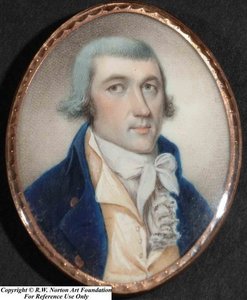
This monochromatic portrait depicts James Bleecker, a gentleman from the late 18th century. The subject is presented in a formal, seated bust-length depiction, captured within an oval frame. He is positioned slightly off-center to the right, creating a balanced asymmetry. His attire, which includes a cravat, waistcoat, and coat, serves as an indication of his social status. The composition focuses attention solely on his likeness, isolating him from any background context.
The image is rendered in shades of gray, ranging from light to dark. Fine lines are used extensively to define the texture of Bleecker’s hair and clothing, while curved lines outline the oval frame and the contours of his face and neck. Straight lines appear in the details of his waistcoat and cravat. The lighting is diffused and even, creating subtle gradations across his face and clothing, with a gentle highlight on his forehead and nose.
Technical Details and Composition
The artwork is a photograph of an original painting by John Ramage from 1788. The original technique likely involved oil paints applied to canvas or panel. The visual elements include:
The perspective is relatively flat, typical of the period, with minimal depth perception. Depth is achieved through subtle tonal variations and the overlapping of elements, such as the waistcoat partially covering the shirt. The subject's expression is dignified, conveying a sense of seriousness and respectability.
Which museum holds James Bleecker?
Metropolitan Museum of Art
new york, United States of America
Origins and History of the Metropolitan Museum of Art The Metropolitan Museum of Art began with a vision shared by a group of businessmen, financiers, and leading artists and thinkers. Following its incorporation in 1870, the institution sought a permanent home to house its growing acquisitions. Before settling into its current location, the museum briefly resided in the Douglas Mansion estate on West 14th Street.


High-resolution images of James Bleecker

John Ramage, James Bleecker (1788), Metropolitan Museum of Art. Public domain.
Questions on James Bleecker, answered
Where is "James Bleecker" by John Ramage on display today?
"James Bleecker" by John Ramage is on display at the Metropolitan Museum of Art, new york, United States of America. The museum listing refers to the original work, not to reproductions.
In what year was "James Bleecker" by John Ramage created?
"James Bleecker" by John Ramage was created in 1788.
What technique was used for "James Bleecker" by John Ramage?
The medium of "James Bleecker" by John Ramage is oil. Reproductions aim to render the appearance of this technique.
What is "James Bleecker" about?
"James Bleecker" by John Ramage depicts: man, portrait, cravat, waistcoat, coat, hair, oval frame.
Can the image of "James Bleecker" by John Ramage be freely reproduced?
Regarding copyright, "James Bleecker" is in the public domain - its copyright has expired.
Who created "James Bleecker"?
"James Bleecker" is attributed to John Ramage.
What style does "James Bleecker" belong to?
"James Bleecker" by John Ramage belongs to the Neoclassicism movement. This movement provides the stylistic context of the work.
What stage of John Ramage's development does "James Bleecker" represent?
Within John Ramage's career, "James Bleecker" falls in the Mature Period. The phase helps compare it with the artist's other works.
What was John Ramage's age when "James Bleecker" was created?
John Ramage made "James Bleecker" at the age of 40. The artist was born in 1748 and the work is dated 1788.
About the artist, John Ramage
1748–1802, Ireland
John Ramage
A Life Bridging Worlds: The Story of John Ramage Born in Dublin, Ireland, in 1748, John Ramage’s life was one of remarkable transition and artistic dedication, a journey that carried him from the refined world of Irish goldsmithing to the burgeoning art scene of colonial America. Details surrounding his early family life remain elusive, yet it is known he received formal training at the Dublin Society of Artists in 1763, laying a foundation in drawing and painting techniques that would serve as the bedrock for his future endeavors. Ramage’s initial career path was notably versatile; he skillfully combined the precision of a goldsmith with the delicate artistry of a miniaturist—a testament to his inherent talent for detail and decorative arts. This early period instilled within him not only technical proficiency but also an appreciation for craftsmanship that would distinguish his work throughout his life.
Also by John Ramage
 Governor George Clinton1785
 Portrait of a Gentleman1780
 Major Greene, B.A1777
 Gilbert Van Cortlandt1785

Essays around James Bleecker
 Rococo vs. Neoclassicism: Understanding the Shift from Pleasure to VirtueMaster the visual shift from Rococo pleasure to Neoclassical virtue. Learn to distinguish these 18th-century styles like an expert today.
 American artworks of the 1810s1810s American art by Gilbert Stuart, John Trumbull, and Rembrandt Peale. Find museum-quality reproductions on OriginalUniqueArt.com.
 American artworks of the 1800sIconic American works by Gilbert Stuart and John Trumbull define an era. Explore the full collection online at OriginalUniqueArt.com.