() ·

A painting made for you, by hand

The Rainbow

Hand Made Oil Reproduction

Hand-painted oil on canvas in your size and frame, made to order by our artists. ( Switch to Print Switch to Digital Image)

Collectible Description

Artist Biography

A leading Realist of the Barbizon school known for The Gleaners. Discover the profound beauty of his rural masterpieces today.

from ·

Chapter 1

How large should it be?

Slide to change the size; the picture on the left shows the frame at its real width. The proportions of the original are kept.

Standard
custom
CM
INCH

Pick from our preset sizes that match the artwork's original proportions.

width
height

Type the width and the height you need, to fit your frame or your wall. This is hand-painted, so for a size with a different shape the artist can paint a bit more around the picture, or cut a bit — you choose. We send you a digital mockup to approve before the painting starts. The picture shown on this page does not show the real result — only the mockup does.

Chapter 2

How should it arrive?

Choose the edges of the stretched canvas

Choose your frame

Corner sample of the WhiteWrap canvas edge finish, stretched on solid wood bars
White $1
Corner sample of the BlurSideWrap canvas edge finish, stretched on solid wood bars
Blurside $1
Corner sample of the ExtendedWrap canvas edge finish, stretched on solid wood bars
Extended $1
Corner sample of the P118B picture frame: moulded polystyrene, 5 cm wide and 3 cm thick
P118B $10
Corner sample of the P118H picture frame: moulded polystyrene, 5 cm wide and 3 cm thick
P118H $10
Corner sample of the P118W picture frame: moulded polystyrene, 5 cm wide and 3 cm thick
P118W $10
Corner sample of the P438Z picture frame: moulded polystyrene, 5.5 cm wide and 3.5 cm thick
P438Z $10
Corner sample of the P508JH picture frame: moulded polystyrene, 7 cm wide and 3.5 cm thick
P508JH $12
Corner sample of the P508YH picture frame: moulded polystyrene, 7 cm wide and 3.5 cm thick
P508YH $12
Corner sample of the P805H picture frame: moulded polystyrene, 5 cm wide and 3.5 cm thick
P805H $10
Corner sample of the P805Z picture frame: moulded polystyrene, 5 cm wide and 3.5 cm thick
P805Z $10
Corner sample of the P919BZ picture frame: moulded polystyrene, 7 cm wide and 3.5 cm thick
P919BZ $10
Corner sample of the P919G picture frame: moulded polystyrene, 7 cm wide and 3.5 cm thick
P919G $10
Corner sample of the P919XJ picture frame: moulded polystyrene, 7 cm wide and 3.5 cm thick
P919XJ $10
Corner sample of the P959ZH picture frame: moulded polystyrene, 5 cm wide and 3 cm thick
P959ZH $10
Corner sample of the P968JZ picture frame: moulded polystyrene, 6 cm wide and 4 cm thick
P968JZ $12
Corner sample of the W106C picture frame: solid wood, 5 cm wide and 3 cm thick
W106C $8
Corner sample of the W218G picture frame: solid wood, 5 cm wide and 3 cm thick
W218G $10
Corner sample of the W218JH picture frame: solid wood, 5 cm wide and 3 cm thick
W218JH $8
Corner sample of the W218Y picture frame: solid wood, 5 cm wide and 3 cm thick
W218Y $10
Corner sample of the W307PJ picture frame: solid wood, 6 cm wide and 3 cm thick
W307PJ $10
Corner sample of the W316G picture frame: solid wood, 6 cm wide and 3 cm thick
W316G $10
Corner sample of the W316PJ picture frame: solid wood, 6 cm wide and 3 cm thick
W316PJ $8
Corner sample of the W316Y picture frame: solid wood, 6 cm wide and 3 cm thick
W316Y $10
Corner sample of the W398PJ picture frame: solid wood, 5 cm wide and 3 cm thick
W398PJ $8
Corner sample of the W4111J picture frame: solid wood, 6.5 cm wide and 3.5 cm thick
W4111J $10
Corner sample of the W500HY picture frame: solid wood, 7 cm wide and 5 cm thick
W500HY $15
Corner sample of the W500JH picture frame: solid wood, 7 cm wide and 5 cm thick
W500JH $15
Corner sample of the W692G picture frame: solid wood, 8 cm wide and 4 cm thick
W692G $12
Corner sample of the W849H picture frame: solid wood, 5 cm wide and 3 cm thick
W849H $8
Corner sample of the W940BG picture frame: solid wood, 7.5 cm wide and 4.5 cm thick
W940BG $15
Corner sample of the W953PJ picture frame: solid wood, 6 cm wide and 3.5 cm thick
W953PJ $8
Corner sample of the H24-GOLD picture frame: carved wood with gesso, 10 cm wide and 6 cm thick
H24-GOLD $30
Corner sample of the H24-SILVER picture frame: carved wood with gesso, 10 cm wide and 6 cm thick
H24-SILVER $30
Corner sample of the H36-GOLD picture frame: carved wood with gesso, 15 cm wide and 6.5 cm thick
H36-GOLD $45
Corner sample of the H36-SILVER picture frame: carved wood with gesso, 15 cm wide and 6.5 cm thick
H36-SILVER $45
Frame preview
Framed

Moulding: . Overall size with the frame: .

Chapter 3

Who paints it, and should anything change?

Examples of what can be changed: Replace face with customer photo; Add pet (e.g., replace cat with dog); Include hidden message in background; Change background landscape or elements.
After order, OriginalUniqueArt.com team will email client for instructions and provide a mockup preview

Worldwide Delivery () in 3/4 weeks instead of standard 5 weeks. (9 November). No compromise on quality.

Chapter 4

The finishing touches

A nameplate, as in a museum?

Engraved Bronze Plaque Details

This elegant plaque features the artist's name and the title of the artwork, finely engraved for a timeless presentation.

It is made from bronze with a refined, elegant finish. The text is precisely laser-engraved for a sharp and permanent result. Measuring 9x2 cm, the plaque is compact yet easy to read. It's built to be durable and scratch-resistant, offering a professional, museum-quality look. Mounting is simple thanks to the included adhesive backing.

Transparent Acrylic Plaque Details

The plaque includes essential engraved details such as the artist's name, the title of the artwork, the date it was created, the type of media used-like oil on canvas or watercolor-a brief description of the piece, and a QR code that links to the complete artwork information.

It is crafted from clear acrylic, offering a sleek, modern appearance. The text is UV-engraved in black to ensure strong visual contrast. With a size of 10x15 cm, it ensures optimal readability. It comes equipped with two metal hooks for secure wall mounting. The plaque is designed to be weather-resistant, making it suitable for various environments, and it includes interactive features that work seamlessly with smartphone scanning.

Black Acrylic Plaque Details

This elegant plaque includes engraved information such as the artist's name, the title of the artwork, the date it was created, the type of media used (like oil on canvas or watercolor), a short description of the artwork, and a QR code for quick access to more information.

The plaque itself is made from refined black acrylic with a premium finish. The text is laser-engraved in white for high contrast and readability. Its size is 10x15 cm, designed to be easy to read. It comes with two metal hooks for professional mounting. The design is sleek and fits any interior style. It is also weather-resistant and durable, with built-in digital integration for mobile compatibility.

A protective varnish?

When do you need it?

Chapter 5

Your painting, as you ordered it

The Rainbow

Reproduction Medium

Reproduction Size

-

Elite Senior Artist

More detail, finesse, and extra production time

-

Reproduction Frame

-

-

For artworks or reproductions larger than 105 cm (approximately 41 inches) on any side, the frame will be shipped as a kit, disassembled. This method ensures safe delivery and prevents damage during transport.

Professional assembly required - this is not a DIY product.
The kit must be assembled and the canvas stretched by an experienced professional framer, using wood glue (not supplied), a canvas stretching plier and clamps to hold the bars square while the glue dries. Incorrect assembly or uneven canvas tension can permanently damage the artwork and is not covered by our warranty.

  • All solid wood bars are included, precisely cut to size.

  • Assembled with the screws provided, plus wood glue for the corner joints, which is not supplied and must be sourced by your framer.

  • Professional tools are required and not included: a canvas stretching plier (tensioner) and clamps to hold the bars square while the glue dries.

Important:
The corner joints require wood glue, the bars must be held with clamps until the glue is fully dry, and tightening the canvas on the assembled frame requires a canvas stretching plier. None of these are included in the kit. Please arrange an experienced professional framer before ordering this size.

Nameplate

-

-

Protective Varnish

Glossy Varnish (enhances colors, protects against light/moisture)

-

Customize My Artwork

Examples of what can be changed: Replace face with customer photo; Add pet (e.g., replace cat with dog); Include hidden message in background; Change background landscape or elements.

-

Urgent

Worldwide Delivery () in 3/4 weeks instead of standard 5 weeks. (9 November). No compromise on quality.

-

Express Shipping

Worldwide Delivery () in 5 weeks. (16 November).

Included

Total Price

$ 300

Total Price $ 300

Glass option is only available in size under 110 CM

Included with every order

  • Free Worldwide Express Shipping
  • High-Quality Linen Canvas
  • Full Shipping Insurance
  • Customs Tax Refund Guarantee
  • True Color Matching Guarantee
  • 100-Day Return Policy (Defects Only)
  • 100% Money-Back Guarantee
  • Bulk Discount Offer

A Testament to Rural Dignity: Millet’s “The Rainbow”

Jean-François Millet's "The Rainbow," completed in 1872, transcends mere depiction; it embodies the spirit of Realism and speaks volumes about the profound connection between humanity and the natural world. Painted with meticulous pastel hues on canvas measuring 42 x 54 cm, this artwork resides within the esteemed Calouste Gulbenkian Museum in Lisbon, Portugal—a testament to its enduring artistic merit. Millet’s vision wasn't born from academic pursuits but from firsthand experience – his father was a farmer, grounding him in the daily realities of rural existence and informing his artistic sensibilities. This formative influence is palpable throughout “The Rainbow,” where Millet captures a simple scene of an apple orchard bathed in the ethereal glow of a summer afternoon.

Style and Technique: Embracing Impressionistic Realism

Millet’s approach distinguishes itself from purely representational art by subtly incorporating elements characteristic of Impressionism. While firmly rooted in Realist principles—a movement dedicated to portraying life as it truly is—without romantic embellishments—he skillfully employs pastel crayons to achieve remarkable luminosity and tonal nuance. The artist eschews harsh outlines, favoring soft blending techniques that capture the diffused light filtering through the foliage and illuminating the figures scattered amongst the trees. This deliberate softness contributes significantly to the painting’s tranquil atmosphere and invites contemplation on the beauty inherent in everyday labor.

Historical Context: Reflecting a Changing Landscape

“The Rainbow” emerged during a pivotal moment in French history—the latter half of the 19th century—a period marked by industrialization, urbanization, and growing social consciousness. The Realist movement arose as a reaction against Romantic idealism, rejecting idealized narratives and focusing instead on depicting ordinary people engaged in honest work. Millet’s depiction of rural life wasn't intended to glorify it but rather to acknowledge its dignity and complexity. The inclusion of the rainbow itself carries symbolic weight; representing hope amidst adversity—a recurring motif within Millet’s oeuvre—it underscores the painting’s message of resilience and harmony between humankind and nature.

Symbolism: More Than Meets the Eye

Beyond its visual beauty, “The Rainbow” is laden with symbolism. The apple trees symbolize fertility and abundance – a cornerstone of agricultural life and a visual reminder of sustenance. The figures themselves—likely farmers tending to their orchard—represent the backbone of rural communities and embody perseverance. Their postures convey quiet contemplation and connection to the surrounding environment. Millet’s careful composition directs the viewer's gaze upwards towards the rainbow, prompting reflection on themes of faith, renewal, and the sublime grandeur of God’s creation – ideas central to the spiritual landscape of the time.

Emotional Impact: A Quiet Resonance

“The Rainbow” possesses a remarkable ability to evoke emotion without resorting to dramatic gestures or overtly sentimental expressions. Its muted palette—dominated by earthy tones punctuated by vibrant pastel shades—creates a sense of serenity and understated beauty. The painting’s stillness invites viewers to pause, observe, and appreciate the subtle nuances of light and color. Ultimately, Millet's masterpiece succeeds in conveying a profound respect for rural life and its inherent dignity – an enduring legacy that continues to inspire admiration and contemplation today.

Questions & Answers

What subjects appear in "The Rainbow" by Jean-François Millet?

"The Rainbow" by Jean-François Millet depicts: rural landscape, orchard, rainbow phenomenon, pastoral scene, agricultural laborers, millet style, impressionistic pastel, norman village.

What kind of piece is "The Rainbow"?

"The Rainbow" is a wall art piece.

What is the dominant color of "The Rainbow" by Jean-François Millet?

The color that stands out most in "The Rainbow" is espresso (#474537). The dominant color is useful when matching an artwork to an interior.

More about this painting

Preview AR preview Switch to Print Switch to Digital Image Send
Details Guide Add to favorites Download Similars X-Ray Diaporama Q&A Stats

In numbers

  • 1872the year it was painted
  • 29frames to choose from
  • standard sizes, in its own proportions
  • 5weeks to paint and deliver it
Jean-François Millet

Jean-François Millet

1814 - 1875, France

Quick facts about Jean-François Millet

  • Artistic Movement Or Style: Realism, Barbizon school
  • Artists Or Movements Influenced By This Artist:
    • Impressionism
    • Social Realism
  • Artists Who Influenced This Artist:
    • Michelangelo
    • Poussin
    • Honoré Daumier
    • Paul Delaroche
    • Antoine-Jean Gros
  • Full Name: Jean-François Millet
  • Nationality: French
  • Notable Artworks:
    • The Gleaners
    • The Angelus
    • The Sower
    • Man with a Hoe
    • Harvesters Resting
    • Woman Baking Bread
  • Place Of Birth: Gruchy, France
  • Date Of Birth: 1814
  • Date Of Death: 1875

Artist Biography

The Early Life of Jean-François Millet

To understand the gravity in the work of Jean-François Millet, one must look past the canvas and toward the soil of Gruchy, France. Born on October 4, 1814, he did not enter the world of art through a gilded door. Instead, his reality was defined by the agricultural traditions of a small Norman village. His parents, Jean-Louis-Nicolas and Aimée-Henriette-Adélaïde Henry Millet, were farmers. This was not a mere background for a future painter; it was a direct, physical education in the mechanics of survival.

The rhythms of the farm dictated his early years. He learned the seasonal necessity of sowing, reaping, and threshing through direct experience. This was not observational study. It was a visceral engagement with the land. Such a beginning stripped away the possibility of the sentimentalized, fake pastoralism that later plagued his contemporaries. He knew the weight of the tools and the physical toll of the harvest because he lived it. This connection to the earth provided a foundation of authenticity that no amount of formal training could replicate.

Artistic Training and Early Aspirations

Millet’s formal training began in Cherbourg, far from the academic centers that would later define his career. He first studied under the portrait painter Bon Du Mouchel, a period that provided the technical foundation necessary for his later, more substantial subjects. This early instruction was practical and direct. It focused on the mechanics of representation rather than the grand historical narratives that dominated the era.

In 1837, he moved to Paris to enroll at the École des Beaux-Arts. This was a decisive step toward professional legitimacy. He studied under Paul Delaroche, a prominent figure in the academic system. This training provided him with the rigorous discipline of the French tradition, even as his personal interests began to drift toward the realities of rural life. The tension between his formal education and his background as a farmer’s son would define his later output.

Success did not come immediately. His first submission to the Salon, Saint Anne Instructing the Virgin, was rejected by the jury. This rejection highlights the friction between his emerging vision and the established expectations of the Parisian art world. He was not an artist who fit easily into the existing structures of the time. His early years were marked by this struggle to reconcile his training with a desire to depict life without the usual academic polish.

The Paris Years and Personal Loss

The early 1840s were a period of professional rejection and personal upheaval that defined Millet's trajectory. After his first submission to the Salon was rejected, he returned to Cherbourg in 1841. This was not a retreat into obscurity but a period of transition. During this time, he married Pauline-Virginie Ono. The stability of this union was short-lived. By April 1844, Pauline-Virginie died of consumption, a loss that stripped away the domestic certainty of his young adulthood.

Millet’s subsequent movements reflect a man navigating both artistic and personal instability. In 1845, he moved to Le Havre with Catherine Lemaire. This period of his life was marked by a shift away from the academic expectations of Paris toward a more grounded, perhaps more somber, reality. His work from this era began to reflect the weight of lived experience rather than the polished ideals of the Salon. The grit of his later subjects finds its roots in these years of struggle and the stark reality of mortality.

The Barbizon School and Rural Life

Millet’s move to Barbizon in 1849 was a calculated rejection of Parisian artifice. He abandoned the stifling academic conventions of the city for the raw reality of the French countryside. This was no mere change of scenery; it was a fundamental shift in purpose. By settling in this small village, he became a founder of the Barbizon school, a group that prioritized direct observation over polished studio fantasies. He found common ground with artists like Constant Troyon, Narcisse Diaz, Charles Jacque, and Théodore Rousseau. Together, they turned their backs on the idealized pastoral scenes that had dominated the salons, choosing instead to confront the grit of the landscape.

His work in Barbizon stripped away the romanticized veneer often applied to the peasantry. He did not paint a sanitized version of the countryside. Instead, he focused on the actual rhythms of agricultural labor—the sowing, the reaping, and the heavy, repetitive toil of the working class. This commitment to truth made his work controversial. While others sought to beautify the rural experience, Millet insisted on its weight and its physical reality. He captured the landscape not as a decorative backdrop, but as a site of intense, often grueling, human effort.

Technique and Artistic Style

Millet’s visual language is defined by a refusal to polish the grit of rural existence. He rejected the slick, idealized finishes of the academic tradition, opting instead for a rough paint handling that mirrors the textures of the earth. His compositions rely on a simplicity of value, using light and dark to create a sense of volume and weight. This approach gives his figures a monumental, sculptural quality, a direct result of his interest in classical sculpture. He did not rely on decorative flourishes; he relied on the structural integrity of the form.

His palette remains strictly grounded. He favored earthy tones that reflected the actual colors of the French countryside, avoiding artificial brightness in favor of a more honest, muted range. This restraint is evident across his various media. While he is most recognized for his oil paintings, his technical range extended to pastels, Conté crayon drawings, and etchings. He drew significant technical inspiration from the Dutch Masters, particularly in his ability to manipulate light and shadow to define space and atmosphere. This was not a pursuit of mere prettiness, but a method to capture the physical reality of labor and landscape.

Key Masterpieces and Iconic Works

Millet’s most enduring images are defined by a refusal to look away from the grit of rural existence. In 1850, he produced The Sower, a work that captures the cyclical nature of agricultural labor. This image remains a central reference point for how the movement of a single figure can represent the weight of human connection to the land. Similarly, The Angelus (1850-1861) captures a peasant couple pausing for prayer at sunset. It transforms a mundane, everyday act into a moment of quiet, spiritual significance without relying on religious artifice.

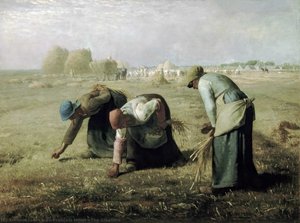
The social reality of the 19th-century working class finds its most direct expression in The Gleaners (1857). Rather than offering a romanticized view of the countryside, the painting depicts three women bent by toil, gathering leftover grain after the harvest. This focus on the physical reality of labor is echoed in Man with a Hoe, a powerful representation of physical toil and human endurance. These works do not offer comfort; they offer a clear, unvarnished look at the resilience required to survive the soil.

  • The Sower (1850)
  • The Angelus (1850-1861)
  • The Gleaners (1857)
  • Man with a Hoe

Legacy and Historical Significance

Millet’s impact on the trajectory of modern painting is undeniable. By centering his subjects on the grit and reality of the peasantry, he helped establish Realism as a dominant force in 19th-century art. This shift moved the focus away from idealized, polished academic subjects toward an unvarnished view of human existence. His insistence on depicting the working class with dignity provided the necessary groundwork for the emergence of Social Realism and the later developments of Impressionism. He changed how the art world perceived the value of the mundane.

His imagery functioned as more than mere observation; his depictions of laborers became powerful symbols of rural virtue and working-class solidarity. The strength of his figures and the weight of their toil resonated far beyond the canvas, influencing how society viewed the dignity of manual labor. This focus on the fundamental connection between humanity and the soil remains his most enduring contribution to the visual language of the era. He died in Barbizon on January 20, 1875, leaving behind a body of work that forced a confrontation with the realities of a changing social landscape.

Where to See His Works Today

To encounter the physical reality of Millet's vision, one must look to the major institutional collections that preserved his output. Paris remains the primary destination for his work. The Louvre holds ten of his paintings, providing a significant concentration of his output within a single city. Nearby, the Musée d'Orsay maintains five works, allowing for a direct comparison of his development within the French landscape. These collections offer the most direct access to the textures and earthy tones that defined his approach to the subject of labor.

Beyond France, his presence is felt in several major international museums. The Museum of Fine Arts in Boston contains three of his works, offering a perspective on his influence outside of Europe. In the United States, the J. Paul Getty Museum in Los Angeles also holds important pieces, including Shepherdess and Her Flock. These locations ensure that his depictions of the rural condition remain accessible to a global audience, far from the original fields of Normandy.

  • The Louvre, Paris
  • Musée d'Orsay, Paris
  • Museum of Fine Arts, Boston
  • J. Paul Getty Museum, Los Angeles

Quick Facts

  • Title: The Rainbow
  • Medium: Pastel
  • Artistic style: Impressionistic Realism
  • Subject or theme: Agricultural Scene
  • Movement: Realism
  • Location: Calouste Gulbenkian Museum, Lisbon

Art Quiz

There is only one correct answer for each question.

Question 1:
What artistic movement is Jean-François Millet’s ‘The Rainbow’ associated with?
Question 2:
Where is ‘The Rainbow’ currently housed?
Question 3:
What prominent feature dominates the composition of ‘The Rainbow’?
Question 4:
Jean-François Millet’s upbringing significantly influenced his artistic style. What was a key aspect of his childhood?
Question 5:
What is the primary subject matter depicted in ‘The Rainbow’?