Preview
 Send
Send Share
Share
 Details
 Guide
Guide

 Download
 Similars
 X-Ray
X-Ray Diaporama
 Q&A
Q&A Stats
StatsFarmhouse

- 130.0 x 212.0 cm


 Read More
Giclée / Art Print
Museum-quality giclée or canvas print with fast production and flexible finish options. ( Buy Hand Made Painting Switch to Digital Image)




P118B $10

P118H $10

P118W $10

P438Z $10

P508JH $12

P508YH $12

P805H $10

P805Z $10

P919BZ $10

P919G $10

P919XJ $10

P959ZH $10

P968JZ $12

W106C $8

W218G $10

W218JH $8

W218Y $10

W307PJ $10

W316G $10

W316PJ $8

W316Y $10

W398PJ $8

W4111J $10

W500HY $15

W500JH $15

W692G $12

W849H $8

W940BG $15

W953PJ $8




Pick from our preset sizes that match the artwork's original proportions.

Type the width and the height you need, to fit your frame or your wall. A print can only be cut, never made bigger than the picture, so a size with a different shape loses a part of the image. We send you a digital mockup to approve before we print anything. The picture shown on this page does not show the real cut — only the mockup does.
Worldwide Delivery () in 2 weeks instead of standard 4/5 weeks. (5 November)

Free Worldwide Express Shipping

High-Quality Linen Canvas

Full Shipping Insurance

Customs Tax Refund Guarantee

True Color Matching Guarantee

100-Day Return Policy (Defects Only)

100% Money-Back Guarantee

Bulk Discount Offer
 Glass option is only available in size under 110 CM

Farmhouse
Giclée / Art Print
Reproduction Size
-


Total Price
$ 81
A Pastoral Dream in Rococo Hues
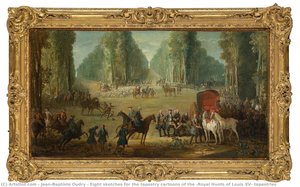
To gaze upon Jean-Baptiste Oudry's "Farmhouse" is to step directly into an idealized vision of 18th-century French rural life. This painting, executed in 1750, transcends a mere depiction of farmstead; it is a carefully orchestrated symphony of light, color, and pastoral tranquility. The Rococo style, with its inherent lightness and elegant exuberance, bathes the entire scene in a soft, almost dreamlike glow. One feels an immediate sense of calm wash over the viewer as the eye wanders from the rustic farmhouse, crowned with its thatched roof, across the fertile expanse of farmland stretching toward the horizon.
Mastery of Light and Detail
Oudry’s technical brilliance is immediately apparent in every meticulously rendered element. His handling of light is nothing short of masterful; it seems to emanate naturally from the scene itself, highlighting the textures of the wood, the softness of the sheep's wool, and the delicate folds of the clouds overhead. The composition is a study in balance, framed beautifully by lush trees that flank both sides, lending an almost theatrical depth to the foreground. Notice the scattered life—the contented cows grazing near the structure, the busy chickens pecking at the earth. These animals are not mere props; they imbue the scene with palpable vitality, suggesting the rhythm of daily existence.
Symbolism of Abundance and Harmony
Beyond its surface beauty, "Farmhouse" carries deep symbolic weight. It speaks to an era's idealized relationship with nature—a time when agricultural bounty was celebrated as a source of both sustenance and aesthetic pleasure. The combination of the thriving farmland, the sheltering farmhouse, and the gentle presence of human figures engaged in labor suggests themes of harmony, prosperity, and settled domestic bliss. Even the inclusion of farm implements hints at a life lived in respectful partnership with the land.
Bringing the Countryside Home
For the collector or designer seeking to infuse a space with timeless elegance, this piece offers unparalleled depth. The warm palette, dominated by rich earth tones punctuated by soft pastels, ensures that "Farmhouse" can anchor any room, whether it be a grand salon yearning for rustic charm or a sunlit breakfast nook desiring an air of cultivated serenity. Owning a reproduction allows one to possess not just a painting, but a tangible piece of 18th-century French artistry—a window into a bygone era of idyllic simplicity and exquisite craftsmanship.
Questions & Answers
What national origin stands behind the Rococo Style of "Farmhouse"?
"Farmhouse" was created by Jean-Baptiste Oudry, born in France, within the Rococo Style movement. The artist's origin links the work to Rococo Style as practiced by artists from France.
What placement suits the format of "Farmhouse" by Jean-Baptiste Oudry?
With its panoramic shape, a reproduction of "Farmhouse" is suggested for a living room.
How do the colors of "Farmhouse" relate to each other?
The colors of "Farmhouse" by Jean-Baptiste Oudry show a balanced harmony harmony. Harmony describes how the colors relate to each other.
Artist Biography
Jean-Baptiste Oudry: A Life in Art
Early Life and Training
- Born: March 17, 1686, in Paris, France.
- Oudry came from an artistic family; his father, Jacques Oudry, was a painter and art dealer. His mother, Nicole Papillon, was related to the engraver Jean-Baptiste-Michel Papillon.
- He began his training at the Académie de Saint-Luc, studying under Nicolas de Largillière from 1707 to 1712. This foundational period shaped his early skills in portraiture and observation.
- He quickly progressed, becoming an assistant professor at the Académie de Saint-Luc in 1714 and a full professor by 1717.
Artistic Development and Style
- Initially focused on portraiture, Oudry gradually expanded his repertoire to include still lifes, particularly of fruits and animals, as well as religious subjects.
- His style evolved towards the Rococo, characterized by elegance, naturalism, and a playful depiction of aristocratic life and leisure.
- Oudry’s meticulous attention to detail and his ability to capture the textures and characteristics of animals became hallmarks of his work.
- He demonstrated mastery in both painting and design, seamlessly transitioning between canvas and tapestry creation.
Major Achievements and Notable Works
- The Pastoral Amusements (Les Amusements Champêtres): A series of tapestries designed for the Royal Beauvais Tapestry Manufactory, showcasing idyllic scenes of rural life and hunting.
- Louis XV Hunting a Deer in the Forest of Saint-Germain (1730): This painting solidified Oudry’s reputation as the official painter of the royal hunt. It exemplifies his skill in depicting both the grandeur of the hunt and the natural environment.
- Royal Hunts of Louis XV (Chasses Royales Gobelins): A series of tapestry designs for the Gobelins Manufactory, further establishing Oudry’s prominence as a tapestry designer.
- Numerous portraits of dead game commissioned by King Louis XV, demonstrating his expertise in animal anatomy and still life composition.
Influences and Legacy
- Influenced By: Nicolas de Largillière played a crucial role in Oudry’s early artistic development, providing foundational training in portraiture and technique.
- Oudry's work influenced subsequent generations of animal painters and tapestry designers. His naturalistic style and attention to detail set a new standard for depicting wildlife.
- He contributed significantly to the decorative arts of the French court, creating luxurious tapestries that adorned royal residences.
Historical Significance
- Oudry’s work provides valuable insights into 18th-century aristocratic life and the importance of hunting as a pastime for the French nobility.
- His tapestries are considered masterpieces of French decorative art, showcasing the technical skill and artistic creativity of the period.
- He was appointed to prestigious positions within the Académie Royale de Peinture et de Sculpture, demonstrating his recognition as a leading artist of his time.
- Died: April 30, 1755, leaving behind a legacy of exquisite paintings and tapestries that continue to be admired today.

Jean-Baptiste Oudry
1686 - 1755 , France
Quick Facts
- Name: Jean-Baptiste Oudry
- Movement: Rococo
- Birth Date: 17 March 1686
- Death Date: 30 April 1755
- Birth Place: Paris, France
- Nationality: French
- Date Of Birth: 1686
- Date Of Death: 1755
- Influenced By: Nicolas de Largillière
- Notable Works:
- The Pastoral Amusements
- Louis XV hunting a deer in the forest of Saint-Germain
- Place Of Birth: Paris, France
Related Articles
Idyllic Visions: Exploring the Pastoral Tradition in Western Art – Themes, Techniques & Enduring Appeal
Explore the rich history of pastoral art from classical Arcadia to contemporary interpretations. Discover key artists, themes & collecting tips at OriginalUniqueArt.

Léon Augustin L'Hermitte: Capturing the Soul of French Rural Life
Discover the captivating realist paintings of Léon Augustin L'Hermitte, masterfully depicting French rural life. Explore his technique, influences & legacy – a cornerstone of 19th-century art.

Rococo's Radiant Legacy: 10 Masterpieces for Your Home |
Indulge in the elegance of Rococo! Explore 10 masterpieces by Fragonard, Boucher & Watteau. Discover the stories behind these iconic paintings and bring timeless art to your home with museum-quality reproductions from .
Animalia: Exploring the Enduring Presence of Animals in Art & Interior Design
Explore the rich history of animal symbolism in art, from ancient mythology to modern masterpieces. Discover how animals have inspired artists for centuries and learn how to incorporate these powerful motifs into your home décor.

The Rococo Aesthetic: Opulence, Rebellion & the Pursuit of Pleasure in 18th-Century Art
Explore the opulent world of Rococo art! Discover its origins, key artists like Watteau & Boucher, and lasting influence on design. Expert insights for collectors & enthusiasts.