Preview
 Send
Send Share
Share
 Details

 Download
 Similars
 X-Ray
X-Ray Diaporama
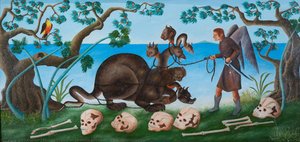
The Owl


 Read More
Giclée / Art Print
Museum-quality giclée or canvas print with fast production and flexible finish options. ( Buy Hand Made Painting Buy Image)




































Pick from our preset sizes that match the artwork's original proportions.

You may enter your own dimensions to fit a specific frame or space. If your selected size does not match the original image's proportions, we will either crop the artwork or extend the image with a mirrored or solid-fill edge. A digital mockup will be sent for your approval before production begins.
Please note that the on-screen preview does not reflect the actual cropping or extension. Only the mockup will accurately show the final composition.
While custom sizes are available, we recommend selecting a dimension from the predefined list to preserve the original proportions.
Worldwide Delivery () in 2 weeks instead of standard 4/5 weeks. (19 August)

Free Worldwide Express Shipping

High-Quality Linen Canvas

Full Shipping Insurance

Customs Tax Refund Guarantee

True Color Matching Guarantee

60-Day Return Policy (Defects Only)

100% Money-Back Guarantee

Bulk Discount Offer
 Glass option is only available in size under 110 CM

The Owl
Giclée / Art Print
Reproduction Size
-


Total Price
$ 81
Artist Biography
Maurice Prendergast: A Mosaic of Modern Life
Maurice Brazil Prendergast, born in 1858 in the remote trading post of St. John’s, Newfoundland, was an American artist whose distinctive style captured a fleeting moment of beauty within the burgeoning modern world. His life, marked by both geographical displacement and artistic exploration, ultimately culminated in a uniquely evocative body of work characterized by delicate landscapes, intimate scenes of urban life, and a masterful manipulation of color—a technique he likened to assembling a mosaic from fragments of experience. Prendergast’s journey began far removed from the bustling art centers of Europe, yet it was this early exposure to a raw, elemental environment that profoundly shaped his artistic vision. The stark beauty of Newfoundland, coupled with the practical skills honed in his family's trading post, instilled in him an appreciation for direct observation and a keen eye for detail—qualities he would later translate into his paintings. His formal training commenced in Boston, where he apprenticed as a commercial artist, a seemingly pragmatic path that nonetheless provided a crucial foundation in composition and design. However, it was his relocation to Paris in 1891 that truly ignited his artistic spirit. There, amidst the vibrant energy of the Impressionist movement, Prendergast immersed himself in the studios of Gustave Courtois at the Académie Colarossi and Jean-Joseph Benjamin-Constant at the Académie Julian. These formative years exposed him to the revolutionary techniques of light and color championed by Monet, Renoir, and Degas—influences that would subtly permeate his own distinctive style. Crucially, Prendergast’s time in Paris also introduced him to a network of avant-garde artists, including Walter Sickert and Aubrey Beardsley, whose experimental approaches further broadened his artistic horizons. Prendergast's artistic development can be understood within the context of the broader artistic currents of the late 19th and early 20th centuries. He was deeply influenced by Post-Impressionism, a movement that sought to move beyond the purely optical representation of reality, exploring instead the subjective experience of perception. His work shares affinities with the works of Paul Gauguin and Vincent van Gogh, both of whom utilized bold colors and expressive brushstrokes to convey emotion and atmosphere. However, Prendergast’s style is uniquely his own—characterized by a remarkable delicacy and precision that sets him apart from his contemporaries. He eschewed the dramatic gestures and turbulent brushwork favored by some Post-Impressionists, instead opting for a more restrained and nuanced approach.The Ashcan School and Early Influences
Despite his association with Parisian artistic circles, Prendergast’s career was inextricably linked to the burgeoning American art scene of the late 19th and early 20th centuries. He became a member of “The Eight,” a group of artists who challenged the established conventions of the art world and sought to depict the realities of urban life with unflinching honesty. This group, often associated with the Ashcan School, rejected the idealized subjects and grand narratives favored by academic painters, instead focusing on scenes of everyday existence—the crowded streets of New York City, the dimly lit interiors of saloons and tenements, and the lives of ordinary people. Prendergast’s paintings of cityscapes, such as “Street Scene” (1907), capture this spirit with remarkable sensitivity and detail.A Distinctive Palette and Technique
Prendergast's artistic signature lies in his distinctive use of color and technique. He employed a limited palette—primarily consisting of muted blues, greens, yellows, and browns—to create a sense of atmospheric depth and tranquility. His brushwork is remarkably delicate and precise, resembling the meticulous application of mosaic tiles. This technique—often described as “mosaicism”—involved layering thin washes of color to build up complex patterns and textures. Prendergast himself likened this process to assembling a mosaic from fragments of experience, suggesting that his paintings were not merely representations of reality but rather constructed interpretations of it.Key Works and Legacy
Among Prendergast’s most celebrated works are “The Street” (1907), “A Corner in the Market” (1908), and numerous landscapes depicting the rugged beauty of Newfoundland. These paintings, characterized by their delicate color palettes, meticulous detail, and evocative atmosphere, have earned him a place among the leading American artists of his era. His work was exhibited widely throughout the United States and Europe, and he enjoyed considerable critical acclaim during his lifetime. Despite fading from public view after 1924, Prendergast’s legacy has been increasingly recognized in recent decades. His paintings are now housed in major museums around the world, including the Metropolitan Museum of Art in New York City and the Smithsonian American Art Museum in Washington, D.C., testament to his enduring artistic merit. Maurice Prendergast's unique vision continues to resonate with viewers today, offering a poignant glimpse into the beauty and complexity of modern life.
jasmin joseph, jasmin joseph
1924 - 2005 , Haiti
Quick Facts
- Artistic Movement Or Style: Post-Impressionism
- Artists Or Movements Influenced By This Artist: ['The Eight']
- Artists Who Influenced This Artist: ['Childe Hassam']
- Date Of Birth: October 10, 1858
- Date Of Death: February 1, 1924
- Full Name: Maurice Brazil Prendergast
- Nationality: American
- Notable Artworks:
- Mosaic Landscapes
- Modern City Scenes
- Place Of Birth: Newfoundland, Canada
Related Articles

Animalia: Exploring the Enduring Presence of Animals in Art & Interior Design
Explore the rich history of animal symbolism in art, from ancient mythology to modern masterpieces. Discover how animals have inspired artists for centuries and learn how to incorporate these powerful motifs into your home décor.
Romantic Realism's Finest: 10 Masterpieces for Your Home | OriginalUniqueArt
Explore 10 defining masterpieces of Romantic Realism! Discover Courbet, Millet & Daumier's powerful paintings—capturing emotion and social realities. Find museum-quality reproductions for your home at OriginalUniqueArt.com.
Beastly Brushstrokes: A Historical Journey Through Animal Painting & Aesthetic Movements
Explore the rich history of animal painting across cultures & movements. Discover iconic artists, symbolism, collecting trends & expert art consultation at OriginalUniqueArt.com.

Beyond the Screen: Transforming Personal Memories into Timeless AI-Driven Anime Masterpieces
Experience the magic of digital metamorphosis. Transform your cherished photos into stunning, hand-painted anime masterpieces using our proprietary AI technology and professional artists. Elevate your personal story with a timeless, high-quality oil painting on canvas.
René Magritte's Masterpieces: 25 Surrealist Paintings for Art Lovers | OriginalUniqueArt
Explore 25 iconic René Magritte paintings & delve into the world of surrealism. Discover the stories behind 'The Son of Man', 'Golconda' & more. Find museum-quality art reproductions and elevate your home decor with OriginalUniqueArt.com.