

 Preview
 Send
Send Share
Share
 Details
 Guide
Guide

 Download
 Similars
 X-Ray
X-Ray Diaporama
 Stats
StatsTugai Bey

 Read More
Giclée / Art Print
Museum-quality giclée or canvas print with fast production and flexible finish options. ( Buy Hand Made Painting Switch to Digital Image)




































Pick from our preset sizes that match the artwork's original proportions.

Type the width and the height you need, to fit your frame or your wall. A print can only be cut, never made bigger than the picture, so a size with a different shape loses a part of the image. We send you a digital mockup to approve before we print anything. The picture shown on this page does not show the real cut — only the mockup does.
Worldwide Delivery () in 2 weeks instead of standard 4/5 weeks. (23 October)

Free Worldwide Express Shipping

High-Quality Linen Canvas

Full Shipping Insurance

Customs Tax Refund Guarantee

True Color Matching Guarantee

100-Day Return Policy (Defects Only)

100% Money-Back Guarantee

Bulk Discount Offer
 Glass option is only available in size under 110 CM

Tugai Bey
Giclée / Art Print
Reproduction Size
-


Total Price
$ 81
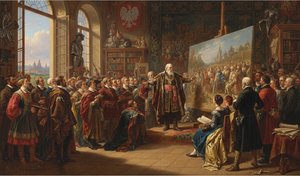
A Glimpse into 17th-Century Conflict: "Tugai Bey" by Jan Matejko
This striking portrait, “Tugai Bey” by Polish master Jan Matejko, offers a compelling window into the complex political and military landscape of 17th-century Eastern Europe. The painting depicts Tugai Bey, a Crimean Tatar leader, a figure pivotal in the tumultuous relationship between Poland-Lithuania and the Cossack Hetmanate. Matejko’s work isn't merely a likeness; it is a carefully constructed narrative reflecting power, diplomacy, and the volatile nature of alliances during a period of intense upheaval. The subject’s commanding presence, captured with meticulous detail, invites viewers to contemplate the historical forces at play.Style & Technique: Romanticism Meets Historical Precision
Matejko was renowned for his monumental historical paintings executed in the Romanticism style. This piece exemplifies that approach. The dramatic lighting, rich color palette (dominated by deep reds, golds, and browns), and dynamic composition create a sense of immediacy and emotional intensity. Matejko’s technique is characterized by its meticulous realism; he painstakingly researched costumes, weaponry, and settings to ensure historical accuracy. The oil on panel medium allows for subtle gradations of tone and texture, bringing the subject's attire and facial features to life with remarkable clarity. Note the careful rendering of the elaborate turban and the detailed depiction of the bow and arrow – hallmarks of Matejko’s dedication to detail.Historical Context & Significance
The painting is inextricably linked to the Khmelnytsky Uprising (1648–1657), a major Cossack rebellion against Polish rule in Ukraine. Tugai Bey played a significant role, initially allied with Bohdan Khmelnytsky, leader of the uprising. Matejko’s work captures a moment of potential alliance or negotiation between these two powerful figures. The painting was created decades after these events (circa 1885), during a period in Poland when national identity and historical memory were being actively cultivated. Matejko's paintings served as visual narratives reinforcing Polish heritage and commemorating key moments in the nation’s history, often with a patriotic undertone. The depiction of Tugai Bey, while acknowledging his role in conflict, also hints at the complex intercultural interactions that shaped this era.Symbolism & Emotional Impact
Beyond its historical accuracy, "Tugai Bey" is rich in symbolism. The subject’s attire—the ornate turban, luxurious fabrics, and weaponry—signifies his status as a leader and warrior. His gaze, both intense and contemplative, suggests a shrewd intellect and strategic mind. The presence of the bow and arrow alludes to military prowess and potential conflict. The overall emotional impact is one of gravitas and restrained power. Matejko masterfully conveys a sense of tension and uncertainty, reflecting the precarious nature of alliances and the ever-present threat of war in 17th-century Eastern Europe. The painting evokes a feeling of witnessing a pivotal moment in history, prompting reflection on themes of leadership, diplomacy, and cultural exchange amidst conflict.Questions & Answers
From which country does the Romanticism work "Tugai Bey" come?
"Tugai Bey" was created by Jan Matejko, born in Poland, within the Romanticism movement. The artist's origin links the work to Romanticism as practiced by artists from Poland.
What is the perceived brightness of "Tugai Bey" by Jan Matejko?
In terms of perceived brightness, "Tugai Bey" by Jan Matejko is bright.
Is a download available for "Tugai Bey"?
A download is available for "Tugai Bey": the artwork's Download page offers a high-resolution digital image download.
Artist Biography
early life and education
jan alojzy matejko, a renowned polish painter, was born on june 24, 1838, in kraków, poland. his father, franciszek ksawery matejko, was a czech-born tutor and music teacher. jan's early life was marked by the kraków revolution of 1846 and the 1848 siege of kraków by the austrians, events that would later influence his artistic themes. matejko attended st. ann's high school but dropped out in 1851 due to poor grades. however, he showed exceptional talent for art from an early age. he studied at the school of fine arts in kraków from 1852 to 1858, specializing in historical painting under the tutelage of wojciech korneli stattler and władysław łuszczkiewicz.artistic career
matejko's first major work, tsars shuyski before zygmunt iii, was completed in 1853. he began exhibiting his historical paintings at the kraków society of friends of fine arts in 1855. notable works include:- rejtan (1866): a large oil on canvas painting depicting a pivotal moment in polish history.
- union of lublin (1869): a significant piece showcasing matejko's skill in capturing historical events.
- battle of grunwald (1878): a masterpiece that highlights his ability to convey the intensity of battle scenes.
museological contributions and legacy
matejko spent most of his life in kraków, eventually becoming a director at the jan matejko academy of fine arts, formerly known as the kraków academy of fine arts. his students included prominent painters such as maurycy gottlieb, jacek malczewski, józef mehoffer, and stanisław wyspiański. notable works available on OriginalUniqueArt:- jan matejko: varna (romanticism)
- jan matejko: still life (romanticism)
- jan matejko: the union of lublin (298 x 512 cm, romanticism, oil on canvas)
references:
discovering the masterpieces of muzeum narodowe krakow, poland (wikipedia.org)
Jan Matejko
1838 - 1893 , Poland
Quick Facts
- Full Name: Jan Alojzy Matejko
- Nationality: Polish
- Date Of Birth: 1838
- Date Of Death: 1893
- Place Of Birth: Krakow, Poland
- Notable Artworks:
- Battle of Grunwald
- Union of Lublin
- Artistic Movement Or Style: Romanticism
- Artists Who Influenced This Artist:
- Wojciech Korneli Stattler
- Władysław Łuszczkiewicz
- Artists Or Movements Influenced By This Artist: ['Maurycy Gottlieb']
Related Articles
Jan Brueghel the Elder: A Master of Flemish Landscape & Allegory – Exploring Innovation & Influence
Explore the captivating world of Jan Brueghel the Elder, a Flemish Baroque master renowned for his stunning landscapes & allegorical paintings. Discover his collaborations with Rubens and lasting artistic legacy.
Jan Gossaert (Mabuse): Pioneering Renaissance Style & the Birth of Netherlandish Antiquity
Explore the groundbreaking art of Jan Gossaert (Mabuse), a pioneer of Renaissance painting in the Low Countries. Discover his Romanist style, stunning portraits, and influence on Northern European art history.
Stanisław Wyspiański: Symbolism, National Identity & the Polish Secession
Explore the life & work of Stanisław Wyspiański, a pivotal figure in Polish Symbolism and the Young Poland movement. Discover his iconic paintings, dramas, and stained glass designs reflecting national identity & artistic innovation.
Jan Steen: A Master of Dutch Genre Painting & the Golden Age
Explore the life & art of Jan Steen, a leading Dutch Golden Age painter renowned for his humorous genre scenes & insightful social commentary. Discover his techniques, legacy, and collecting tips.
Jan Matejko: Historical Narrative & National Identity in 19th-Century Polish Painting
Explore the powerful historical paintings of Jan Matejko, Poland's national artist. Discover his iconic works & learn how he shaped Polish identity in the 19th century. High-quality reproductions available.


![The Battle of Grunwald [Tannenberg]](/media/artworks/images-thumb/76/63/7663bffc0e03f3032abe818c6c091ed6.jpg)


