The Crucible of Young Poland: Historical Context & Artistic Ferment
 Wikipedia: Stanisław Wyspiański
Stanisław Mateusz Ignacy Wyspiański (pronounced ['staˈɲiswaf vɨˈspjaɲskʲi]; 15 January 1869 – 28 November 1907) was a Polish playwright, painter, poet, and interior and furniture designer. A patriotic writer, he created symbolic national dramas accor...
The late 19th and early 20th centuries witnessed a profound cultural awakening in Poland, a nation partitioned and struggling to maintain its identity under the rule of Russia, Prussia, and Austria. This period, known as “Young Poland” (Młoda Polska), was characterized by a fervent nationalism intertwined with aesthetic rebellion against both Western materialism and traditional conservatism. It wasn’t merely an artistic movement; it was a desperate attempt to forge a new cultural consciousness in the face of political oppression. Within this volatile landscape emerged Stanisław Wyspiański, a polymath—painter, playwright, poet, designer—who would become its most iconic figure. Born in Kraków in 1869, Wyspiański’s artistic journey was deeply rooted in his homeland's history and folklore, yet boldly forward-looking, embracing the burgeoning currents of Symbolism and Art Nouveau sweeping across Europe. The yearning for a revitalized Poland fueled an intense focus on national narratives, myths, and the beauty of the rural past, all filtered through a distinctly modern sensibility.
Wyspiański’s Symbolist Language: Beyond Realism in Painting & Drama
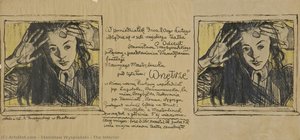 The Interior
Admire 'The Interior' by Stanisław Wyspiański – a poignant black & white lithograph capturing a woman’s contemplation. Explore Symbolist art & Polish heritage. Hand-painted reproductions available.
Rejecting the straightforward depiction of reality favored by Realism, Wyspiański embraced Symbolism as a means to explore deeper psychological and spiritual truths. His paintings are not simply representations of figures or scenes; they are imbued with layers of meaning, often alluding to historical events, philosophical concepts, and the collective anxieties of Polish society. Consider “Mietek Leaning on His Arms,” a poignant pastel drawing that transcends a simple portrait of childhood contemplation. The melancholic beauty of the work lies in its evocation of lost innocence and the weight of national destiny. Similarly, “Girl Putting Out A Candle” is a masterclass in Symbolist subtlety; the extinguishing flame becomes a metaphor for fading hope or perhaps the suppression of Polish culture. Wyspiański’s loose brushstrokes and muted color palettes contribute to an atmosphere of dreamlike ambiguity, inviting viewers to interpret the works on multiple levels. This symbolic approach extended seamlessly into his dramatic writing, where characters often embody abstract ideas or historical forces rather than being fully realized individuals.
National Identity as Motif: Folklore, History & the Polish Soul
At the heart of Wyspiański’s artistic vision lay a profound preoccupation with Polish national identity. He delved into the rich tapestry of Polish folklore, history, and Romantic literature, seeking to unearth the essence of the “Polish soul.” His plays frequently drew upon historical events and legendary figures, reimagining them in ways that resonated with contemporary concerns. The past wasn’t simply recreated; it was reinterpreted as a means of understanding the present and envisioning a future Poland. This fascination is evident in works like *Wesele* (The Wedding), arguably his most famous play, which uses a seemingly simple wedding celebration as a springboard for exploring themes of national disillusionment and social stagnation. He wasn’t interested in idealized portrayals of heroism; instead, he presented complex characters grappling with moral ambiguities and the challenges of forging a unified national identity. The use of traditional Polish costumes, music, and folk motifs further underscored his commitment to celebrating and preserving his nation's cultural heritage.
Stained Glass & Interior Design: A Gesamtkunstwerk Vision
Wyspiański’s artistic ambitions extended beyond painting and drama into the realm of applied arts. He believed in the concept of a Gesamtkunstwerk – a “total work of art” where all elements, from architecture to furniture to decorative details, harmoniously contribute to a unified aesthetic experience. His designs for stained glass windows are particularly noteworthy, transforming sacred spaces with their vibrant colors and symbolic imagery. These weren’t merely decorative additions; they were integral components of the overall artistic vision, intended to evoke spiritual contemplation and national pride. He also designed interiors, furniture, and even theatrical sets, creating immersive environments that reflected his modernist sensibilities while simultaneously drawing upon traditional Polish craftsmanship. His work on the Włodzimierz Tetmajer House in Kraków exemplifies this holistic approach, showcasing a seamless integration of art, architecture, and design.
The Wedding & Key Dramatic Works: Exploring Themes of Disillusionment
*Wesele* (The Wedding), premiered in 1901, remains Wyspiański’s most enduring legacy. The play is a scathing critique of Polish society at the turn of the century, exposing its internal divisions and lack of collective purpose. Set against the backdrop of a rural wedding, it features a cast of characters representing various social classes and political factions, each grappling with their own disillusionment and self-interest. Through poetic dialogue and symbolic imagery, Wyspiański paints a bleak portrait of a nation paralyzed by apathy and unable to unite in pursuit of independence. Other key dramatic works, such as *Klątwa* (The Malediction) and *Wyzwolenie* (Liberation), further explore these themes of national identity, social responsibility, and the challenges of achieving political freedom. His plays weren’t simply entertainment; they were powerful calls to action, challenging audiences to confront uncomfortable truths about themselves and their society.
Legacy and Influence: Wyspiański’s Enduring Impact on Polish Art
Stanisław Wyspiański’s tragically short life – he died in 1907 at the age of just 38 – belies his immense artistic output and lasting influence. He left an indelible mark on Polish art, paving the way for future generations of artists and writers. His innovative use of Symbolism, combined with his deep commitment to national themes, continues to resonate today. He is often hailed as the “fourth bard” of Poland, joining the ranks of Mickiewicz, Słowacki, and Krasiński in the pantheon of Polish literary giants. Wyspiański’s work not only captured the spirit of a nation struggling for self-determination but also anticipated many of the artistic trends that would define the 20th century. His paintings, plays, and designs continue to be celebrated as masterpieces of Polish art, inspiring artists and audiences alike with their beauty, complexity, and enduring relevance. At OriginalUniqueArt.com, we are proud to offer high-quality reproductions of Wyspiański’s iconic works, allowing you to experience the power and beauty of his artistry firsthand. Explore our collection today and discover the legacy of a true Polish visionary.