The Rise of Polish History Painting: A Nation Forged on Canvas
History paintings is a genre Western art that focuses on the depiction of historical, mythological, biblical, or literary subjects, often with a moral or didactic purpose. Considered the most prestigious genre in the academic art hierarchy during the...
The 19th century was a crucible for national identities across Europe, and Poland’s experience was particularly fraught. Partitioned between Russia, Prussia, and Austria, the very idea of “Poland” existed more as a potent memory and fervent aspiration than a concrete political reality. In this environment, art took on an extraordinary significance—it wasn't merely aesthetic expression but a vital act of cultural resistance and nation-building. And at the forefront of this movement stood Jan Matejko, whose monumental canvases became synonymous with Polish heroism, tragedy, and enduring spirit. Before Matejko, Polish painting largely mirrored European trends; after him, it was inextricably linked to the narrative of a nation struggling for self-determination. He didn’t simply depict historical events; he *created* a visual mythology that resonated deeply with a populace yearning for unity and independence.
Matejko's Early Life & Artistic Formation: Seeds of Patriotism
 Wikipedia: Jan Matejko
Jan Alojzy Matejko (Polish pronunciation: [ˈjan aˈlɔjzɨ maˈtɛjkɔ] ; also known as Jan Mateyko; 24 June 1838 – 1 November 1893) was a Polish painter, a leading 19th-century exponent of history painting, known for depicting nodal events from Polish his...
Born in Kraków in 1838, Jan Alojzy Matejko’s upbringing was steeped in Polish patriotism. Though his family origins were diverse—his father a Czech tutor and his mother of German-Polish descent—the household fostered a strong sense of national identity. The walls of their home were adorned with portraits of Polish kings and historical figures, instilling in the young Matejko a reverence for the nation’s past. This early exposure was further intensified by Kraków's unique position as a cultural haven within partitioned Poland, allowing for a degree of freedom in preserving traditions that were suppressed elsewhere. The 1846 uprising in Kraków left an indelible mark on him, and his brothers’ participation in armed conflicts fueled his burgeoning sense of national purpose. His formal artistic training began at the Kraków School of Fine Arts, where he honed his skills under Wojciech Korneli Stattler and Władysław Łuszczkiewicz, developing a meticulous attention to detail that would become a hallmark of his style. However, it was within the vibrant intellectual circles of Kraków—among artists, writers, and historians—that Matejko truly found his calling: to translate Poland’s history into powerful visual narratives.
Iconic Works & Historical Dramas: Stańczyk, Rejtan, and Beyond
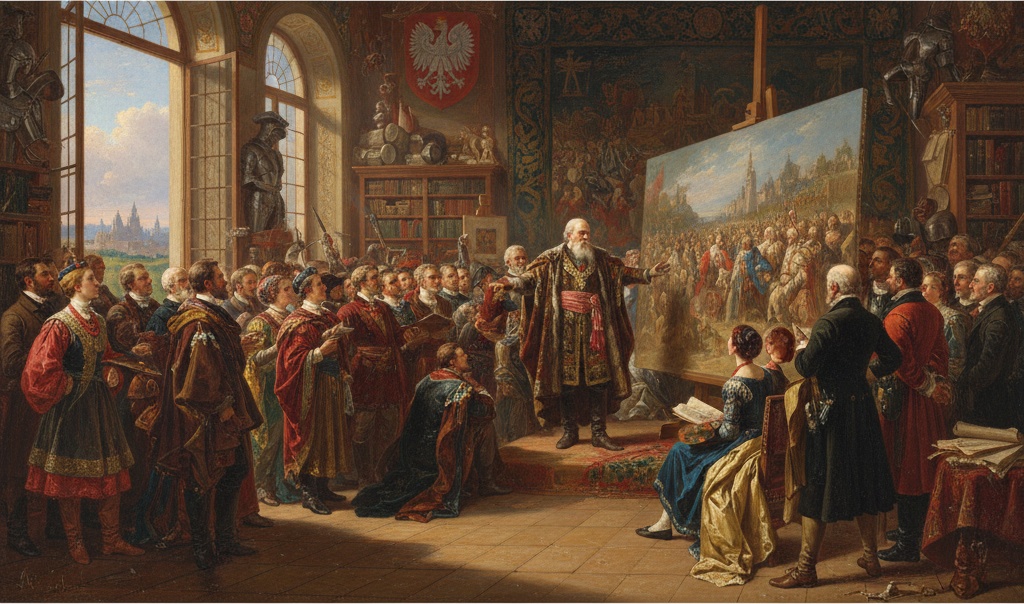
 Shuiskiis czars at the Seym in Warsaw
Discover 'Shuiskiis Czars at the Seym,' a monumental Romantic painting by Jan Matejko. Witness Polish history vividly portrayed! Hand-painted reproduction available.
Matejko's breakthrough came with works like Stańczyk (1862), a painting that instantly captivated the Polish imagination. Depicting the court jester of King Sigismund I, not in a moment of merriment but lost in contemplation amidst a lavish ball, it’s a poignant meditation on national responsibility and the weight of political crisis. The jester, alone and burdened by the loss of Smolensk, embodies the collective anxiety of a nation facing adversity. This wasn't simply a historical portrait; it was a contemporary allegory resonating with the anxieties of partitioned Poland. Rejtan (1866) further cemented his reputation. The painting dramatically portrays Tadeusz Rejtan’s desperate attempt to prevent the ratification of the First Partition in 1773, a scene charged with emotional intensity and patriotic fervor. Later masterpieces like Union of Lublin (1869), Astronomer Copernicus, or Conversations with God (1873) and the colossal Battle of Grunwald (1878) continued to explore pivotal moments in Polish history, each canvas a meticulously researched and emotionally charged spectacle. These weren’t just paintings; they were national shrines rendered in oil and canvas.
Romanticism & Realism in Matejko’s Style: Blending Emotion with Detail
Matejko's artistic style is often described as a compelling fusion of Romanticism and realism. He embraced the Romantic emphasis on emotion, drama, and national themes, imbuing his paintings with a palpable sense of passion and urgency. However, unlike some of his Romantic contemporaries who favored idealized landscapes or fantastical subjects, Matejko was deeply committed to historical accuracy. His canvases are meticulously researched, filled with detailed depictions of costumes, architecture, and weaponry. He wasn’t interested in creating abstract allegories; he wanted to recreate the past as vividly and authentically as possible. This commitment to realism extended to his portrayal of human figures—his characters aren't idealized heroes but complex individuals grappling with difficult choices and profound emotions. The result is a unique style that combines historical rigor with dramatic flair, making his paintings both informative and deeply moving. He masterfully employed chiaroscuro – the interplay of light and shadow – to heighten emotional impact and draw the viewer into the heart of the scene.
The Painter as National Bard: Matejko's Legacy and Impact on Polish Identity
Jan Matejko became more than just a painter; he was a national bard, a visual poet who articulated Poland’s collective memory and aspirations. His works weren’t confined to galleries—they were reproduced in countless prints and circulated widely throughout Polish society, becoming powerful symbols of national identity. He played a crucial role in shaping the way Poles understood their own history, fostering a sense of unity and pride during a time of political fragmentation. His influence extended beyond the realm of art; he also contributed financially to the January Uprising of 1863, demonstrating his unwavering commitment to the Polish cause. Later in life, as director of the Kraków Academy of Fine Arts (later renamed the Jan Matejko Academy of Fine Arts), he nurtured a new generation of artists who carried on his legacy. While his style has sometimes been criticized for its theatricality and perceived lack of nuance, there’s no denying the profound impact he had on Polish culture and national consciousness.
Collecting Jan Matejko Today: Preserving a Vision of Poland’s Past
Today, owning a reproduction of a Jan Matejko painting is more than just acquiring a beautiful artwork; it's connecting with a powerful legacy. OriginalUniqueArt.com offers meticulously crafted handmade oil paintings that capture the detail and emotional depth of Matejko’s originals. These reproductions allow you to bring these iconic scenes into your home, preserving a vision of Poland’s past for generations to come. Whether you're drawn to the poignant solitude of Stańczyk, the dramatic struggle of Rejtan, or the epic scale of Battle of Grunwald, these paintings serve as a powerful reminder of Poland’s enduring spirit and unwavering pursuit of independence. Explore our collection today and discover the timeless beauty and historical significance of Jan Matejko's masterpieces.