

 Preview
 Send
Send Share
Share
 Details
 Guide
Guide

 Download
 Similars
 X-Ray
X-Ray Diaporama
 Stats
StatsLieu dit II (rot)
 Oil
Oil- WallArt
- Contemporary Art
 1989
1989- Contemporary
 218.0 x 314.0 cm
 Lentos Kunstmuseum Linz
 Read More
The artwork displayed on this page is protected by copyright law, which means we cannot legally create or sell an identical reproduction. This protection is enforced under international agreements such as the Berne Convention and by national laws, including those outlined by the U.S. Copyright Law - Title 17.
As a respectful and legal alternative, we offer custom, hand-painted artworks inspired by the original. Our skilled and professional artists carefully study the original's style, mood, and artistic essence to create a new, unique piece that evokes the same feeling - while remaining an original creation in its own right.
This method fully complies with copyright regulations because it does not involve copying or duplicating the protected artwork. Instead, it is a creative reinterpretation - a new painting that is influenced by the original but not identical to it.
Hand Made Oil Reproduction
Hand-painted oil on canvas in your size and frame, made to order by our artists. ( Switch to Print Switch to Digital Image)




































Pick from our preset sizes that match the artwork's original proportions.

Type the width and the height you need, to fit your frame or your wall. This is hand-painted, so for a size with a different shape the artist can paint a bit more around the picture, or cut a bit — you choose. We send you a digital mockup to approve before the painting starts. The picture shown on this page does not show the real result — only the mockup does.
After order, OriginalUniqueArt.com team will email client for instructions and provide a mockup preview
Worldwide Delivery () in 3/4 weeks instead of standard 5 weeks. (26 October). No compromise on quality.

Free Worldwide Express Shipping

High-Quality Linen Canvas

Full Shipping Insurance

Customs Tax Refund Guarantee

True Color Matching Guarantee

100-Day Return Policy (Defects Only)

100% Money-Back Guarantee

Bulk Discount Offer
 Glass option is only available in size under 110 CM

Lieu dit II (rot)
Reproduction Medium
Reproduction Size
-


Total Price
$ 300
A Symphony of Crimson Chaos
In the vast, immersive expanse of Lieu dit II (rot), the viewer is immediately plunged into a visceral, monochromatic world where color ceases to be merely a pigment and becomes an environment. Created in 1989 by the enigmatic German artist Jan Appel, this monumental oil painting—measuring a staggering 218 x 314 cm—commands the space it inhabits with an unapologetic intensity. The work is a masterclass in the use of red, utilizing a spectrum of scarlet, crimson, and deep vermilion to create a textured landscape that feels both tactile and atmospheric. At first glance, the composition presents a sense of profound disarray, as if a moment of creative destruction has been frozen in time. Scattered across the canvas are fragments of red fabric, scraps of paper, and even the sharp, metallic presence of scissors, all layered within a sea of crimson that blurs the line between painting and assemblage.
The technique employed by Appel in this late-career masterpiece suggests a deep engagement with the physical properties of his medium. Rather than seeking a smooth, illusionistic finish, the artist embraces the raw, sculptural quality of oil paint combined with mixed media elements. The way the fabric pieces interact with the painted surface creates a rhythmic, almost percussive visual texture, drawing the eye through a labyrinth of folds and edges. This approach evokes the spirit of late 20th-century abstraction, where the act of creation is as much about the physical struggle with materials as it is about the final image. For the collector or interior designer, this piece offers a profound sense of depth; its sheer scale and complex layering allow it to serve as a powerful focal point that changes character depending on the light and the angle of observation.
Historical Echoes and Emotional Resonance
To understand the turbulent energy of Lieu dit II (rot), one must consider the historical weight carried by Jan Appel. Though often remembered for his revolutionary political activism in early 20th-century Germany, Appel’s later artistic output reflects a lifetime of navigating social and structural upheaval. The "chaos" within this painting—the scattered remnants and the sense of fragmentation—can be read as a metaphor for the fractured nature of modern existence and the beautiful, messy process of reconstruction. There is a profound tension between the destruction suggested by the discarded scraps and the vibrant, life-affirming power of the red hue itself. It is an artwork that does not merely sit on a wall; it breathes with a restless, revolutionary spirit.
For those looking to integrate such a commanding work into a curated space, Lieu dit II (rot) offers unparalleled emotional impact. In a contemporary interior, this reproduction serves as a bold statement of sophistication and intellectual depth. It provides a warm yet provocative energy that can anchor a minimalist room or add a layer of complex history to a more traditional setting. The painting invites contemplation, prompting the viewer to find order within the disorder and beauty within the fragments. Owning a piece of this magnitude is an opportunity to possess a fragment of German art history—a work that captures the raw, unyielding pulse of human expression.
Questions & Answers
What national origin stands behind the Contemporary Art of "Lieu dit II (rot)"?
The Contemporary Art work "Lieu dit II (rot)" was made by an artist born in Germany.
Does "Lieu dit II (rot)" have an augmented reality preview?
"Lieu dit II (rot)" by Jan Appel can be previewed on your own wall with the artwork's AR Preview page, using augmented reality on a compatible device.
Which room is "Lieu dit II (rot)" by Jan Appel recommended for, given its colors?
The dark colors of "Lieu dit II (rot)" by Jan Appel match its recommended space: a coworking.
Artist Biography
The Revolutionary Spirit of Jan Appel
Jan Appel, a figure whose life was inextricably woven into the turbulent fabric of early 20th-century Germany, remains one of history's most enigmatic protagonists. Born in 1890 in Mecklenburg, Germany, his path was shaped by the fires of political upheaval and the heavy industry of the shipyard. While often remembered through the lens of his radical activism, Appel’s identity was a complex tapestry of the proletarian intellectual and the revolutionary theorist. His early years were defined by a deep commitment to social change, joining the SPD in 1908 and later becoming a prominent voice within the Left Communist movement. The echoes of the German Revolution of 1918 resonate through his biography, marking him as a man who did not merely observe history but actively sought to steer its course.
His life was characterized by a relentless pursuit of ideological clarity and action. From his time serving in the army to his labor at the Vulcan Werft Hamburg shipyard, Appel lived at the heart of the class struggle. He was a man of movement—both political and physical—notably participating in the strike waves that demanded peace and justice during the Great War's aftermath. His involvement with the Spartacus League and the KPD, and his role as chairperson of the Revolutionary Shop Stewards, placed him at the center of the most intense political debates of his era. Even his daring exploits, such as the hijacking of a steamship to reach Russia on behalf of the KAPD, serve as legendary markers of a life lived in defiance of established orders.
Artistic Expression Amidst Turmoil
Though primarily recognized for his revolutionary activities and theoretical contributions, Jan Appel possessed an artistic side that offered a different window into his soul. As a painter, he utilized the canvas to express the profound views shaped by the tumultuous era in which he lived. His art was not a mere hobby but a medium through which the visceral realities of revolution and social upheaval could be reflected. In his work, one finds the echoes of a man attempting to capture the essence of a world in flux, translating the chaos of political struggle into visual form.
The scarcity of documented works by Appel adds to his mystique, making each piece a precious fragment of a larger, more complex narrative. His paintings serve as a testament to the intersection of art and activism, where the brushstroke becomes an extension of the political manifesto. While he may not have achieved the widespread recognition of traditional masters, his ability to channel the spirit of early 20th-century Germany through his aesthetic lens ensures his place in the historical dialogue between creativity and conviction.
A Legacy of Resistance and Reflection
The legacy of Jan Appel is one of profound complexity, bridging the gap between the shipyard and the studio, between theory and lived experience. His life serves as a vital study of the German revolutionary heritage, illustrating how personal conviction can drive an individual to participate in the most significant shifts of their time. Through his autobiography and his documented political interventions, we gain a glimpse into the mind of a man who viewed the world through the dual lenses of class struggle and artistic reflection.
Today, Appel’s story continues to intrigue historians and art enthusiasts alike. He remains an essential figure for understanding the multifaceted nature of German identity during the revolutionary period. Whether viewed as a theorist, an activist, or a painter, Jan Appel stands as a symbol of the enduring power of the human spirit to seek meaning and justice within the most turbulent of historical currents.

Jan Appel
1890 - 1985 , Germany
Quick Facts
- Full Name: Jan Appel
- Nationality: German
- Notable Artworks: ['Lieu dit II (rot)']
- Note: Jan Appel was a German revolutionary and painter.
- Place Of Birth: Bremen, Germany
- Date Of Birth: 1890
- Date Of Death: 1985
Related Articles

Abstract Expressionism's 10 Defining Masterpieces |
Explore 10 defining Abstract Expressionism masterpieces by Pollock, Rothko & de Kooning. Discover the stories behind these iconic paintings and find museum-quality art reproductions to elevate your home decor on .

Geometric Abstraction's 10 Defining Masterpieces | Art for Your Home - OriginalUniqueArt
Explore 10 defining masterpieces of Geometric Abstraction! Discover Kandinsky, Mondrian & Malevich’s iconic works. Find museum-quality art reproductions and curated decor ideas to elevate your home at OriginalUniqueArt.com.
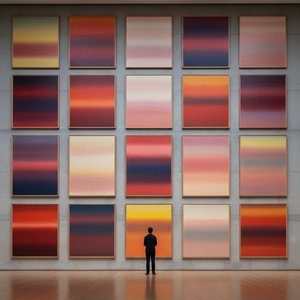
Mark Rothko's Masterpieces: 25 Paintings That Define Abstract Expressionism | OriginalUniqueArt
Explore 25 iconic Mark Rothko paintings that define Abstract Expressionism. Discover the stories, colors & emotions behind these masterpieces. Find museum-quality art reproductions and curated decor ideas at OriginalUniqueArt.com.

Crimson Threads of Narrative: Exploring Symbolism & Representation in Artworks Featuring the Red Dress
Explore the rich symbolism of the red dress in art history! From ancient power displays to iconic portraits like Cézanne’s 'Madame Cezanne', discover the cultural and artistic significance behind this captivating color. Expert analysis & insights.

Kandinsky's Masterpieces: 25 Paintings That Define Abstract Art | OriginalUniqueArt
Journey through Wassily Kandinsky's 25 most iconic abstract paintings. Explore his revolutionary use of color, form & spiritual expressionism. Find museum-quality Kandinsky reproductions and elevate your home decor with OriginalUniqueArt.com. Discover all masterpieces on OriginalUniqueArt.com!
