Preview
 Send
Send Share
Share
 Details
 Guide
Guide

 Download
 Similars
 X-Ray
X-Ray Diaporama
 Q&A
Q&A Stats
StatsPastoral


 Read More
Giclée / Art Print
Museum-quality giclée or canvas print with fast production and flexible finish options. ( Buy Hand Made Painting Switch to Digital Image)




P118B $10

P118H $10

P118W $10

P438Z $10

P508JH $12

P508YH $12

P805H $10

P805Z $10

P919BZ $10

P919G $10

P919XJ $10

P959ZH $10

P968JZ $12

W106C $8

W218G $10

W218JH $8

W218Y $10

W307PJ $10

W316G $10

W316PJ $8

W316Y $10

W398PJ $8

W4111J $10

W500HY $15

W500JH $15

W692G $12

W849H $8

W940BG $15

W953PJ $8




Pick from our preset sizes that match the artwork's original proportions.

Type the width and the height you need, to fit your frame or your wall. A print can only be cut, never made bigger than the picture, so a size with a different shape loses a part of the image. We send you a digital mockup to approve before we print anything. The picture shown on this page does not show the real cut — only the mockup does.
Worldwide Delivery () in 2 weeks instead of standard 4/5 weeks. (11 November)

Free Worldwide Express Shipping

High-Quality Linen Canvas

Full Shipping Insurance

Customs Tax Refund Guarantee

True Color Matching Guarantee

100-Day Return Policy (Defects Only)

100% Money-Back Guarantee

Bulk Discount Offer
 Glass option is only available in size under 110 CM

Pastoral
Giclée / Art Print
Reproduction Size
-


Total Price
$ 81
A Serene Encounter with the Scottish Highlands
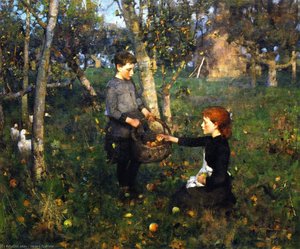
In the quietude of the late nineteenth century, Sir James Guthrie captured a moment of profound stillness that continues to resonate with the modern soul. His 1887 masterpiece, Pastoral, serves as more than just a depiction of rural life; it is an invitation into a world where time seems to decelerate. The painting presents a breathtakingly tranquil scene of a man tending to his flock, a composition that masterfully balances the human presence with the vast, breathing landscape of the Scottish countryside. As the eye wanders across the canvas, one encounters sheep scattered naturally throughout the field, their forms creating a rhythmic depth that draws the viewer into the heart of the meadow. The inclusion of two delicate birds, poised almost imperceptively within the frame, adds a layer of living detail that heightens the sense of an undisturbed, breathing ecosystem.
The technical brilliance of Guthrie lies in his ability to marry the ruggedness of nature with a soft, emotive light. Utilizing a palette of warm, sun-drenched colors, the artist evokes an immediate sense of comfort and nostalgia. His brushstrokes are notably bold and expressive, imbuing the landscape with a subtle energy that prevents the scene from feeling static. Instead, there is a palpable movement in the grass and a vitality in the light that suggests the gentle rustle of wind through the hills. This technique allows the viewer to feel the warmth of the afternoon sun, making the painting not merely an object to be seen, but an atmosphere to be inhabited.
The Soul of the Scottish Landscape
To understand Pastoral, one must understand the spirit of Guthrie himself. As a prominent figure in the Scottish art scene, Guthrie possessed a unique gift for translating the raw, natural beauty of his homeland into something poetic and timeless. This work stands as a testament to his skill in the landscape genre, where he moved beyond mere topographical accuracy to capture the emotional essence of the land. The painting reflects a period when artists sought to find divinity in the everyday—finding the sacred in the simple act of shepherding and the quiet dignity of the pastoral life.
For the discerning collector or interior designer, this piece offers an unparalleled opportunity to introduce a sense of peace and historical weight into a living space. The painting’s ability to anchor a room with its warm tones and balanced composition makes it a versatile choice for both classical and contemporary settings. Whether placed in a sunlit study or a grand hallway, Pastoral acts as a window into a more tranquil era, providing a focal point that inspires contemplation and provides a respite from the frenetic pace of modern existence. Owning a high-quality reproduction of this work is not simply about acquiring art; it is about bringing a piece of the enduring Scottish spirit into one's personal sanctuary.
Questions & Answers
Can I preview "Pastoral" by James Guthrie before ordering?
To preview a reproduction of "Pastoral" by James Guthrie, open the artwork's Preview page.
What color intensity does "Pastoral" by James Guthrie have?
The colors in "Pastoral" by James Guthrie have a balanced intensity.
Is "Pastoral" by James Guthrie a painting, a drawing or a print?
In the catalog, "Pastoral" by James Guthrie is filed as wall art. The category helps find similar works.
Artist Biography
The Soul of Scottish Realism
Born in Greenock, United Kingdom, Sir James Guthrie emerged as a pivotal figure in the landscape of late nineteenth-century art. Though he initially embarked on a path toward a legal career at Glasgow University, the call of the canvas proved irresistible, leading him to abandon his law studies in 1877 to pursue painting. Unlike many of his contemporaries who sought refinement in the studios of Paris, Guthrie followed a more solitary and self-taught trajectory. While he received brief mentorship from figures such as James Drummond in Glasgow and John Pettie in London, his artistic identity was forged through a deep, personal engagement with the natural world and the works of the French Realists.
His development was profoundly shaped by the influence of Jules Bastien-Lepage, whose approach to realism provided a blueprint for Guthrie’s own mastery of atmosphere and light. This connection helped him become a prominent member of the Glasgow Boys, a group known for pushing the boundaries of traditional Scottish painting. His work often moved beyond mere documentation, seeking instead to capture the fleeting sensations of light and air through loose brushstrokes and a vibrant, yet often muted, color palette. Whether depicting the quiet dignity of rural life or the intimate details of portraiture, Guthrie possessed a rare ability to translate the emotional weight of a scene onto the canvas.
Mastery of Light and Landscape
Guthrie’s oeuvre is celebrated for its evocative power, particularly in his ability to imbue landscapes with a sense of profound tranquility. In works such as Pastureland, he demonstrates a symphonic command over light and shadow, creating an immersive experience of the Scottish countryside. His technique often embraced elements of Impressionism, prioritizing mood and sensation over rigid, academic precision. This is evident in his use of textures—the soft fur of cattle, the swaying grass of a field, or the hazy luminosity of a summer day—all rendered with a sensitivity that speaks to the rhythms of nature.
His landscapes were frequently inspired by the Scottish Borders, specifically locations like Cockburnspath, where he lived for much of his life. These settings provided the backdrop for some of his most enduring achievements, including:
- A Hind's Daughter: A masterpiece that serves as a meditation on childhood innocence and the quiet dignity of rural existence.
- Schoolmates: An evocative piece that showcases his skill in capturing human connection within a natural setting.
- Pastoral: A work held within the Scottish National Gallery that exemplifies his ability to capture atmospheric beauty.
Legacy and Recognition
Throughout his career, Guthrie achieved significant institutional recognition, reflecting his importance to the British art scene. His ascent through the ranks of the Royal Scottish Academy saw him elected as an associate in 1888 and a full member in 1892, eventually succeeding Sir George Reid as President of the RSA. This professional prestige was matched by personal honors, including being knighted in 1903 for his immense contributions to the arts.
Beyond his landscapes and portraits, Guthrie’s historical significance is cemented by his ability to capture the spirit of an era. His later years saw him commissioned for monumental tasks, such as the large-scale group portrait Statesmen of World War I, completed in 1930. This work, depicting seventeen politicians and statesmen, stands as a testament to his skill in handling complex compositions and historical gravity. Today, Guthrie is remembered not just as a painter of Scottish Realism, but as an artist who could capture the very essence of peace, light, and the enduring beauty of the natural world.

James Guthrie
1859 - 1930 , United Kingdom
Quick Facts
- Artistic Movement Or Style: Scottish Realism and Glasgow Boys
- Artists Who Influenced This Artist: ['Jules Bastien-Lepage']
- Full Name: Sir James Guthrie
- Nationality: Scottish
- Notable Artworks:
- Pastureland
- A Hind's Daughter
- Schoolmates
- Hard at It
- Statesmen of World War I
- Place Of Birth: Greenock, United Kingdom
- Date Of Birth: 1859
- Date Of Death: 1930
Related Articles

Masterpieces of Nature: The Top 25 John Constable Artworks
Explore John Constable's iconic landscapes and Romantic masterpieces. Discover the full collection online at OriginalUniqueArt.com.

Romantic Landscapes: 10 Masterpieces for Your Home | OriginalUniqueArt
Journey through 10 Romantic landscape masterpieces by Friedrich, Turner & Cole. Explore emotional art, sublime nature scenes & iconic 19th-century paintings. Find museum-quality reproductions for your home at OriginalUniqueArt.com – discover the full collection online!

Evocations of Place: A Historical Journey Through Landscape Art
Explore the rich history of landscape art with OriginalUniqueArt. Discover renowned artists, movements like Impressionism & Romanticism, and expert guidance for collecting timeless pieces. Find your perfect serene escape today!
Idyllic Visions: Exploring the Pastoral Tradition in Western Art – Themes, Techniques & Enduring Appeal
Explore the rich history of pastoral art from classical Arcadia to contemporary interpretations. Discover key artists, themes & collecting tips at OriginalUniqueArt.

Idyllic Visions: Exploring the Pastoral Scene in Art History – From Arcadia to Modern Interpretations
Explore the captivating history of pastoral art from classical Arcadia to modern masterpieces. Discover key artists like Millet & Cole at OriginalUniqueArt. Find serene landscape paintings for your home.