Early Life, Family and Training
James Abbott McNeill Whistler was born on July 10, 1834, in Lowell, Massachusetts. His childhood was shaped by the movement of his family, following the career of his father, George Washington Whistler, a railroad engineer. In 1842, the family moved to St. Petersburg, Russia, a transition that would fundamentally alter the course of the young boy's life. It was there, amidst the atmosphere of a foreign city, that he received his first drawing lessons. By the age of eleven, his talent led him to enroll in the Imperial Academy of Arts in St. Petersburg, where he began to formalize his understanding of form and line.
Life took a difficult turn in 1849 when his father died from cholera. This loss marked a period of transition for the family as they eventually returned to the United States. Seeking a more stable or perhaps more traditional path, James Abbott McNeill Whistler entered the United States Military Academy at West Point when he was 17. However, the rigid structure of military life did not suit his temperament. He eventually left the academy, choosing instead to follow the path of a professional artist, a decision that would lead him away from the structured discipline of his youth and toward the experimental studios of Europe.
The Parisian Years and Artistic Development
In 1855, Whistler left the familiar surroundings of his youth to move to Paris, a city where he could finally devote himself entirely to his art. He sought out formal training, studying under Sébastien Bouré and later entering the studio of Gleyre in 1856. These years were a period of intense absorption. He found himself drawn to the ideas of French Realism and the works of the Barbizon School painters, learning to look at the world with a more direct, unadorned eye. He was not merely a student of technique; he was a participant in a changing era, finding himself in the company of Manet, Monet, and Degas. These encounters helped shape his understanding of how light and color could be used to capture a mood rather than just a literal scene.
His time in Paris was less about following a set path and more about finding his own voice amidst a sea of new ideas. He began to move away from the need to replicate reality exactly, focusing instead on the essence of what he saw. This shift was a quiet rebellion against the heavy, moralizing stories that many of his contemporaries felt art had to tell. Instead, he looked for the subtle nuances of atmosphere. He was learning to treat a canvas like a musical score, where the arrangement of tones mattered more than the specific details of the subject. This period laid the groundwork for his later belief that art should exist for its own sake, free from the burden of storytelling.
Life and Work in London
After leaving Paris, Whistler arrived in London in 1859. He spent much of his life here, becoming a central figure in the city's artistic circles. He spent many hours along the Thames River, capturing its shifting light and movement through both paintings and etchings. These river scenes became a significant part of his output, reflecting the atmosphere of the water and the sky. His presence in London was marked by a certain social prominence, as he moved through the high-society settings of the time.
His professional standing grew steadily through the decades. In 1884, he was elected an honorary member of the Royal Academy of Fine Arts in Munich. His influence continued to expand, and in 1892, he was named an officer of the Légion d'honneur in France. By 1898, he was chosen as the first president of the International Society of Sculptors, Painters and Gravers. These roles reflected his deep involvement in the organized art world of the late nineteenth century.
Technique and Artistic Style
Whistler sought to strip away the need for storytelling or moral lessons in his paintings. He believed in the principle of "art for art's sake," a conviction that led him to focus on the pure relationship between color and form. Rather than trying to replicate the world with photographic precision, he focused on the way light and shadow could create a specific mood. This approach made him a founder of Tonalism, a style that prioritized atmosphere and the subtle gradations of color over sharp, detailed edges. His work often feels like a quiet study in how one shade of grey might melt into another.
There was a musicality to his method that went beyond mere metaphor. He frequently gave his works titles such as "arrangements," "harmonies," and "nocturnes," treating the canvas much like a musical score where color functioned as a note. This connection between sight and sound helped him move toward abstraction. He was also deeply moved by the compositions found in Japanese prints, or ukiyo-e. From these, he learned how to use decorative patterns and asymmetrical layouts to guide the eye through a scene without relying on a central, dramatic subject.
His ability to capture the fleeting, misty quality of light was most evident in his studies of the Thames. In these works, the boundaries between the river, the sky, and the fog often dissolve into a single, harmonious tone. He used a limited palette to achieve these effects, often working with muted colors to evoke a sense of stillness. This restraint allowed him to explore the essence of a landscape or a portrait through its tonal values rather than its literal details.
Key Works and Famous Portraits
Whistler’s brush often sought the quiet moments of life. In 1858-59, he painted At the Piano, a scene capturing two women lost in music. This work shows his early interest in the intimacy of everyday life. By 1860, his focus had shifted toward the river, as seen in Wapping. This piece reflects a serene atmosphere, depicting people gathered by the water's edge near the industrial dockyards of East London.
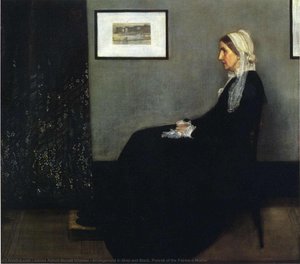
As his style matured, he moved away from literal storytelling toward his "arrangements." He treated his subjects like musical notes, focusing on how color and light could create a specific mood. His 1871 work, Arrangement in Grey and Black No. 1, became widely known as Whistler's Mother. While many saw it as a simple portrait of his mother, Anna McNeill Whistler, he viewed it through the lens of tonal harmony and formal composition.
His experiments with light reached a peak in 1875 with Nocturne in Black and Gold – The Falling Rocket. This painting moved even further from reality, using a limited palette to capture the fleeting essence of a night scene. He continued this exploration of light and color in other works, such as The Little White Girl Symphony in White, No. 2, painted about 1864.
- At the Piano (1858-59)
- The Little White Girl Symphony in White, No. 2 (about 1864)
- Wapping (1860)
- Arrangement in Grey and Black No. 1 (Whistler's Mother) (1871)
- Nocturne in Black and Gold – The Falling Rocket (1875)
Legal Battles and Controversy
The friction between Whistler’s aesthetic ideals and the expectations of the public often led to heated confrontations. In 1878, this tension reached a breaking point when he brought a libel suit against a prominent critic. The conflict was sparked by the critic's reaction to his painting, Nocturne in Black and Gold – The Falling Rocket. The critic had dismissed the work in a way that Whistler felt attacked his professional integrity and his right to define his own art. He sought to defend his autonomy, arguing that his paintings were intended as arrangements of color and form rather than literal, photographic representations of the world.
The legal battle was a significant moment in the history of art, but the outcome was a bittersweet victory. While Whistler technically won the case, the damages awarded to him were a mere farthing. The financial reality of the trial was far more punishing than the verdict itself. The immense costs of the legal proceedings eventually bankrupted him, leaving him in a precarious position despite his moral win. It was a heavy price to pay for the right to paint according to his own vision.
Legacy and Influence
Whistler’s insistence on "art for art’s sake" changed the way people thought about the purpose of a painting. By arguing that a work should be judged on its own aesthetic qualities rather than its ability to tell a moral story, he helped fuel the Aesthetic movement. He moved the conversation away from what a picture represented and toward how it was composed. This shift helped pave the way for the modern era, as his focus on the arrangement of color and light prefigured the abstraction that would define much of the coming century.
His influence reached across the Atlantic, leaving a lasting mark on American art. He showed that an artist could find profound meaning in the subtle gradations of a landscape or the quiet mood of a room. By stripping away unnecessary detail to find the essence of a scene, he taught generations of artists to look for the atmospheric truth in their subjects. His ability to capture the fleeting, silvered light of a fog or the soft shadows of twilight offered a new way of seeing the world.
- Arrangement in Grey and Black No. 1 (1871)
- Nocturne in Black and Gold – The Falling Rocket (1875)
- Arrangement in Yellow and Gray (about 1876-1878)
Where to See the Works Today
Finding the traces of Whistler's hand requires traveling through the cities that shaped his life and his restless spirit. In Paris, the Musée d'Orsay houses his famous Arrangement in Grey and Black No. 1, a painting that many recognize by its more common name. It remains one of the most recognizable images from his time in Europe, capturing a quiet, domestic moment through a lens of careful tonal balance.
London remains a central place for his legacy, with the Tate Gallery holding several of his works. These pieces offer a way to see how he navigated the English art scene and his deep connection to the river and the atmosphere of the city. Across the Atlantic, the National Gallery of Art in Washington holds Wapping, a piece that reflects his ability to find beauty in everyday scenes. In New York, the Metropolitan Museum of Art preserves Arrangement in Black: Girl Reading, allowing viewers to observe his specific approach to light and composition.
- Arrangement in Grey and Black No. 1
- Wapping
- Arrangement in Black: Girl Reading

 Switch to Print
 Read More







































 For artworks or reproductions larger than 105 cm (approximately 41 inches) on any side, the frame will be shipped as a kit, disassembled. This method ensures safe delivery and prevents damage during transport.


 Preview
 Send
Send Share
Share
 Details
 Guide
Guide

 Download
 Similars
 X-Ray
X-Ray Diaporama
 Q&A
Q&A Stats
Stats