() ·

A painting made for you, by hand

Falling rocket

Hand Made Oil Reproduction

Hand-painted oil on canvas in your size and frame, made to order by our artists. ( Switch to Print Switch to Digital Image)

Collectible Description

James Abbott McNeill Whistler’s evocative ‘Falling Rocket,’ painted during the Aesthetic movement, captures a mesmerizing nighttime beach scene—a lone figure gazing upwards at a fiery rocket display beneath an umbrella, embodying artistic contemplation amidst vibrant celebration.

Artist Biography

A leader of Aestheticism known for Nocturnes. Discover the atmospheric beauty of his iconic works today.

from ·

Chapter 1

How large should it be?

Slide to change the size; the picture on the left shows the frame at its real width. The proportions of the original are kept.

Standard
custom
CM
INCH

Pick from our preset sizes that match the artwork's original proportions.

width
height

Type the width and the height you need, to fit your frame or your wall. This is hand-painted, so for a size with a different shape the artist can paint a bit more around the picture, or cut a bit — you choose. We send you a digital mockup to approve before the painting starts. The picture shown on this page does not show the real result — only the mockup does.

Chapter 2

How should it arrive?

Choose the edges of the stretched canvas

Choose your frame

Corner sample of the WhiteWrap canvas edge finish, stretched on solid wood bars
White $1
Corner sample of the BlurSideWrap canvas edge finish, stretched on solid wood bars
Blurside $1
Corner sample of the ExtendedWrap canvas edge finish, stretched on solid wood bars
Extended $1
Corner sample of the P118B picture frame: moulded polystyrene, 5 cm wide and 3 cm thick
P118B $10
Corner sample of the P118H picture frame: moulded polystyrene, 5 cm wide and 3 cm thick
P118H $10
Corner sample of the P118W picture frame: moulded polystyrene, 5 cm wide and 3 cm thick
P118W $10
Corner sample of the P438Z picture frame: moulded polystyrene, 5.5 cm wide and 3.5 cm thick
P438Z $10
Corner sample of the P508JH picture frame: moulded polystyrene, 7 cm wide and 3.5 cm thick
P508JH $12
Corner sample of the P508YH picture frame: moulded polystyrene, 7 cm wide and 3.5 cm thick
P508YH $12
Corner sample of the P805H picture frame: moulded polystyrene, 5 cm wide and 3.5 cm thick
P805H $10
Corner sample of the P805Z picture frame: moulded polystyrene, 5 cm wide and 3.5 cm thick
P805Z $10
Corner sample of the P919BZ picture frame: moulded polystyrene, 7 cm wide and 3.5 cm thick
P919BZ $10
Corner sample of the P919G picture frame: moulded polystyrene, 7 cm wide and 3.5 cm thick
P919G $10
Corner sample of the P919XJ picture frame: moulded polystyrene, 7 cm wide and 3.5 cm thick
P919XJ $10
Corner sample of the P959ZH picture frame: moulded polystyrene, 5 cm wide and 3 cm thick
P959ZH $10
Corner sample of the P968JZ picture frame: moulded polystyrene, 6 cm wide and 4 cm thick
P968JZ $12
Corner sample of the W106C picture frame: solid wood, 5 cm wide and 3 cm thick
W106C $8
Corner sample of the W218G picture frame: solid wood, 5 cm wide and 3 cm thick
W218G $10
Corner sample of the W218JH picture frame: solid wood, 5 cm wide and 3 cm thick
W218JH $8
Corner sample of the W218Y picture frame: solid wood, 5 cm wide and 3 cm thick
W218Y $10
Corner sample of the W307PJ picture frame: solid wood, 6 cm wide and 3 cm thick
W307PJ $10
Corner sample of the W316G picture frame: solid wood, 6 cm wide and 3 cm thick
W316G $10
Corner sample of the W316PJ picture frame: solid wood, 6 cm wide and 3 cm thick
W316PJ $8
Corner sample of the W316Y picture frame: solid wood, 6 cm wide and 3 cm thick
W316Y $10
Corner sample of the W398PJ picture frame: solid wood, 5 cm wide and 3 cm thick
W398PJ $8
Corner sample of the W4111J picture frame: solid wood, 6.5 cm wide and 3.5 cm thick
W4111J $10
Corner sample of the W500HY picture frame: solid wood, 7 cm wide and 5 cm thick
W500HY $15
Corner sample of the W500JH picture frame: solid wood, 7 cm wide and 5 cm thick
W500JH $15
Corner sample of the W692G picture frame: solid wood, 8 cm wide and 4 cm thick
W692G $12
Corner sample of the W849H picture frame: solid wood, 5 cm wide and 3 cm thick
W849H $8
Corner sample of the W940BG picture frame: solid wood, 7.5 cm wide and 4.5 cm thick
W940BG $15
Corner sample of the W953PJ picture frame: solid wood, 6 cm wide and 3.5 cm thick
W953PJ $8
Corner sample of the H24-GOLD picture frame: carved wood with gesso, 10 cm wide and 6 cm thick
H24-GOLD $30
Corner sample of the H24-SILVER picture frame: carved wood with gesso, 10 cm wide and 6 cm thick
H24-SILVER $30
Corner sample of the H36-GOLD picture frame: carved wood with gesso, 15 cm wide and 6.5 cm thick
H36-GOLD $45
Corner sample of the H36-SILVER picture frame: carved wood with gesso, 15 cm wide and 6.5 cm thick
H36-SILVER $45
Frame preview
Framed

Moulding: . Overall size with the frame: .

Chapter 3

Who paints it, and should anything change?

Examples of what can be changed: Replace face with customer photo; Add pet (e.g., replace cat with dog); Include hidden message in background; Change background landscape or elements.
After order, OriginalUniqueArt.com team will email client for instructions and provide a mockup preview

Worldwide Delivery () in 3/4 weeks instead of standard 5 weeks. (9 November). No compromise on quality.

Chapter 4

The finishing touches

A nameplate, as in a museum?

Engraved Bronze Plaque Details

This elegant plaque features the artist's name and the title of the artwork, finely engraved for a timeless presentation.

It is made from bronze with a refined, elegant finish. The text is precisely laser-engraved for a sharp and permanent result. Measuring 9x2 cm, the plaque is compact yet easy to read. It's built to be durable and scratch-resistant, offering a professional, museum-quality look. Mounting is simple thanks to the included adhesive backing.

Transparent Acrylic Plaque Details

The plaque includes essential engraved details such as the artist's name, the title of the artwork, the date it was created, the type of media used-like oil on canvas or watercolor-a brief description of the piece, and a QR code that links to the complete artwork information.

It is crafted from clear acrylic, offering a sleek, modern appearance. The text is UV-engraved in black to ensure strong visual contrast. With a size of 10x15 cm, it ensures optimal readability. It comes equipped with two metal hooks for secure wall mounting. The plaque is designed to be weather-resistant, making it suitable for various environments, and it includes interactive features that work seamlessly with smartphone scanning.

Black Acrylic Plaque Details

This elegant plaque includes engraved information such as the artist's name, the title of the artwork, the date it was created, the type of media used (like oil on canvas or watercolor), a short description of the artwork, and a QR code for quick access to more information.

The plaque itself is made from refined black acrylic with a premium finish. The text is laser-engraved in white for high contrast and readability. Its size is 10x15 cm, designed to be easy to read. It comes with two metal hooks for professional mounting. The design is sleek and fits any interior style. It is also weather-resistant and durable, with built-in digital integration for mobile compatibility.

A protective varnish?

When do you need it?

Chapter 5

Your painting, as you ordered it

Falling rocket

Reproduction Medium

Reproduction Size

-

Elite Senior Artist

More detail, finesse, and extra production time

-

Reproduction Frame

-

-

For artworks or reproductions larger than 105 cm (approximately 41 inches) on any side, the frame will be shipped as a kit, disassembled. This method ensures safe delivery and prevents damage during transport.

Professional assembly required - this is not a DIY product.
The kit must be assembled and the canvas stretched by an experienced professional framer, using wood glue (not supplied), a canvas stretching plier and clamps to hold the bars square while the glue dries. Incorrect assembly or uneven canvas tension can permanently damage the artwork and is not covered by our warranty.

  • All solid wood bars are included, precisely cut to size.

  • Assembled with the screws provided, plus wood glue for the corner joints, which is not supplied and must be sourced by your framer.

  • Professional tools are required and not included: a canvas stretching plier (tensioner) and clamps to hold the bars square while the glue dries.

Important:
The corner joints require wood glue, the bars must be held with clamps until the glue is fully dry, and tightening the canvas on the assembled frame requires a canvas stretching plier. None of these are included in the kit. Please arrange an experienced professional framer before ordering this size.

Nameplate

-

-

Protective Varnish

Glossy Varnish (enhances colors, protects against light/moisture)

-

Customize My Artwork

Examples of what can be changed: Replace face with customer photo; Add pet (e.g., replace cat with dog); Include hidden message in background; Change background landscape or elements.

-

Urgent

Worldwide Delivery () in 3/4 weeks instead of standard 5 weeks. (9 November). No compromise on quality.

-

Express Shipping

Worldwide Delivery () in 5 weeks. (16 November).

Included

Total Price

$ 300

Total Price $ 300

Glass option is only available in size under 110 CM

Included with every order

  • Free Worldwide Express Shipping
  • High-Quality Linen Canvas
  • Full Shipping Insurance
  • Customs Tax Refund Guarantee
  • True Color Matching Guarantee
  • 100-Day Return Policy (Defects Only)
  • 100% Money-Back Guarantee
  • Bulk Discount Offer

A Nocturnal Reverie: The Ethereal Glow of Whistler’s ‘Falling Rocket’

In the quietude of a moonless night, where the boundary between the sea and the heavens becomes a blurred whisper of shadow, James Abbott McNeill Whistler’s “Falling Rocket” invites us into a moment of profound contemplation. This masterpiece captures a quintessential seaside scene, centered around a lone figure gazing upward toward a vibrant, descending spectacle. Whether one perceives a celebratory firework or the melancholic descent of a rocket, the composition prioritizes the act of observation itself. As viewers, we are placed alongside the protagonist, sharing in that breathless pause where the world falls away, leaving only the silent, luminous trail of light against the dark expanse.

Whistler’s approach to this piece is a masterclass in the Aestheticism movement, a philosophy that famously championed “art for art’s sake.” Eschewing the heavy-handed moralizing and dramatic storytelling prevalent in much of the 19th-century art world, Whistler focused instead on pure sensory experience. There is no didactic lesson to be found here; rather, there is only the pursuit of beauty. The painting does not seek to tell us a story of triumph or tragedy, but to capture a fleeting moment of visual delight, making it an exquisite choice for those who appreciate art that evokes mood and atmosphere over explicit narrative.

Mastery of Tone and Atmospheric Depth

The technical brilliance of “Falling Rocket” lies in Whistler’s sophisticated use of tonal painting. Moving away from the traditional, high-contrast chiaroscuro, he employed a meticulous layering of deep blacks and muted greens to create an illusionistic depth that feels almost infinite. This technique, often described as atmospheric perspective, allows the viewer to feel the damp, cool air of the coast and the immense weight of the night sky. The subtle gradations of color do not merely represent a landscape; they evoke a sense of stillness and profound quietude, even amidst the energetic descent of the rocket.

Historically, this work emerged during Whistler’s formative years in Paris, a period where he was deeply immersed in the burgeoning Impressionist movement. Yet, true to his rebellious spirit, Whistler deliberately distanced himself from the trend. While his contemporaries were obsessed with capturing the fleeting effects of sunlight, Whistler sought something more permanent and structural through color and tone. This deliberate rejection of popular convention solidified his reputation as a pioneer of independent expression, offering a vision that is both deeply personal and universally evocative.

A Symbol of Aspiration and Timeless Elegance

Beyond its visual splendor, the painting carries a potent symbolic weight. The falling rocket serves as a metaphor for aspiration and ambition—a bright, singular burst of energy that inevitably descends back into the darkness. It represents the ephemeral nature of beauty and the fleeting moments of brilliance that define the human experience. For the discerning collector or interior designer, this piece offers more than just decoration; it provides a focal point of intellectual and emotional depth.

Integrating a high-quality reproduction of “Falling Rocket” into a living space can transform an environment, adding a layer of sophisticated mystery and calm. Its dark, tonal palette is particularly effective in creating a sense of intimacy in study areas, bedrooms, or elegant lounges. It is a work that rewards long periods of looking, offering new layers of shadow and light to discover with every glance, much like the nocturnal mysteries it so beautifully depicts.

Questions & Answers

How strong are the colors of "Falling rocket"?

"Falling rocket" by James Abbott McNeill Whistler is recorded with a subtle color saturation and a monochromatic intensity.

Which period of James Abbott McNeill Whistler's career does "Falling rocket" belong to?

"Falling rocket" represents the Mature Period of James Abbott McNeill Whistler.

Is a download available for "Falling rocket"?

The image of "Falling rocket" by James Abbott McNeill Whistler can be downloaded from the artwork's Download page: a high-resolution digital image download.

More about this painting

Preview AR preview Switch to Print Switch to Digital Image Send
Details Guide Add to favorites Download Similars X-Ray Diaporama Q&A Stats

In numbers

  • 29frames to choose from
  • standard sizes, in its own proportions
  • 5weeks to paint and deliver it
James Abbott McNeill Whistler

James Abbott McNeill Whistler

1834 - 1903, United States of America

Quick facts about James Abbott McNeill Whistler

  • Artistic Movement Or Style: Tonalism & Aestheticism
  • Artists Or Movements Influenced By This Artist:
    • Aesthetic movement
    • Modernism
  • Artists Who Influenced This Artist: ['Velázquez']
  • Full Name: James Abbott McNeill Whistler
  • Nationality: American
  • Notable Artworks:
    • The Forge
    • Whistler's Mother
    • Nocturne in Black and Gold
  • Place Of Birth: Lowell, United States of America
  • Date Of Birth: 1834
  • Date Of Death: 1903

Artist Biography

Early Life, Family and Training

James Abbott McNeill Whistler was born on July 10, 1834, in Lowell, Massachusetts. His childhood was shaped by the movement of his family, following the career of his father, George Washington Whistler, a railroad engineer. In 1842, the family moved to St. Petersburg, Russia, a transition that would fundamentally alter the course of the young boy's life. It was there, amidst the atmosphere of a foreign city, that he received his first drawing lessons. By the age of eleven, his talent led him to enroll in the Imperial Academy of Arts in St. Petersburg, where he began to formalize his understanding of form and line.

Life took a difficult turn in 1849 when his father died from cholera. This loss marked a period of transition for the family as they eventually returned to the United States. Seeking a more stable or perhaps more traditional path, James Abbott McNeill Whistler entered the United States Military Academy at West Point when he was 17. However, the rigid structure of military life did not suit his temperament. He eventually left the academy, choosing instead to follow the path of a professional artist, a decision that would lead him away from the structured discipline of his youth and toward the experimental studios of Europe.

The Parisian Years and Artistic Development

In 1855, Whistler left the familiar surroundings of his youth to move to Paris, a city where he could finally devote himself entirely to his art. He sought out formal training, studying under Sébastien Bouré and later entering the studio of Gleyre in 1856. These years were a period of intense absorption. He found himself drawn to the ideas of French Realism and the works of the Barbizon School painters, learning to look at the world with a more direct, unadorned eye. He was not merely a student of technique; he was a participant in a changing era, finding himself in the company of Manet, Monet, and Degas. These encounters helped shape his understanding of how light and color could be used to capture a mood rather than just a literal scene.

His time in Paris was less about following a set path and more about finding his own voice amidst a sea of new ideas. He began to move away from the need to replicate reality exactly, focusing instead on the essence of what he saw. This shift was a quiet rebellion against the heavy, moralizing stories that many of his contemporaries felt art had to tell. Instead, he looked for the subtle nuances of atmosphere. He was learning to treat a canvas like a musical score, where the arrangement of tones mattered more than the specific details of the subject. This period laid the groundwork for his later belief that art should exist for its own sake, free from the burden of storytelling.

Life and Work in London

After leaving Paris, Whistler arrived in London in 1859. He spent much of his life here, becoming a central figure in the city's artistic circles. He spent many hours along the Thames River, capturing its shifting light and movement through both paintings and etchings. These river scenes became a significant part of his output, reflecting the atmosphere of the water and the sky. His presence in London was marked by a certain social prominence, as he moved through the high-society settings of the time.

His professional standing grew steadily through the decades. In 1884, he was elected an honorary member of the Royal Academy of Fine Arts in Munich. His influence continued to expand, and in 1892, he was named an officer of the Légion d'honneur in France. By 1898, he was chosen as the first president of the International Society of Sculptors, Painters and Gravers. These roles reflected his deep involvement in the organized art world of the late nineteenth century.

Technique and Artistic Style

Whistler sought to strip away the need for storytelling or moral lessons in his paintings. He believed in the principle of "art for art's sake," a conviction that led him to focus on the pure relationship between color and form. Rather than trying to replicate the world with photographic precision, he focused on the way light and shadow could create a specific mood. This approach made him a founder of Tonalism, a style that prioritized atmosphere and the subtle gradations of color over sharp, detailed edges. His work often feels like a quiet study in how one shade of grey might melt into another.

There was a musicality to his method that went beyond mere metaphor. He frequently gave his works titles such as "arrangements," "harmonies," and "nocturnes," treating the canvas much like a musical score where color functioned as a note. This connection between sight and sound helped him move toward abstraction. He was also deeply moved by the compositions found in Japanese prints, or ukiyo-e. From these, he learned how to use decorative patterns and asymmetrical layouts to guide the eye through a scene without relying on a central, dramatic subject.

His ability to capture the fleeting, misty quality of light was most evident in his studies of the Thames. In these works, the boundaries between the river, the sky, and the fog often dissolve into a single, harmonious tone. He used a limited palette to achieve these effects, often working with muted colors to evoke a sense of stillness. This restraint allowed him to explore the essence of a landscape or a portrait through its tonal values rather than its literal details.

Key Works and Famous Portraits

Whistler’s brush often sought the quiet moments of life. In 1858-59, he painted At the Piano, a scene capturing two women lost in music. This work shows his early interest in the intimacy of everyday life. By 1860, his focus had shifted toward the river, as seen in Wapping. This piece reflects a serene atmosphere, depicting people gathered by the water's edge near the industrial dockyards of East London.

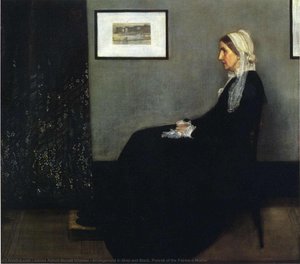
As his style matured, he moved away from literal storytelling toward his "arrangements." He treated his subjects like musical notes, focusing on how color and light could create a specific mood. His 1871 work, Arrangement in Grey and Black No. 1, became widely known as Whistler's Mother. While many saw it as a simple portrait of his mother, Anna McNeill Whistler, he viewed it through the lens of tonal harmony and formal composition.

His experiments with light reached a peak in 1875 with Nocturne in Black and Gold – The Falling Rocket. This painting moved even further from reality, using a limited palette to capture the fleeting essence of a night scene. He continued this exploration of light and color in other works, such as The Little White Girl Symphony in White, No. 2, painted about 1864.

  • At the Piano (1858-59)
  • The Little White Girl Symphony in White, No. 2 (about 1864)
  • Wapping (1860)
  • Arrangement in Grey and Black No. 1 (Whistler's Mother) (1871)
  • Nocturne in Black and Gold – The Falling Rocket (1875)

Legal Battles and Controversy

The friction between Whistler’s aesthetic ideals and the expectations of the public often led to heated confrontations. In 1878, this tension reached a breaking point when he brought a libel suit against a prominent critic. The conflict was sparked by the critic's reaction to his painting, Nocturne in Black and Gold – The Falling Rocket. The critic had dismissed the work in a way that Whistler felt attacked his professional integrity and his right to define his own art. He sought to defend his autonomy, arguing that his paintings were intended as arrangements of color and form rather than literal, photographic representations of the world.

The legal battle was a significant moment in the history of art, but the outcome was a bittersweet victory. While Whistler technically won the case, the damages awarded to him were a mere farthing. The financial reality of the trial was far more punishing than the verdict itself. The immense costs of the legal proceedings eventually bankrupted him, leaving him in a precarious position despite his moral win. It was a heavy price to pay for the right to paint according to his own vision.

Legacy and Influence

Whistler’s insistence on "art for art’s sake" changed the way people thought about the purpose of a painting. By arguing that a work should be judged on its own aesthetic qualities rather than its ability to tell a moral story, he helped fuel the Aesthetic movement. He moved the conversation away from what a picture represented and toward how it was composed. This shift helped pave the way for the modern era, as his focus on the arrangement of color and light prefigured the abstraction that would define much of the coming century.

His influence reached across the Atlantic, leaving a lasting mark on American art. He showed that an artist could find profound meaning in the subtle gradations of a landscape or the quiet mood of a room. By stripping away unnecessary detail to find the essence of a scene, he taught generations of artists to look for the atmospheric truth in their subjects. His ability to capture the fleeting, silvered light of a fog or the soft shadows of twilight offered a new way of seeing the world.

  • Arrangement in Grey and Black No. 1 (1871)
  • Nocturne in Black and Gold – The Falling Rocket (1875)
  • Arrangement in Yellow and Gray (about 1876-1878)

Where to See the Works Today

Finding the traces of Whistler's hand requires traveling through the cities that shaped his life and his restless spirit. In Paris, the Musée d'Orsay houses his famous Arrangement in Grey and Black No. 1, a painting that many recognize by its more common name. It remains one of the most recognizable images from his time in Europe, capturing a quiet, domestic moment through a lens of careful tonal balance.

London remains a central place for his legacy, with the Tate Gallery holding several of his works. These pieces offer a way to see how he navigated the English art scene and his deep connection to the river and the atmosphere of the city. Across the Atlantic, the National Gallery of Art in Washington holds Wapping, a piece that reflects his ability to find beauty in everyday scenes. In New York, the Metropolitan Museum of Art preserves Arrangement in Black: Girl Reading, allowing viewers to observe his specific approach to light and composition.

  • Arrangement in Grey and Black No. 1
  • Wapping
  • Arrangement in Black: Girl Reading

Quick Facts

  • Movement: Aestheticism
  • Notable elements or techniques: Atmospheric perspective
  • Influences: Japanese prints
  • Medium: Oil on canvas