Text size

() ·

A painting made for you, by hand

David and Goliath

Hand Made Oil Reproduction

Hand-painted oil on canvas in your size and frame, made to order by our artists. ( Switch to Print Switch to Digital Image)

Collectible Description

Experience Jacob Jordaens' 'David and Goliath'! This dynamic Baroque masterpiece captures the biblical tale of courage & victory, showcasing David’s triumph over Goliath with rich colors & dramatic figures.

Artist Biography

A Flemish Baroque master known for boisterous scenes like The King Drinks. Explore his vibrant and energetic masterpieces today.

from ·

Chapter 1

How large should it be?

Slide to change the size; the picture on the left shows the frame at its real width. The proportions of the original are kept.

Standard
custom
CM
INCH

Pick from our preset sizes that match the artwork's original proportions.

width
height

Type the width and the height you need, to fit your frame or your wall. This is hand-painted, so for a size with a different shape the artist can paint a bit more around the picture, or cut a bit — you choose. We send you a digital mockup to approve before the painting starts. The picture shown on this page does not show the real result — only the mockup does.

Chapter 2

How should it arrive?

Choose the edges of the stretched canvas

Choose your frame

Corner sample of the WhiteWrap canvas edge finish, stretched on solid wood bars
White $1
Corner sample of the BlurSideWrap canvas edge finish, stretched on solid wood bars
Blurside $1
Corner sample of the ExtendedWrap canvas edge finish, stretched on solid wood bars
Extended $1
Corner sample of the P118B picture frame: moulded polystyrene, 5 cm wide and 3 cm thick
P118B $10
Corner sample of the P118H picture frame: moulded polystyrene, 5 cm wide and 3 cm thick
P118H $10
Corner sample of the P118W picture frame: moulded polystyrene, 5 cm wide and 3 cm thick
P118W $10
Corner sample of the P438Z picture frame: moulded polystyrene, 5.5 cm wide and 3.5 cm thick
P438Z $10
Corner sample of the P508JH picture frame: moulded polystyrene, 7 cm wide and 3.5 cm thick
P508JH $12
Corner sample of the P508YH picture frame: moulded polystyrene, 7 cm wide and 3.5 cm thick
P508YH $12
Corner sample of the P805H picture frame: moulded polystyrene, 5 cm wide and 3.5 cm thick
P805H $10
Corner sample of the P805Z picture frame: moulded polystyrene, 5 cm wide and 3.5 cm thick
P805Z $10
Corner sample of the P919BZ picture frame: moulded polystyrene, 7 cm wide and 3.5 cm thick
P919BZ $10
Corner sample of the P919G picture frame: moulded polystyrene, 7 cm wide and 3.5 cm thick
P919G $10
Corner sample of the P919XJ picture frame: moulded polystyrene, 7 cm wide and 3.5 cm thick
P919XJ $10
Corner sample of the P959ZH picture frame: moulded polystyrene, 5 cm wide and 3 cm thick
P959ZH $10
Corner sample of the P968JZ picture frame: moulded polystyrene, 6 cm wide and 4 cm thick
P968JZ $12
Corner sample of the W106C picture frame: solid wood, 5 cm wide and 3 cm thick
W106C $8
Corner sample of the W218G picture frame: solid wood, 5 cm wide and 3 cm thick
W218G $10
Corner sample of the W218JH picture frame: solid wood, 5 cm wide and 3 cm thick
W218JH $8
Corner sample of the W218Y picture frame: solid wood, 5 cm wide and 3 cm thick
W218Y $10
Corner sample of the W307PJ picture frame: solid wood, 6 cm wide and 3 cm thick
W307PJ $10
Corner sample of the W316G picture frame: solid wood, 6 cm wide and 3 cm thick
W316G $10
Corner sample of the W316PJ picture frame: solid wood, 6 cm wide and 3 cm thick
W316PJ $8
Corner sample of the W316Y picture frame: solid wood, 6 cm wide and 3 cm thick
W316Y $10
Corner sample of the W398PJ picture frame: solid wood, 5 cm wide and 3 cm thick
W398PJ $8
Corner sample of the W4111J picture frame: solid wood, 6.5 cm wide and 3.5 cm thick
W4111J $10
Corner sample of the W500HY picture frame: solid wood, 7 cm wide and 5 cm thick
W500HY $15
Corner sample of the W500JH picture frame: solid wood, 7 cm wide and 5 cm thick
W500JH $15
Corner sample of the W692G picture frame: solid wood, 8 cm wide and 4 cm thick
W692G $12
Corner sample of the W849H picture frame: solid wood, 5 cm wide and 3 cm thick
W849H $8
Corner sample of the W940BG picture frame: solid wood, 7.5 cm wide and 4.5 cm thick
W940BG $15
Corner sample of the W953PJ picture frame: solid wood, 6 cm wide and 3.5 cm thick
W953PJ $8
Corner sample of the H24-GOLD picture frame: carved wood with gesso, 10 cm wide and 6 cm thick
H24-GOLD $30
Corner sample of the H24-SILVER picture frame: carved wood with gesso, 10 cm wide and 6 cm thick
H24-SILVER $30
Corner sample of the H36-GOLD picture frame: carved wood with gesso, 15 cm wide and 6.5 cm thick
H36-GOLD $45
Corner sample of the H36-SILVER picture frame: carved wood with gesso, 15 cm wide and 6.5 cm thick
H36-SILVER $45
Frame preview
Framed

Moulding: . Overall size with the frame: .

Chapter 3

Who paints it, and should anything change?

Examples of what can be changed: Replace face with customer photo; Add pet (e.g., replace cat with dog); Include hidden message in background; Change background landscape or elements.
After order, OriginalUniqueArt.com team will email client for instructions and provide a mockup preview

Worldwide Delivery () in 3/4 weeks instead of standard 5 weeks. (11 November). No compromise on quality.

Chapter 4

The finishing touches

A nameplate, as in a museum?

Engraved Bronze Plaque Details

This elegant plaque features the artist's name and the title of the artwork, finely engraved for a timeless presentation.

It is made from bronze with a refined, elegant finish. The text is precisely laser-engraved for a sharp and permanent result. Measuring 9x2 cm, the plaque is compact yet easy to read. It's built to be durable and scratch-resistant, offering a professional, museum-quality look. Mounting is simple thanks to the included adhesive backing.

Transparent Acrylic Plaque Details

The plaque includes essential engraved details such as the artist's name, the title of the artwork, the date it was created, the type of media used-like oil on canvas or watercolor-a brief description of the piece, and a QR code that links to the complete artwork information.

It is crafted from clear acrylic, offering a sleek, modern appearance. The text is UV-engraved in black to ensure strong visual contrast. With a size of 10x15 cm, it ensures optimal readability. It comes equipped with two metal hooks for secure wall mounting. The plaque is designed to be weather-resistant, making it suitable for various environments, and it includes interactive features that work seamlessly with smartphone scanning.

Black Acrylic Plaque Details

This elegant plaque includes engraved information such as the artist's name, the title of the artwork, the date it was created, the type of media used (like oil on canvas or watercolor), a short description of the artwork, and a QR code for quick access to more information.

The plaque itself is made from refined black acrylic with a premium finish. The text is laser-engraved in white for high contrast and readability. Its size is 10x15 cm, designed to be easy to read. It comes with two metal hooks for professional mounting. The design is sleek and fits any interior style. It is also weather-resistant and durable, with built-in digital integration for mobile compatibility.

A protective varnish?

When do you need it?

Chapter 5

Your painting, as you ordered it

David and Goliath

Reproduction Medium

Reproduction Size

-

Elite Senior Artist

More detail, finesse, and extra production time

-

Reproduction Frame

-

-

For artworks or reproductions larger than 105 cm (approximately 41 inches) on any side, the frame will be shipped as a kit, disassembled. This method ensures safe delivery and prevents damage during transport.

Professional assembly required - this is not a DIY product.
The kit must be assembled and the canvas stretched by an experienced professional framer, using wood glue (not supplied), a canvas stretching plier and clamps to hold the bars square while the glue dries. Incorrect assembly or uneven canvas tension can permanently damage the artwork and is not covered by our warranty.

  • All solid wood bars are included, precisely cut to size.

  • Assembled with the screws provided, plus wood glue for the corner joints, which is not supplied and must be sourced by your framer.

  • Professional tools are required and not included: a canvas stretching plier (tensioner) and clamps to hold the bars square while the glue dries.

Important:
The corner joints require wood glue, the bars must be held with clamps until the glue is fully dry, and tightening the canvas on the assembled frame requires a canvas stretching plier. None of these are included in the kit. Please arrange an experienced professional framer before ordering this size.

Nameplate

-

-

Protective Varnish

Glossy Varnish (enhances colors, protects against light/moisture)

-

Customize My Artwork

Examples of what can be changed: Replace face with customer photo; Add pet (e.g., replace cat with dog); Include hidden message in background; Change background landscape or elements.

-

Urgent

Worldwide Delivery () in 3/4 weeks instead of standard 5 weeks. (11 November). No compromise on quality.

-

Express Shipping

Worldwide Delivery () in 5 weeks. (18 November).

Included

Total Price

$ 300

Total Price $ 300

Glass option is only available in size under 110 CM

Included with every order

  • Free Worldwide Express Shipping
  • High-Quality Linen Canvas
  • Full Shipping Insurance
  • Customs Tax Refund Guarantee
  • True Color Matching Guarantee
  • 100-Day Return Policy (Defects Only)
  • 100% Money-Back Guarantee
  • Bulk Discount Offer

A Symphony of Life: Jacob Jordaens’ “David and Goliath”

Jacob Jordaens' "David and Goliath," painted in 1667, isn’t merely a biblical narrative rendered on canvas; it’s a vibrant explosion of human drama, a testament to courage, triumph, and the enduring spirit of humanity. This monumental mural, now largely confined to museum walls but eternally accessible through faithful reproductions, captures a pivotal moment – David's decisive victory over the Philistine giant – with an unparalleled dynamism and emotional intensity rarely seen in Baroque art. Jordaens, rooted firmly in the artistic traditions of Antwerp, eschewed the idealized formality favored by some of his contemporaries, opting instead for a raw, earthy realism that imbues the scene with palpable energy.

The composition immediately commands attention. David, youthful and resolute, stands poised to deliver the final blow, his sling held aloft – not as an instrument of cold calculation, but as an extension of his own fierce determination. The colossal Goliath lies prone at his feet, a symbol of overwhelming defeat rendered utterly vulnerable by David’s ingenuity and bravery. Yet, Jordaens doesn't simply depict a straightforward victory; he layers the scene with complex emotions. The Israelites erupt in joyous celebration on the left, their faces alight with relief and gratitude, while the panicked flight of the Philistines on the right underscores the magnitude of David’s triumph. Above Goliath, a grotesque Medusa – a deliberate nod to classical mythology – spews venom, adding an element of dark irony and highlighting the vanquished giant's ultimate demise.

The Painter’s Palette: Technique and Style

Jordaens’ mastery lies in his ability to fuse meticulous detail with sweeping gestures. The figures are rendered with a remarkable degree of realism – observe the furrowed brow of David, the muscular physique of Goliath, the intricate folds of their garments. However, he doesn't slavishly adhere to photographic accuracy; rather, he employs a loose, expressive brushstroke that imbues the scene with movement and vitality. The use of chiaroscuro—the dramatic contrast between light and shadow—is particularly effective, sculpting the forms and intensifying the emotional impact. Notice how the light catches David’s face, illuminating his courage, while plunging Goliath into darkness, symbolizing his downfall.

The color palette is rich and earthy – deep reds, browns, and ochres dominate, reflecting the rugged landscape and the physicality of the scene. Touches of gold—represented by the angel offering a crown and palm frond—add a touch of regal splendor, acknowledging David’s future kingship. The background, an arched ceiling reminiscent of Renaissance architecture, provides depth and grandeur, elevating the narrative beyond a simple battlefield encounter.

A Tapestry of Symbolism

“David and Goliath” is replete with symbolic meaning. The story itself represents the triumph of the underdog—the small and vulnerable overcoming the powerful and seemingly invincible. David’s victory embodies hope, faith, and the potential for greatness within ordinary individuals. The angel's offering symbolizes divine favor and recognition of David’s heroic deed. Furthermore, Jordaens subtly incorporates elements from classical mythology – Medusa, a symbol of monstrous power, serves as a visual reminder of the dangers that can be overcome through courage and righteousness.

Interestingly, Jordaens’ depiction resonates with broader historical contexts. The painting draws parallels to William of Orange's victory over the Spanish Armada, mirroring the theme of an underdog triumphing against overwhelming odds – a narrative powerfully relevant in 17th-century Europe grappling with religious and political upheaval.

Bringing “David and Goliath” Home

Reproductions of Jordaens’ "David and Goliath" offer a remarkable opportunity to bring this dramatic masterpiece into your home or office. Whether you choose a large-scale mural print or a smaller, more intimate reproduction, the painting's vibrant colors, dynamic composition, and profound symbolism will undoubtedly captivate viewers and evoke a sense of awe and inspiration. Consider framing it in a rich, dark wood to complement the painting’s earthy tones, or displaying it alongside other works that celebrate themes of courage, faith, and human resilience. This iconic image is more than just a depiction of a biblical story; it's a timeless reminder of the power of the human spirit.

Questions & Answers

How is "David and Goliath" recommended to be printed - what size, what orientation?

large size, square orientation: that is the print setup suggested for "David and Goliath" by Jacob Jordaens.

Is "David and Goliath" by Jacob Jordaens in the public domain?

"David and Goliath" by Jacob Jordaens is in the public domain - its copyright has expired. This status governs how the image of the work may be reproduced.

Which museum holds the original "David and Goliath"?

"David and Goliath" by Jacob Jordaens is on display at the Royal Palace Amsterdam, Amsterdam, Netherlands. The museum listing refers to the original work, not to reproductions.

More about this painting

Preview AR preview Switch to Print Switch to Digital Image Send
Details Guide Add to favorites Download Similars X-Ray Diaporama Q&A Stats

In numbers

  • 1667the year it was painted
  • 29frames to choose from
  • standard sizes, in its own proportions
  • 5weeks to paint and deliver it
Jacob Jordaens

Jacob Jordaens

1593 - 1678, Belgium

Quick facts about Jacob Jordaens

  • Artistic Movement Or Style: Baroque
  • Artists Or Movements Influenced By This Artist: ['Jan Steen']
  • Artists Who Influenced This Artist:
    • Adam van Noort
    • Jacopo Bassano
    • Paolo Veronese
    • Caravaggio
  • Full Name: Jacob Jordaens
  • Nationality: Flemish
  • Notable Artworks:
    • The King Drinks
    • The Bean King
    • Prometheus Bound
    • The Four Evangelists
    • As the Old Sang the Young Play Pipes
  • Place Of Birth: Antwerp, Belgium
  • Date Of Birth: 1593
  • Date Of Death: 1678

Artist Biography

Early Life, Family and Training

In the bustling streets of Antwerp, Jacob Jordaens entered a world of commerce and industry. Born in 1593, he was the first of eleven children born to Jacob Jordaens, a man who had found success as a linen merchant, and his wife, Barbara van Wolschaten. This prosperous upbringing provided the young boy with a stable foundation, though his path would eventually lead away from the trade of textiles and toward the pigments and brushes of the studio. His early years were shaped by the rhythms of a large, active household in the Spanish Netherlands.

The boy's ambition revealed itself early, and by the age of fourteen, he was already following the path of a craftsman. In 1607, he was registered in the local Guild of Saint Luke, entering the service of the master Adam van Noort. This apprenticeship was a formative period that demanded discipline and a keen eye for detail. Under Van Noort, Jordaens learned the essential mechanics of his craft, absorbing the technical secrets of composition and the handling of light that would define his later years. He was a dedicated student, and his talent was recognized by the guild long before he achieved full independence.

By 1615, the young man had reached a significant milestone in his professional life. He was accepted into the Antwerp Guild of Saint Luke as a master, specifically categorized as a waterscilder. This designation meant he was trained to work with tempera, a medium often used for preparing designs or creating works that required a certain clarity of form. This technical beginning laid the groundwork for a career that would see him move from the controlled application of tempera to the more expansive use of oil, always maintaining the robust connection to his native city.

Patrons, Workshop and Commissions

While his early years were spent mastering the brush under his teacher, Jordaens soon found himself navigating the social hierarchies of Antwerp. He did not seek the distant courts of Italy, finding instead a steady stream of work from the wealthy bourgeoisie and the local churches of his home city. These patrons provided the foundation for a prolific career, demanding works that spoke to the piety and the prosperity of the Flemish people. As his reputation grew, his reach extended far beyond the borders of the Spanish Netherlands. He eventually attracted the attention of royalty, securing commissions from King Charles I of England and Queen Christina of Sweden. Even the stadtholder class of the Dutch Republic sought his hand, bringing him into the service of high political circles.

To manage such a heavy burden of work, Jordaens maintained a busy studio where many pupils and assistants labored under his direction. In his later years, the demands of his commissions grew so great that he relied heavily on the assistance of his workshop to maintain his output. This industrious environment was not limited to canvas alone; he frequently collaborated with Brussels workshops to create designs for woven works. His ability to translate his compositions into these other mediums ensured his influence was felt in many households.

Technique and Artistic Style

Jordaens possessed a hand that favored the tangible and the real over the idealized dreams of the court. He worked with a loose and expressive brushwork, a method that allowed him to capture the immediate movement of a scene. To achieve a sense of deep luminosity, he employed a meticulous blending of oil paint with various glazing techniques. This careful layering gave his surfaces a certain glow, even when the subjects themselves were of a most earthly nature. His palette remained rooted in the soil, favoring warm and glowing tones that complemented his preference for robust realism.

Light was a primary tool in his service, used to sculpt the very air within his compositions. He embraced chiaroscuro, creating strong contrasts between light and shade that pulled the viewer into the drama of the moment. This interplay of shadow was never merely decorative; it gave weight to his figures, which were often substantial and even corpulent. He had a particular knack for painting faces flushed with health and vitality, capturing the redness of a cheek or the sweat of a laborer with a directness that felt startlingly alive. Through this command of light and form, he rendered the human experience in all its heavy, physical truth.

Key Works and Subject Matter

Jordaens possessed a restless imagination that found comfort in the most varied of themes. He moved with ease between the sacred and the profane, crafting biblical narratives that felt grounded in the tangible world, alongside mythological tales and complex allegories. His brush often turned toward the common man, capturing genre scenes and even illustrating the witty, spoken proverbs of Flanders. This ability to translate the spoken word and the everyday habits of his neighbors into visual form allowed him to speak directly to the people of Antwerp.

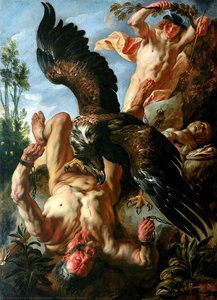
In his earlier years, he showed a particular talent for the dramatic tension of nocturnal scenes, as seen in his 1616 work, The Adoration of the Shepherds. As his career matured, he embraced the boisterous energy of social gatherings. His 1638 painting, The King Drinks, remains a profound example of this spirit, depicting a crowded, lively banquet where the joy of the feast is almost palpable. He did not shy away from the weight of mythic suffering either, as evidenced by his 1640 depiction of Prometheus Bound. Even when handling the solemnity of the Gospels, such as in his 1620 work, The Four Evangelists, he maintained a sense of human presence that distinguished his hand from those who sought only the ideal.

  • The Adoration of the Shepherds (1616)
  • The Four Evangelists (1620)
  • The King Drinks (1638)
  • Prometheus Bound (1640)

Circle, Rivals and Pupils

In the bustling art circles of the Antwerp school, Jordaens moved alongside the giants of his age. He lived and worked in the shadow of Peter Paul Rubens and Anthony van Dyck, yet he carved a space that was entirely his own. While his contemporaries often looked toward the courtly elegance of Italy, Jordaens found his inspiration in the works of Northern Italian painters like Jacopo Bassano, Paolo Veronese, and Caravaggio. He absorbed their dramatic light and their focus on the human form, yet he never felt the need to leave his native city to find his truth. After the passing of Rubens in 1640, Jordaens stepped forward to become the principal associate of the great master, maintaining the prestige of the Antwerp tradition through his own prolific hand.

His studio was a place of constant activity, a workshop that flourished as he grew in stature. He was a teacher of significant influence, guiding many through the rigors of his craft. Between 1621 and 1667, the Guild of Saint Luke officially recorded fifteen of his pupils, men who learned his methods of composition and his preference for a more direct, unrefined realism. These students carried his approach into the next generation, ensuring that his particular way of seeing the world would endure long after his own brush had fallen silent.

Legacy and Influence

The prestige of the Antwerp school of painting found a powerful champion in Jordaens, who stood alongside Rubens and Van Dyck as one of the three great figures to bring international renown to his home city. While his contemporaries often looked toward the courtly elegance of Italy, Jordaens found his strength in the soil of Flanders. His preference for the unrefined and the real allowed him to carve out a space that was entirely his own, one that celebrated the robust vitality of the human condition rather than the idealized grace of the aristocracy. This commitment to a more direct, earthy realism ensured that his presence in the Flemish Baroque was both distinct and enduring.

His influence traveled through the decades, finding a natural successor in the works of Jan Steen, who shared his fascination with the lively, often boisterous scenes of everyday life. By elevating the depiction of peasant festivals and tavern revelry, Jordaens challenged the traditional hierarchies of subject matter. He proved that the common man, with all his appetites and imperfections, was a subject worthy of grand scale and serious artistic attention. His classically inspired themes of abundance and human gathering left a lasting mark on the art world, teaching later painters how to find dignity and energy in the most mundane of celebrations.

Even today, those who stand before his canvases feel the pulse of the life he so carefully observed. His ability to capture a sense of movement and the warmth of a crowded room continues to draw viewers into his compositions. The energy he poured into his brushwork remains palpable, inviting a sense of shared human experience that transcends the centuries.

Where to See the Works Today

To witness the robust vitality of his brushwork, one must travel across the continent to the great halls of Europe. In Paris, the Louvre preserves his hand, while the Museo del Prado in Madrid offers a glimpse into his ability to render the human form with such substantial presence. Those who seek the spirit of the Flemish Baroque in its most direct and unrefined state might find it in the National Gallery of Denmark in Copenhagen. His presence is felt deeply in the Hermitage Museum in Saint Petersburg, where several of his compositions remain held in the collection.

The artist's reach extends far beyond the borders of his native Flanders. In the United States, the Metropolitan Museum of Art in New York holds his works, allowing a different audience to encounter his dramatic use of light and shadow. For those interested in the history of the Antwerp school, the Royal Museum of Fine Arts in Brussels remains a vital destination, housing paintings that reflect the energy of his many years of practice. His legacy is scattered across these great institutions, waiting for the curious eye to find them.

Quick Facts

  • Notable elements: Biblical scene, David's victory
  • Medium: Oil on canvas
  • Movement: Baroque
  • Title: David and Goliath
  • Subject or theme: Religious narrative

Art Quiz

There is only one correct answer for each question.

Question 1:
What biblical story is depicted in the painting "David and Goliath"?
Question 2:
Which artist created the painting "David and Goliath"?
Question 3:
What is David holding in his hand as he prepares to defeat Goliath?
Question 4:
According to the description, what is happening on the left side of the painting?
Question 5:
What symbolic elements are present in the painting to represent victory?