Preview
 Send
Send Share
Share
 Details
 Guide
Guide

 Download
 Similars
 X-Ray
X-Ray Diaporama
 Q&A
Q&A Stats
StatsThe Flea

- 28.0 x 24.0 cm


 Read More
Giclée / Art Print
Museum-quality giclée or canvas print with fast production and flexible finish options. ( Buy Hand Made Painting Switch to Digital Image)




P118B $10

P118H $10

P118W $10

P438Z $10

P508JH $12

P508YH $12

P805H $10

P805Z $10

P919BZ $10

P919G $10

P919XJ $10

P959ZH $10

P968JZ $12

W106C $8

W218G $10

W218JH $8

W218Y $10

W307PJ $10

W316G $10

W316PJ $8

W316Y $10

W398PJ $8

W4111J $10

W500HY $15

W500JH $15

W692G $12

W849H $8

W940BG $15

W953PJ $8




Pick from our preset sizes that match the artwork's original proportions.

Type the width and the height you need, to fit your frame or your wall. A print can only be cut, never made bigger than the picture, so a size with a different shape loses a part of the image. We send you a digital mockup to approve before we print anything. The picture shown on this page does not show the real cut — only the mockup does.
Worldwide Delivery () in 2 weeks instead of standard 4/5 weeks. (5 November)

Free Worldwide Express Shipping

High-Quality Linen Canvas

Full Shipping Insurance

Customs Tax Refund Guarantee

True Color Matching Guarantee

100-Day Return Policy (Defects Only)

100% Money-Back Guarantee

Bulk Discount Offer
 Glass option is only available in size under 110 CM

The Flea
Giclée / Art Print
Reproduction Size
-


Total Price
$ 81
An Intimate Glimpse into Domestic Life
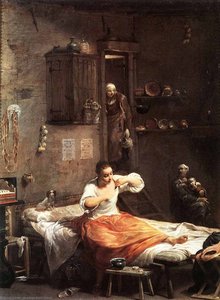
This evocative painting transports us into the private chambers of a woman in an era long past. The scene unfolds with an almost palpable sense of quietude, capturing a moment suspended between states—perhaps the gentle ritual of dressing or the lingering intimacy of repose. Every object within this richly appointed bedroom seems imbued with untold stories. From the plush bedding on the left to the carefully placed chair on the right, the composition guides the eye through a tableau vivant of domesticity. The scattered details—the two bowls resting near the center, the elegant vase crowning the upper corner, and the stack of books upon the bed—do not merely decorate; they anchor the narrative, suggesting a life lived with quiet grace amidst tangible beauty.
The Hand of Giuseppe Maria Crespi
To gaze upon this work is to connect directly with the masterful hand of Giuseppe Maria Crespi. A Bolognese artist whose career spanned the vibrant years of the early 18th century, Crespi possessed a unique ability to elevate the mundane into the realm of high art. While his contemporaries might have focused on grand mythological scenes or overt religious fervor, Crespi found his genius in the everyday. His style is characterized by an astonishing realism and a meticulous attention to texture—one can almost feel the weave of the fabric or the coolness of the porcelain.
Baroque Realism and Genre Mastery
The painting stands as a superb example of Baroque genre painting, yet it possesses a distinctly intimate quality that sets it apart. Crespi masterfully blends the dramatic flair inherent in the Baroque period with an almost Vermeer-like sense of quiet observation. The technique employed suggests a deep understanding of light and shadow; the way the ambient light catches the folds of the woman's dress or illuminates the spines of the books speaks to years of dedicated study. This commitment to verisimilitude makes the piece feel immediate, as if the artist simply opened a window into this very moment.
Symbolism and Emotional Resonance
Beyond its technical brilliance, the painting whispers secrets. The arrangement of objects—the literature suggesting contemplation, the bed implying rest or anticipation—invites the modern viewer to project their own narratives onto the canvas. It speaks to a time when domestic life was itself worthy of monumental artistic commemoration. For collectors and those seeking art for an interior space, this piece offers more than mere decoration; it provides a focal point steeped in history, suggesting comfort, refinement, and the enduring beauty found within private moments.
Questions & Answers
Is "The Flea" by Giuseppe Maria Crespi kept in the artist's home country?
Yes - the artwork is kept in the artist's home country. Giuseppe Maria Crespi was born in Italy, and the original "The Flea" is held in a museum in Italy.
Is "The Flea" typical of what Giuseppe Maria Crespi usually created?
Among Giuseppe Maria Crespi's recorded themes - religious symbolism, bolognese tradition, domestic observation, genre innovation, painter’s legacy - "The Flea" brings its own focus on domestic interior, female figure, bedroom scene, everyday life, clothing detail, baroque painting, genre art, quiet contemplation.
Where is "The Flea" suggested to be displayed, considering its palette?
The dark colors of "The Flea" by Giuseppe Maria Crespi match its recommended space: a bedroom.
Artist Biography
A Bolognese Original: The Life and Art of Giuseppe Maria Crespi
Giuseppe Maria Crespi, affectionately known as “Lo Spagnuolo” – the Spaniard – was a captivating anomaly within the Italian Baroque landscape. Born in Bologna in 1665, his nickname stemmed not from ancestry but from a penchant for the tightly fitted clothing fashionable in Spain at the time, a sartorial choice that hinted at the independent spirit simmering beneath the surface of this remarkable artist. Crespi’s journey began with a traditional apprenticeship, first under Angelo Michele Toni and then Domenico Maria Canuti, absorbing the foundational techniques of Bolognese painting. However, he resisted the pull of Rome when invited by Carlo Maratti, choosing instead to forge his own path, one that would ultimately redefine genre painting and offer a strikingly intimate glimpse into everyday life.Breaking with Tradition: A New Vision Emerges
Crespi’s artistic output was remarkably diverse, encompassing religious paintings, portraits, and etchings inspired by masters like Rembrandt and Salvator Rosa. Yet, it is for his genre scenes – depictions of ordinary people engaged in commonplace activities – that he is most celebrated today. This focus represented a significant departure from the prevailing academic traditions which favored historical or mythological subjects. He wasn’t interested in grand narratives or idealized forms; instead, Crespi turned his attention to the lives unfolding around him—women washing dishes, families sharing meals, children at play. These weren't merely representations of daily life but imbued with a psychological depth and realism previously unseen. His style was characterized by a deliberate restraint in color and brushwork, employing a limited palette with judicious skill, though some critics noted a lack of robust physicality in his application. This subtlety, however, served to heighten the emotional impact of his scenes, drawing viewers into the quiet dramas of domestic existence.The Seven Sacraments and Lasting Influence
While his genre paintings secured his lasting fame, Crespi’s broader artistic achievements shouldn't be overlooked. A pivotal work is *The Seven Sacraments*, a series of canvases painted around 1712 for Cardinal Ottoboni. This ambitious project demonstrated Crespi’s ability to tackle complex religious themes with an innovative approach. Rather than depicting biblical events in a distant, historical setting, he placed them within the context of his own time, featuring contemporary figures and locales. The result was a series that felt both deeply spiritual and profoundly human. His influence extended beyond Italy; he mentored artists like Giovanni Battista Piazzetta and Pietro Longhi, who carried forward his commitment to realism and genre painting in Venice. Though he became increasingly reclusive later in life, dedicating himself primarily to religious works after the death of his wife in 1722, Crespi’s legacy as a groundbreaking artist remained secure. He was even granted a knighthood by Pope Benedict XIV in 1740, a testament to his artistic standing and cultural significance.A Legacy of Realism and Intimacy
Giuseppe Maria Crespi died in Bologna in 1747, leaving behind a body of work that continues to resonate with viewers today. He was a master observer of human nature, capable of capturing the subtle nuances of emotion and experience with remarkable sensitivity. His paintings are not merely historical artifacts; they are windows into the lives of ordinary people, offering a timeless glimpse into the universal themes of love, loss, faith, and everyday existence. Lo Spagnuolo's contribution to Italian art lies in his ability to elevate the mundane to the level of artistic significance, proving that beauty and meaning can be found not only in grand narratives but also in the quiet moments of daily life. His work remains a powerful reminder of the enduring human capacity for resilience, connection, and grace.Exploring Crespi’s World Today
Fortunately, opportunities to experience Crespi's artistry firsthand are plentiful. His works can be found in prominent museums such as the Gemäldegalerie Alte Meister in Dresden, which houses *The Seven Sacraments*, and the Museo dell'Opera di Santa Croce in Florence. Numerous reproductions of his paintings are available, allowing art enthusiasts to bring a piece of this Bolognese master’s vision into their own homes. Resources like OriginalUniqueArt.com and OriginalUniqueArt.com offer high-quality hand-painted reproductions, ensuring that Crespi’s legacy continues to inspire and captivate audiences for generations to come. Further research can be found on Wikipedia and Britannica providing detailed accounts of his life and artistic development.
Giuseppe Maria Crespi
1665 - 1747 , Italy
Quick Facts
- Full Name: Giuseppe Maria Crespi
- Nationality: Italian
- Date Of Birth: 1665
- Date Of Death: 1747
- Place Of Birth: Bologna, Italy
- Notable Artworks:
- Seven Sacraments
- Santa Maria Maddalena penitente
- Confession
- Woman Washing Dishes
- Artistic Movement Or Style: Late Baroque
- Artists Who Influenced This Artist:
- Angelo Michele Toni
- Domenico Maria Canuti
- Artists Or Movements Influenced By This Artist:
- Pietro Longhi
- G. B. Piazzetta
Related Articles

Baroque Masterpieces: 10 Paintings That Defined an Era |
Journey through the drama & grandeur of Baroque art! Explore 10 masterpieces by Caravaggio, Rembrandt, Rubens & more. Discover stunning oil paintings, rich colors & timeless stories. Find museum-quality reproductions at .

Giuseppe Maria Crespi: Pioneering Genre Painting & the Bolognese Baroque
Explore the life & art of Giuseppe Maria Crespi, a pivotal Bolognese Baroque painter. Discover his groundbreaking genre scenes, religious works, and lasting influence on Italian art history. Learn more at OriginalUniqueArt.

Baroque Drama: Bringing Opulence & Emotion into Contemporary Interiors
Explore the opulent world of Baroque interior design! Discover key elements, modern applications & how to bring dramatic elegance into your home with OriginalUniqueArt.com's authentic reproductions.

Italian Baroque Unlocked: High-Drama Art That Hits Hard
Dive into the high-drama world of Italian Baroque art. Discover how chiaroscuro, intense emotion, and theatrical lighting redefined aesthetics. Explore the visceral power of the Counter-Reformation through a modern lens with expert insights from OriginalUniqueArt.com.

The Visceral Stage: Exploring Dramatic Narratives & Emotional Intensity in Baroque Art
Explore the dramatic world of Baroque art! Discover iconic masters like Caravaggio & Rembrandt, their techniques, and the movement's lasting impact. Expert insights for collectors & enthusiasts at OriginalUniqueArt.