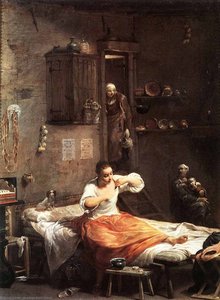
Confession
Oil On Canvas
WallArt
Baroque
1712
127.0 x 95.0 cm
Gemäldegalerie
Hand Made Oil Reproduction
Hand-painted oil on canvas in your size and frame, made to order by our artists. ( Buy Print
Buy Image)
P118B $10
P118H $10
P118W $10
P438Z $10
P508JH $12
P508YH $12
P805H $10
P805Z $10
P919BZ $10
P919G $10
P919XJ $10
P959ZH $10
P968JZ $12
W106C $8
W218G $10
W218JH $8
W218Y $10
W307PJ $10
W316G $10
W316PJ $8
W316Y $10
W398PJ $8
W4111J $10
W500HY $15
W500JH $15
W692G $12
W849H $8
W940BG $15
W953PJ $8
Pick from our preset sizes that match the artwork's original proportions.
You may enter your own dimensions to fit a specific frame or space. If your selected size does not match the original image's proportions, we will either crop the artwork or extend the painting with additional hand-painted elements. A digital mockup will be sent for your approval before production begins.

Please note that the on-screen preview does not reflect the actual cropping or extension. Only the mockup will accurately show the final composition.
While custom sizes are available, we recommend selecting a dimension from the predefined list to preserve the original proportions.
After order, OriginalUniqueArt.com team will email client for instructions and provide a mockup preview
Worldwide Delivery () in 3/4 weeks instead of standard 5 weeks. (13 August). No compromise on quality.
Free Worldwide Express Shipping
High-Quality Linen Canvas
Full Shipping Insurance
Customs Tax Refund Guarantee
True Color Matching Guarantee
60-Day Return Policy (Defects Only)
100% Money-Back Guarantee
Bulk Discount Offer
Confession
Reproduction Medium
Reproduction Size
-
Total Price
$ 350
Artwork Description
Giuseppe Maria Crespi’s “Confession”: A Window into the Soul of Early Baroque
Giuseppe Maria Crespi's "Confession," painted in 1712, isn’t merely a depiction of a religious scene; it’s a profound exploration of human vulnerability and spiritual seeking. This remarkable work, now housed within the Gemäldegalerie Alte Meister in Dresden, offers a rare glimpse into the artist’s unique approach to genre painting – a style he largely pioneered in Italy during the early 18th century. Far removed from the grand narratives favored by many of his contemporaries, Crespi focused on intimate moments of everyday life, imbuing them with an emotional depth and symbolic resonance that continues to captivate viewers today.
The painting immediately draws the eye into a dimly lit interior, dominated by a simple wooden bench upon which sits a man – presumed to be a priest or bishop – engaged in conversation with another figure shrouded in shadow. This deliberate use of obscurity is crucial; it’s not simply a matter of poor lighting but a calculated strategy to heighten the sense of mystery and introspection. Crespi masterfully employs *chiaroscuro*, the dramatic contrast between light and dark, characteristic of Baroque art, to sculpt the figures and create an atmosphere of solemnity and privacy. The background, a dark room punctuated by a window offering a sliver of natural light, serves as a potent symbol – representing the struggle between worldly darkness and spiritual enlightenment.
A Masterclass in Technique and Composition
Crespi’s skill lies not just in his ability to capture a mood but also in his meticulous technique. The painting is executed in oil on canvas, showcasing a remarkable level of detail and texture. Notice the rough, layered brushstrokes that build up the forms, particularly in the folds of the monks' robes and the wooden bench. These aren’t smooth, idealized representations; they are imbued with a sense of physicality and age – as if we’re witnessing a scene from real life, not a carefully constructed allegory. The composition is remarkably balanced, utilizing vertical lines—the walls of the booth and the figures themselves—to create a feeling of enclosure and reinforce the solemnity of the moment. Crespi's use of perspective is subtly flattened, suggesting a two-dimensional representation rather than a fully realistic depiction of space, further contributing to the painting’s intimate and introspective quality.
Symbolism and the Language of Faith
Beyond its technical brilliance, “Confession” is rich in symbolic meaning. The confessional booth itself represents repentance, seeking forgiveness, and confronting one's own shortcomings. The obscured face of the second figure adds to this ambiguity, suggesting a hidden truth or an unresolved conflict. The gesture of prayer—raised hands, bowed heads—convey a profound sense of humility and reverence. Crespi wasn’t interested in illustrating specific religious doctrines; instead, he used these gestures and symbols to evoke a universal experience of spiritual longing and the desire for redemption. The painting speaks to the fundamental human need to acknowledge our flaws and seek solace from a higher power – a theme that resonates powerfully across cultures and time periods.
Giuseppe Maria Crespi: A Revolutionary Voice
Crespi’s work, including “Confession,” is considered revolutionary for its time. He broke with the conventions of traditional religious painting by focusing on everyday people and their emotional lives. His willingness to depict scenes of poverty, introspection, and moral struggle offered a stark contrast to the idealized portrayals favored by many of his contemporaries. His influence extended beyond Italy, inspiring artists across Europe who sought to capture the complexities of human experience with honesty and sensitivity. To delve deeper into Crespi’s artistic journey, consider exploring works like “Baptism” and “Ordination,” available through OriginalUniqueArt, which further illuminate his distinctive style and thematic concerns. The Gemäldegalerie Alte Meister offers a remarkable opportunity to witness this masterpiece firsthand, or explore its digital collection for a closer examination of its details.
Artist Biography
A Bolognese Original: The Life and Art of Giuseppe Maria Crespi
Giuseppe Maria Crespi, affectionately known as “Lo Spagnuolo” – the Spaniard – was a captivating anomaly within the Italian Baroque landscape. Born in Bologna in 1665, his nickname stemmed not from ancestry but from a penchant for the tightly fitted clothing fashionable in Spain at the time, a sartorial choice that hinted at the independent spirit simmering beneath the surface of this remarkable artist. Crespi’s journey began with a traditional apprenticeship, first under Angelo Michele Toni and then Domenico Maria Canuti, absorbing the foundational techniques of Bolognese painting. However, he resisted the pull of Rome when invited by Carlo Maratti, choosing instead to forge his own path, one that would ultimately redefine genre painting and offer a strikingly intimate glimpse into everyday life.Breaking with Tradition: A New Vision Emerges
Crespi’s artistic output was remarkably diverse, encompassing religious paintings, portraits, and etchings inspired by masters like Rembrandt and Salvator Rosa. Yet, it is for his genre scenes – depictions of ordinary people engaged in commonplace activities – that he is most celebrated today. This focus represented a significant departure from the prevailing academic traditions which favored historical or mythological subjects. He wasn’t interested in grand narratives or idealized forms; instead, Crespi turned his attention to the lives unfolding around him—women washing dishes, families sharing meals, children at play. These weren't merely representations of daily life but imbued with a psychological depth and realism previously unseen. His style was characterized by a deliberate restraint in color and brushwork, employing a limited palette with judicious skill, though some critics noted a lack of robust physicality in his application. This subtlety, however, served to heighten the emotional impact of his scenes, drawing viewers into the quiet dramas of domestic existence.The Seven Sacraments and Lasting Influence
While his genre paintings secured his lasting fame, Crespi’s broader artistic achievements shouldn't be overlooked. A pivotal work is *The Seven Sacraments*, a series of canvases painted around 1712 for Cardinal Ottoboni. This ambitious project demonstrated Crespi’s ability to tackle complex religious themes with an innovative approach. Rather than depicting biblical events in a distant, historical setting, he placed them within the context of his own time, featuring contemporary figures and locales. The result was a series that felt both deeply spiritual and profoundly human. His influence extended beyond Italy; he mentored artists like Giovanni Battista Piazzetta and Pietro Longhi, who carried forward his commitment to realism and genre painting in Venice. Though he became increasingly reclusive later in life, dedicating himself primarily to religious works after the death of his wife in 1722, Crespi’s legacy as a groundbreaking artist remained secure. He was even granted a knighthood by Pope Benedict XIV in 1740, a testament to his artistic standing and cultural significance.A Legacy of Realism and Intimacy
Giuseppe Maria Crespi died in Bologna in 1747, leaving behind a body of work that continues to resonate with viewers today. He was a master observer of human nature, capable of capturing the subtle nuances of emotion and experience with remarkable sensitivity. His paintings are not merely historical artifacts; they are windows into the lives of ordinary people, offering a timeless glimpse into the universal themes of love, loss, faith, and everyday existence. Lo Spagnuolo's contribution to Italian art lies in his ability to elevate the mundane to the level of artistic significance, proving that beauty and meaning can be found not only in grand narratives but also in the quiet moments of daily life. His work remains a powerful reminder of the enduring human capacity for resilience, connection, and grace.Exploring Crespi’s World Today
Fortunately, opportunities to experience Crespi's artistry firsthand are plentiful. His works can be found in prominent museums such as the Gemäldegalerie Alte Meister in Dresden, which houses *The Seven Sacraments*, and the Museo dell'Opera di Santa Croce in Florence. Numerous reproductions of his paintings are available, allowing art enthusiasts to bring a piece of this Bolognese master’s vision into their own homes. Resources like OriginalUniqueArt.com and OriginalUniqueArt.com offer high-quality hand-painted reproductions, ensuring that Crespi’s legacy continues to inspire and captivate audiences for generations to come. Further research can be found on Wikipedia and Britannica providing detailed accounts of his life and artistic development.Giuseppe Maria Crespi
1665 - 1747 , Italy
Quick Facts
- Artistic Movement Or Style: Late Baroque
- Artists Or Movements Influenced By This Artist:
- Pietro Longhi
- G. B. Piazzetta
- Artists Who Influenced This Artist:
- Angelo Michele Toni
- Domenico Maria Canuti
- Date Of Birth: March 14, 1665
- Date Of Death: July 16, 1747
- Full Name: Giuseppe Maria Crespi
- Nationality: Italian
- Notable Artworks:
- Seven Sacraments
- Santa Maria Maddalena penitente
- Confession
- Woman Washing Dishes
- Place Of Birth: Bologna, Italy

Glass option is only available in size under 110 CM