Send
Send Share
Share
 Details
 Guide
Guide

 Download
 Similars
 Diaporama
 Stats
StatsThe Three Theological Virtues
 Gold Leaf
- Sculpture
- High Renaissance
 Renaissance
 318.0 x 224.0 cm
 The Louvre
 Read More
Giclée / Art Print
Museum-quality giclée or canvas print with fast production and flexible finish options. ( Buy Hand Made Painting Switch to Digital Image)




































Pick from our preset sizes that match the artwork's original proportions.

You may enter your own dimensions to fit a specific frame or space. If your selected size does not match the original image's proportions, we will either crop the artwork or extend the image with a mirrored or solid-fill edge. A digital mockup will be sent for your approval before production begins.
Please note that the on-screen preview does not reflect the actual cropping or extension. Only the mockup will accurately show the final composition.
While custom sizes are available, we recommend selecting a dimension from the predefined list to preserve the original proportions.
Worldwide Delivery () in 2 weeks instead of standard 4/5 weeks. (27 September)

Free Worldwide Express Shipping

High-Quality Linen Canvas

Full Shipping Insurance

Customs Tax Refund Guarantee

True Color Matching Guarantee

100-Day Return Policy (Defects Only)

100% Money-Back Guarantee

Bulk Discount Offer
 Glass option is only available in size under 110 CM

The Three Theological Virtues
Giclée / Art Print
Reproduction Size
-


Total Price
$ 81
A Celestial Radiance: The Brilliance of Clovio’s Masterpiece
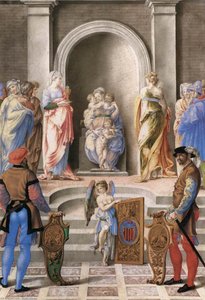
In the heart of the High Renaissance, where the boundaries between the earthly and the divine often blurred through the tip of a master's brush, Giulio Clovio achieved something truly transcendent. His work, "The Three Theological Virtues," is not merely an illumination; it is a luminous window into the spiritual aspirations of the sixteenth century. Created around 1542 for the illustrious Cardinal Alessandro Farnese, this monumental folio from the Farnese Hours serves as a breathtaking testament to the zenith of manuscript illumination. To gaze upon this work is to witness a symphony of light and color, where the meticulous application of gold leaf does more than decorate—it illuminates the very essence of grace, casting a shimmering glow that seems to emanate from within the parchment itself.
The composition is a masterful blend of Gothic precision and Renaissance grandeur. Clovio, often celebrated as the "Michelangelo of the miniature," possessed an uncanny ability to marry the intricate, delicate traditions of manuscript art with the burgeoning realism and anatomical depth of his era. The figures are rendered with an astonishing vitality, their drapery flowing with a weight and texture that suggest movement even in stillness. For the discerning collector or interior designer, this piece offers a profound sense of historical gravity and aesthetic opulence, making it a centerpiece capable of anchoring a room with its sophisticated elegance and timeless allure.
Symbolism and the Architecture of Faith
Beyond its visual splendor, "The Three Theological Virtues" is a deeply intellectual endeavor, laden with the theological weight of the age. The work serves as an allegory for the virtues of faith, hope, and charity—the pillars of Christian salvation. Clovio utilizes a complex visual language to guide the viewer through a spiritual journey. Within the scene, architectural elements such as classical columns and stately arches provide a structured, almost theatrical setting, reminiscent of a Roman palace. This setting is not merely a backdrop but a symbolic stage where the virtues are personified, inviting contemplation on the moral order of the universe.
The use of gold leaf is particularly significant in this context; it acts as a metaphor for divine light piercing through the material world. As the eye wanders across the intricate heraldic shields and the delicately rendered facial expressions, one discovers a narrative of devotion. The interplay between the rich pigments—deep blues, vibrant reds, and earthy ochres—and the reflective gold creates an emotional resonance that is both humbling and uplifting. It is an art form designed to inspire awe, reminding the viewer of the eternal truths that lie beneath the surface of human existence.
A Legacy for the Modern Collector
For those seeking to bring a piece of history into a contemporary space, a high-quality reproduction of Clovio’s masterpiece offers an unparalleled opportunity. The sheer scale and detail of the original work—measuring an impressive 318 x 224 cm—demand attention, yet its intricate details reward the closest inspection. Whether placed in a grand library, a formal dining hall, or a curated gallery space, this artwork brings with it the prestige of the Farnese legacy and the exquisite craftsmanship of the Italian Renaissance.
Owning a reproduction of such significance is an act of preserving cultural heritage. It allows the warmth of Clovio’s palette and the spiritual depth of his themes to permeate modern interiors, providing a sense of continuity and intellectual richness. This piece is more than a decoration; it is an invitation to engage with the profound beauty of human creativity and the enduring power of the allegorical tradition.
Artist Biography
A Croatian Luminary of the Italian Renaissance
Giulio Clovio, born Juraj Julije Klović in 1498 amidst the rolling hills of Grižane, Croatia, stands as a pivotal figure bridging the late Gothic tradition of manuscript illumination with the burgeoning High Renaissance. Though his origins lay within the Kingdom of Croatia, it was in Italy that Clovio’s artistic genius truly blossomed, earning him renown as arguably the greatest illuminator of his era and the last significant master in a lineage stretching back centuries. His story is one of remarkable talent, astute patronage, and an unwavering dedication to transforming the miniature into a breathtakingly sophisticated art form.
The early years of Clovio’s life remain shrouded in some mystery. It's believed he may have received initial artistic training within monastic circles near Rijeka, but by the age of eighteen, his ambition led him to Italy. Entering the household of Cardinal Marino Grimani proved a turning point; here, under the cardinal’s guidance, Clovio honed his skills as a painter and began to develop the meticulous technique that would define his career. He absorbed influences from leading artists of the time—Giulio Romano and Girolamo dai Libri both played roles in shaping his style—but quickly forged his own path, demonstrating an exceptional aptitude for translating the grandeur of Renaissance painting onto a miniature scale.
The Art of Miniature: A Synthesis of Styles
Clovio’s artistry wasn't merely about replicating existing styles; it was about synthesizing them. He masterfully blended the delicate precision of Northern European illumination with the dynamic compositions and vibrant color palettes characteristic of Italian Renaissance masters like Raphael, Michelangelo, and Titian. This fusion is particularly evident in his illuminated manuscripts, where figures possess a sculptural quality, landscapes recede into atmospheric perspective, and every detail—from the folds of drapery to the glint of jewelry—is rendered with astonishing accuracy.
His work for Cardinal Domenico Grimani, including the exquisitely detailed commentary on St. Paul’s Epistle to the Romans (now housed in the Sir John Soane's Museum), showcased his burgeoning talent and secured his reputation. The miniatures within this manuscript are not simply illustrations; they are miniature paintings in their own right, brimming with narrative power and emotional depth. The conversion of Saint Paul is depicted with a dramatic intensity rarely seen in illuminated manuscripts.
Patronage, Travel, and Artistic Flourishing
Clovio’s career was inextricably linked to the powerful patrons who recognized his exceptional abilities. Following his time with the Grimani family, he served at the Hungarian court of King Louis II, creating works like “The Judgment of Paris” and “Lucretia.” The king's untimely death at the Battle of Mohács propelled Clovio back to Rome, where he continued to attract influential supporters.
His association with Cardinal Alessandro Farnese proved particularly fruitful. It was for Farnese that Clovio created his magnum opus: the Farnese Hours, a lavishly illuminated book of hours completed in 1546 after nine years of painstaking work. This masterpiece, now residing in the Morgan Library in New York, contains twenty-eight miniatures depicting scenes from both the Old and New Testaments, culminating in a spectacular double-page spread representing the Corpus Christi procession in Rome. The Farnese Hours is not only a testament to Clovio’s technical skill but also a reflection of his deep understanding of Renaissance iconography and theological themes.
A Legacy Illuminated
Clovio's influence extended beyond the realm of manuscript illumination. He was a respected figure in artistic circles, befriending artists like Pieter Bruegel the Elder—who even contributed a miniature to one of Clovio’s works—and El Greco, who painted several portraits of the master illuminator, placing him alongside Michelangelo, Raphael and Titian as his influences. These portraits serve as powerful visual statements about Clovio's standing within the artistic community.
Though he worked primarily in miniature, Clovio’s impact on Renaissance art was significant. He elevated the status of illumination from a craft to a fine art, demonstrating its potential for expressive power and technical virtuosity. His ability to capture the spirit of the High Renaissance within the confines of a small-scale format ensured his place as one of the most celebrated artists of his time—a Croatian luminary whose legacy continues to illuminate the world of art today.

Giulio Clovio
1498 - 1578 , Croatia
Quick Facts
- Artistic Movement Or Style: High Renaissance
- Artists Or Movements Influenced By This Artist: ['El Greco']
- Artists Who Influenced This Artist:
- Giulio Romano
- Girolamo dai Libri
- Date Of Birth: 1498
- Date Of Death: 1578
- Full Name: Giulio Clovio
- Nationality: Croatian-Italian
- Notable Artworks:
- Farnese Hours
- Towneley Lectionary
- Soane Manuscript
- Place Of Birth: Grižane, Croatia
Related Articles
High Renaissance Masterpieces: Iconic Art for Your Home |
Journey through the High Renaissance! Explore 10 iconic masterpieces by Leonardo da Vinci, Michelangelo & Raphael. Discover art history, techniques & find museum-quality reproductions to elevate your home decor on .
High Medieval Art: 10 Masterpieces That Shaped an Era | OriginalUniqueArt
Journey through High Medieval Art! Explore 10 iconic masterpieces – from Giotto's frescoes to stunning Gothic cathedrals. Discover the stories behind these timeless paintings, sculptures & illuminated manuscripts. Find museum-quality art reproductions at OriginalUniqueArt.com.
Max Ernst's Masterpieces: 25 Surreal Visions for Art Lovers & Home Decor
Journey into the surreal world of Max Ernst! Explore 25 iconic paintings, from Dada to abstract expressionism. Discover the stories behind his masterpieces & find museum-quality art reproductions for your home decor at OriginalUniqueArt.com.
Hermitage Masterpieces: 25 Art Treasures to Inspire Your Home Decor
Journey through the Hermitage Museum's 25 greatest artworks! Explore masterpieces by Rembrandt, Leonardo da Vinci & Vermeer. Find museum-quality art reproductions and curated decor ideas to bring timeless beauty home. Discover all masterpieces on OriginalUniqueArt.com.

Tactile Maximalism: The Expert Guide to Styling Bold Pop Art for Dopamine Decor Interiors
Master the art of Dopamine Decor with our expert guide to Tactile Maximalism. Learn how to professionally style bold Pop Art through texture, color theory, and curated layers to create a joyful, high-end interior that inspires.