Preview
 Send
Send Share
Share
 Details
 Guide
Guide

 Download
 Similars
 X-Ray
X-Ray Diaporama
 Stats
StatsPassion Flower


 Read More
Giclée / Art Print
Museum-quality giclée or canvas print with fast production and flexible finish options. ( Buy Hand Made Painting Switch to Digital Image)




P118B $10

P118H $10

P118W $10

P438Z $10

P508JH $12

P508YH $12

P805H $10

P805Z $10

P919BZ $10

P919G $10

P919XJ $10

P959ZH $10

P968JZ $12

W106C $8

W218G $10

W218JH $8

W218Y $10

W307PJ $10

W316G $10

W316PJ $8

W316Y $10

W398PJ $8

W4111J $10

W500HY $15

W500JH $15

W692G $12

W849H $8

W940BG $15

W953PJ $8




Pick from our preset sizes that match the artwork's original proportions.

You may enter your own dimensions to fit a specific frame or space. If your selected size does not match the original image's proportions, we will either crop the artwork or extend the image with a mirrored or solid-fill edge. A digital mockup will be sent for your approval before production begins.
Please note that the on-screen preview does not reflect the actual cropping or extension. Only the mockup will accurately show the final composition.
While custom sizes are available, we recommend selecting a dimension from the predefined list to preserve the original proportions.
Worldwide Delivery () in 2 weeks instead of standard 4/5 weeks. (26 September)

Free Worldwide Express Shipping

High-Quality Linen Canvas

Full Shipping Insurance

Customs Tax Refund Guarantee

True Color Matching Guarantee

100-Day Return Policy (Defects Only)

100% Money-Back Guarantee

Bulk Discount Offer
 Glass option is only available in size under 110 CM

Passion Flower
Giclée / Art Print
Reproduction Size
-


Total Price
$ 81
Gene Davis’s “Passion Flower”: A Vertical Symphony of Color
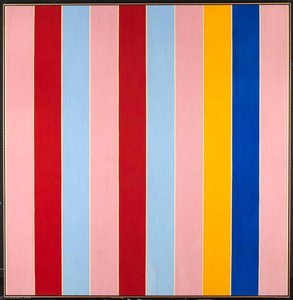
Gene Davis's "Passion Flower," painted in 1968, isn’t merely a depiction of a flower; it’s an immersive experience—a vibrant plunge into the heart of Color Field painting and the Washington Color School. This work, housed within the esteemed San Francisco Museum of Modern Art (SFMOMA), stands as a testament to Davis's pioneering approach to abstraction, utilizing color not to represent form but to evoke feeling and rhythm. The piece immediately commands attention with its bold, vertical stripes—a seemingly simple arrangement that belies a complex interplay of visual elements and a profound exploration of the chromatic spectrum.
Davis’s genius lies in his meticulous control of color and line. Each stripe is an individual entity, a solid block of hue ranging from fiery oranges and passionate reds to cool blues and serene pinks. These colors aren't blended or mixed; they exist as distinct, unyielding planes, creating a dynamic visual texture that shifts with the viewer’s perspective. The consistent width of each line adds to this sense of order and rhythm, while subtle variations in saturation and intensity prevent the composition from feeling static. It’s akin to a carefully orchestrated musical score—a series of deliberate color notes building towards an emotional crescendo.
The Washington Color School and the Rise of Field Painting
To fully appreciate “Passion Flower,” it's crucial to understand its context within the broader art movement of the mid-20th century. Davis was a key figure in the Washington Color School, a group of painters based in Washington D.C. who pushed the boundaries of abstract expressionism by focusing almost exclusively on color and its effects. This movement emerged as a reaction against the gestural brushstrokes and figurative elements prevalent in earlier forms of abstraction. Instead, artists like Davis sought to create paintings that were purely about color—to explore its emotional power and visual resonance without relying on representational imagery.
The Washington Color School’s approach was heavily influenced by the work of Mark Rothko, whose large-scale color field paintings had a profound impact on the group. However, Davis developed his own distinctive style, characterized by his use of vertical stripes and his meticulous attention to detail. His work can be seen as a bridge between Rothko's meditative color explorations and the more dynamic compositions of Morris Louis and Kenneth Noland, both contemporaries within the Color Field movement.
Decoding the Symbolism: Beyond the Floral Subject
While “Passion Flower” ostensibly depicts a flower—a symbol of love, sacrifice, and rebirth—Davis deliberately stripped away any representational elements. The absence of recognizable forms allows the viewer to project their own emotions and associations onto the painting. The vibrant colors themselves carry symbolic weight: red evokes passion and energy, blue suggests tranquility and introspection, while pink hints at tenderness and vulnerability.
Interestingly, the title itself—"Passion Flower"—references the flower's association with the crucifixion of Christ. This religious symbolism adds another layer of meaning to the work, suggesting a connection between earthly beauty and spiritual transcendence. However, Davis’s focus on pure color suggests that he wasn’t interested in literal representation but rather in capturing the *feeling* of passion—its intensity, its complexity, and its transformative power.
A Legacy of Color: Reproduction and Interior Design
Today, “Passion Flower” remains a seminal work of American abstract art. Its bold colors and dynamic composition continue to captivate viewers and inspire artists. High-quality reproductions offer an accessible way to experience the painting’s emotional impact, making it a valuable addition to any collection or interior space. The vertical stripes create a strong visual anchor, adding a touch of sophistication and energy to any room. Consider pairing this artwork with complementary colors—such as earthy greens or warm neutrals—to enhance its vibrancy and create a harmonious aesthetic.
Gene Davis’s “Passion Flower” is more than just a painting; it's an invitation to lose yourself in the world of color, to explore the depths of emotion, and to appreciate the power of abstraction. It stands as a testament to his innovative approach and enduring legacy within the art world.
Artist Biography
The Architect of Color: The Life and Legacy of Gene Davis
In the vibrant tapestry of mid-century American abstraction, few threads shine as brightly or as rhythmically as those woven by Gene Davis. A pioneer of the Color Field movement, Davis possessed a singular ability to transform the canvas into a rhythmic experience of light and motion. Born in Washington, D.C., in 1920, his journey toward becoming a central figure of the Washington Color School was not one of immediate abstraction, but rather a gradual evolution shaped by a keen observational eye. Before he ever commanded the brush to create his iconic stripes, Davis worked as a sportswriter, a profession that demanded a sharp focus on movement, energy, and the unfolding drama of live events—elements that would later find their way into the pulsating verticality of his paintings.
The seeds of his abstract language were sown through deep engagement with European modernism. During his formative years, Davis found profound inspiration in the works of Paul Klee and Arshile Gorky, artists who demonstrated how form could be distilled into pure emotion and symbolic weight. By immersing himself in the masterpieces held within the Phillips Collection, he began to understand that color did not merely serve a subject; color was the subject. This realization set him on a path away from traditional representation and toward a revolutionary way of seeing, where the boundaries between shape and hue began to dissolve into pure, chromatic energy.
The Rhythm of the Stripe: Innovation and Technique
The year 1958 marked a seismic shift in Davis’s career and the broader trajectory of American art. It was during this period that he began producing his celebrated acrylic stripe paintings, a technique that would become his unmistakable signature. Moving away from the heavy, gestural textures of Abstract Expressionism, Davis embraced the flat, luminous qualities of acrylic paint. His compositions often featured monumental vertical bands of color that seemed to vibrate against one another, creating a sense of optical movement that drew the viewer into a hypnotic, rhythmic trance.
These works were far more than simple geometric exercises; they were explorations of space and perception. By utilizing the Washington Color School approach, Davis emphasized the primacy of color, allowing each stripe to interact with its neighbor through subtle shifts in value and saturation. His technique allowed for a unique kind of "breathing" within the painting, where the eye is encouraged to dance vertically across the canvas. This mastery of repetition and rhythm allowed him to capture the essence of urban energy and natural light, translating the chaos of the modern world into a structured, yet profoundly fluid, visual language.
A Lasting Impression on American Abstraction
As a cornerstone of the Washington Color School alongside contemporaries like Morris Louis and Kenneth Nurtland, Gene Davis helped redefine the boundaries of post-painterly abstraction. His work stood as a testament to the power of restraint and the infinite possibilities found within a limited palette. Even in his later works, such as the evocative Night Rider from 1983, one can see his ability to blend bold hues with complex imagery, proving that his mastery of color could support deep, symbolic narratives.
The historical significance of Gene Davis lies in his role as a bridge between the intense emotionality of early abstraction and the cool, calculated precision of later Color Field painting. His legacy is found in every canvas that prioritizes the sensory experience of color over the depiction of form. Through his rhythmic stripes, he left behind a visual symphony that continues to resonate with collectors and art enthusiasts worldwide, reminding us that art can be both profoundly simple and infinitely complex.

Gene Davis
1920 - 1985 , United States of America
Quick Facts
- Artistic Movement Or Style: Color Field Painting
- Artists Or Movements Influenced By This Artist: ['Abstract Expressionism']
- Artists Who Influenced This Artist:
- Paul Klee
- Arshile Gorky
- Date Of Birth: August 22, 1920
- Date Of Death: April 6, 1985
- Full Name: Gene Bernard Davis
- Nationality: American
- Notable Artworks:
- Black Grey Beat
- Blue Freak-Out
- Place Of Birth: Washington, D.C.
Related Articles
Color Field Painting: The Emotional Power of Pure Abstraction and Chromatic Depth
Explore the profound emotional depth of Color Field painting. Discover the history of mid-century abstraction, from Rothko to Newman, and learn how pure color transforms the viewer's experience through our expert art history guide.

Abstract Expressionism's 10 Defining Masterpieces |
Explore 10 defining Abstract Expressionism masterpieces by Pollock, Rothko & de Kooning. Discover the stories behind these iconic paintings and find museum-quality art reproductions to elevate your home decor on .

Geometric Abstraction's 10 Defining Masterpieces | Art for Your Home - OriginalUniqueArt
Explore 10 defining masterpieces of Geometric Abstraction! Discover Kandinsky, Mondrian & Malevich’s iconic works. Find museum-quality art reproductions and curated decor ideas to elevate your home at OriginalUniqueArt.com.
Beyond the Brushstroke: A Definitive Guide to the Emotional Power of Color Field Painting
Explore the profound history and emotional depth of Color Field painting. From Mark Rothko to Barnett Newman, discover how pure color redefined modern art through our expert-led guide for students and collectors alike.

Gene Davis: Chromatic Explorations of Color Field Painting & the Washington Color School
Explore the vibrant world of Gene Davis and the Washington Color School. Discover his iconic stripe paintings, innovative techniques, and lasting impact on American abstract art. A deep dive for collectors & enthusiasts.