The Genesis of Abstraction: Davis’s Early Influences
Color field painting (Colour field painting in Commonwealth English) is a style of abstract painting that emerged in New York City during the 1940s and 1950s. It was inspired by European modernism and closely related to abstract expressionism, while ...
Gene Davis, a name synonymous with the radiant energy of Color Field painting, didn't emerge from a vacuum. His artistic trajectory was a fascinating confluence of experiences – a youthful immersion in sports journalism, a keen observation of the Washington D.C. social landscape, and ultimately, a profound engagement with the burgeoning abstract expressionist movement. While many artists of his generation sought formal training, Davis charted his own course, educating himself through diligent museum visits and absorbing the atmosphere of a city poised on the cusp of artistic change. Early works reveal a subtle debt to Paul Klee’s lyrical abstraction and Arshile Gorky’s biomorphic forms, but these influences were quickly subsumed by a growing fascination with pure color and its capacity for direct emotional impact. Davis wasn't interested in replicating reality; he sought to create it anew through the interplay of hue and form. This initial period was characterized by an improvisational quality, a willingness to experiment that would become a hallmark of his mature style. He approached painting not as a problem to be solved, but as a spontaneous act of visual discovery.
Washington Color School: A Collective Spirit & Defining Characteristics
The Washington Color School, also known as the Washington, D.C., Color School, was an art movement starting during the 1950s–1970s in Washington, D.C., in the United States, built of abstract expressionist artists. The movement emerged during a time ...
By the 1950s, Washington D.C. had begun to coalesce into a vibrant artistic hub, giving rise to what would become known as the Washington Color School. Though often described as a “school,” it was less a formal institution and more a loose gathering of artists – Kenneth Noland, Morris Louis, Thomas Downing, Howard Mehring, Paul Reed, alongside Davis – united by a shared exploration of color abstraction. The group’s emergence coincided with a broader shift in American art, moving away from the gestural intensity of Abstract Expressionism towards a greater emphasis on flatness and clarity. Influenced significantly by Clement Greenberg's critical theories, these artists sought to distill painting to its essential elements: color, surface, and form. What distinguished the Washington Color School was its rejection of narrative content and symbolic meaning in favor of pure visual experience. Their canvases weren’t windows onto another world; they *were* the world – self-contained fields of color designed to engage the viewer directly and immediately. This focus on opticality, coupled with a distinctive use of acrylic stain techniques, established a unique aesthetic identity for the D.C. art scene.
Stripe Paintings: Rhythm, Interval, and the Essence of Color
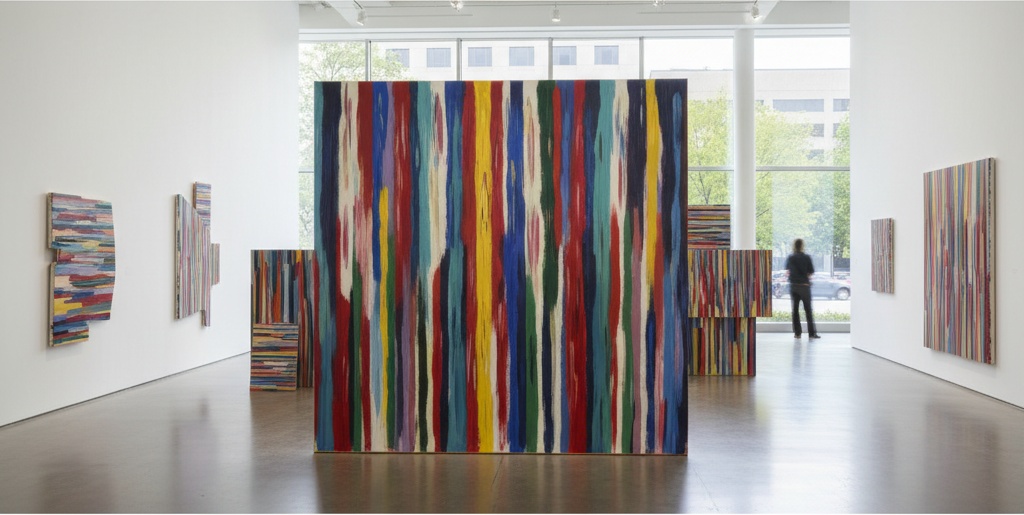
Gene Davis’s most recognizable contribution to the art world is undoubtedly his series of stripe paintings. Beginning in the late 1950s, he embarked on a relentless exploration of vertical stripes, creating compositions that are both strikingly simple and remarkably complex. These weren't merely decorative arrangements; they were carefully orchestrated systems designed to evoke rhythm, movement, and emotional resonance. Davis often spoke of “color interval,” emphasizing the importance of the spaces *between* colors as much as the colors themselves. He likened his process to jazz improvisation, selecting hues intuitively and arranging them in sequences that felt both spontaneous and deliberate. The scale of these paintings is crucial; they demand a sustained gaze, inviting viewers to immerse themselves in the interplay of color and perceive subtle shifts in tone and intensity. Works like Checkmate (1973) exemplify this approach – a minimalist composition of precisely calibrated stripes that pulsates with energy and invites contemplation.
Technique and Process: Painting ‘By Eye’ and the Stain Method
Davis famously described his painting process as “playing by eye,” rejecting pre-determined formulas or theoretical frameworks. While he embraced acrylic paints for their vibrant intensity and rapid drying time, it was his innovative application of these materials that truly set him apart. He often employed a stain technique, diluting the paint with water to allow it to soak directly into the raw canvas. This method eliminated the physical layering associated with traditional painting, creating surfaces that were remarkably flat and luminous. The absence of brushstrokes further emphasized the purity of color and the immediacy of the visual experience. However, Davis’s process wasn't entirely haphazard. He meticulously planned his compositions, often working on multiple canvases simultaneously to achieve a desired balance and harmony. This combination of spontaneity and control – intuition guided by careful observation – was central to his artistic practice. Banjo (1981), with its dynamic arrangement of vertical stripes, showcases the fluidity and precision that characterized Davis’s technique.
Davis's Legacy: Impact on Contemporary Art and Beyond
Gene Davis’s influence extends far beyond the confines of the Washington Color School. His pioneering exploration of color abstraction paved the way for subsequent generations of artists interested in opticality, minimalism, and the expressive potential of pure form. He challenged conventional notions of painting, demonstrating that profound artistic impact could be achieved through seemingly simple means. While his work was initially championed by critics like Clement Greenberg as a culmination of modernist principles, it also anticipated the emergence of post-minimalism and other contemporary movements. Davis’s emphasis on improvisation and spontaneity resonated with artists seeking to break free from rigid formalism. His legacy is evident in the work of numerous contemporary painters who continue to explore the possibilities of color and abstraction. The Smithsonian American Art Museum's ongoing recognition of his contributions, including exhibitions like “Gene Davis: Hot Beat,” underscores his enduring significance within the canon of American art.
Exploring Gene Davis’s Work Through Key Pieces
To truly appreciate the breadth and depth of Gene Davis’s artistic vision, it is essential to examine key works from throughout his career. 5th Anniversary, Kennedy Center (a striking study in grey and beige stripes) demonstrates his ability to create subtle yet powerful compositions using a limited palette. The modular paintings, consisting of discrete but related pieces, reveal his interest in fragmentation and spatial relationships. Even his smaller-scale works, often referred to as “micro-paintings,” possess the same intensity and rhythmic energy as his larger canvases. Davis’s willingness to experiment with diverse media – from watercolor to neon – further underscores his restless creativity and unwavering commitment to artistic exploration. Ultimately, Gene Davis's work invites us to look closely, to immerse ourselves in color, and to experience the transformative power of abstract art. Discovering his paintings is not merely an act of aesthetic appreciation; it’s a journey into the very essence of visual perception.