The New England Roots of an 'Angel Painter': Thayer's Early Life & Influences
 Wikipedia: Abbott Handerson Thayer
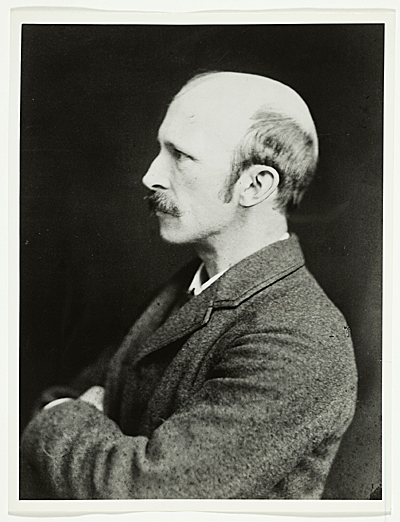
Abbott Handerson Thayer (August 12, 1849 – May 29, 1921) was an American painter, naturalist, and teacher. As a painter of portraits, figures, animals, and landscapes, he enjoyed a certain prominence during his lifetime, and his paintings are represe...
Abbott Handerson Thayer’s artistic journey, though celebrated for its ethereal beauty and spiritual depth, began not in the hallowed halls of European academies but amidst the rugged landscapes of rural New Hampshire. Born in 1849 to a distinguished Boston family, young Abbott was steeped in a world far removed from the burgeoning art centers of the East Coast. This early immersion in nature—a childhood spent at the foot of Mount Monadnock—would prove foundational, shaping not only his subject matter but also his very philosophy of art. He wasn’t merely sketching birds and animals; he was absorbing their essence, studying their forms with a naturalist's precision and a budding artist’s eye. The influence of John James Audubon’s *Birds of America* cannot be overstated; Thayer meticulously copied the illustrations, developing an acute understanding of avian anatomy and plumage that would later distinguish his work. This early passion wasn’t simply a hobby but a precursor to a lifelong fascination with the interplay between form, color, and the natural world.
His formal training began in Boston at Chauncy Hall School and then at the National Academy of Design in New York, followed by four years at the École des Beaux-Arts in Paris. While he absorbed the technical skills taught within these institutions, Thayer’s artistic temperament remained distinctly American—a blend of meticulous realism tempered with a yearning for something beyond mere representation. His time in Paris exposed him to the works of Jean-Léon Gérôme and other established masters, but it was his return to New York that marked a turning point, as he began to forge his own unique path, balancing portrait commissions with increasingly ambitious allegorical compositions.
Bridging Realism and Symbolism: Thayer’s Innovative Artistic Style
Thayer occupies a fascinating position in the history of American art—a bridge between the established conventions of realism and the burgeoning currents of symbolism. He wasn't content to simply depict the world as it appeared; he sought to imbue his subjects with deeper meaning, exploring themes of spirituality, innocence, and the ideal form. This pursuit led him to develop a distinctive style characterized by its luminous quality, delicate modeling, and subtle use of color. Unlike many of his contemporaries who embraced bold brushwork and dramatic contrasts, Thayer favored a refined technique that prioritized nuance and atmosphere.
His approach was remarkably innovative for the time. He manipulated paint with unconventional tools—brooms, scrapers, even his fingers—to achieve textures and effects that defied easy categorization. This tactile quality, combined with his meticulous attention to anatomical detail, created a sense of both realism and otherworldliness. The influence of Renaissance masters is evident in his compositions, particularly in the idealized forms and harmonious arrangements reminiscent of Botticelli and Raphael. However, Thayer wasn’t simply imitating these earlier artists; he was synthesizing their techniques with his own unique sensibility, creating a distinctly American brand of Symbolism.
The Allure of the Angel Paintings: Spirituality, Allegory, and Feminine Ideals
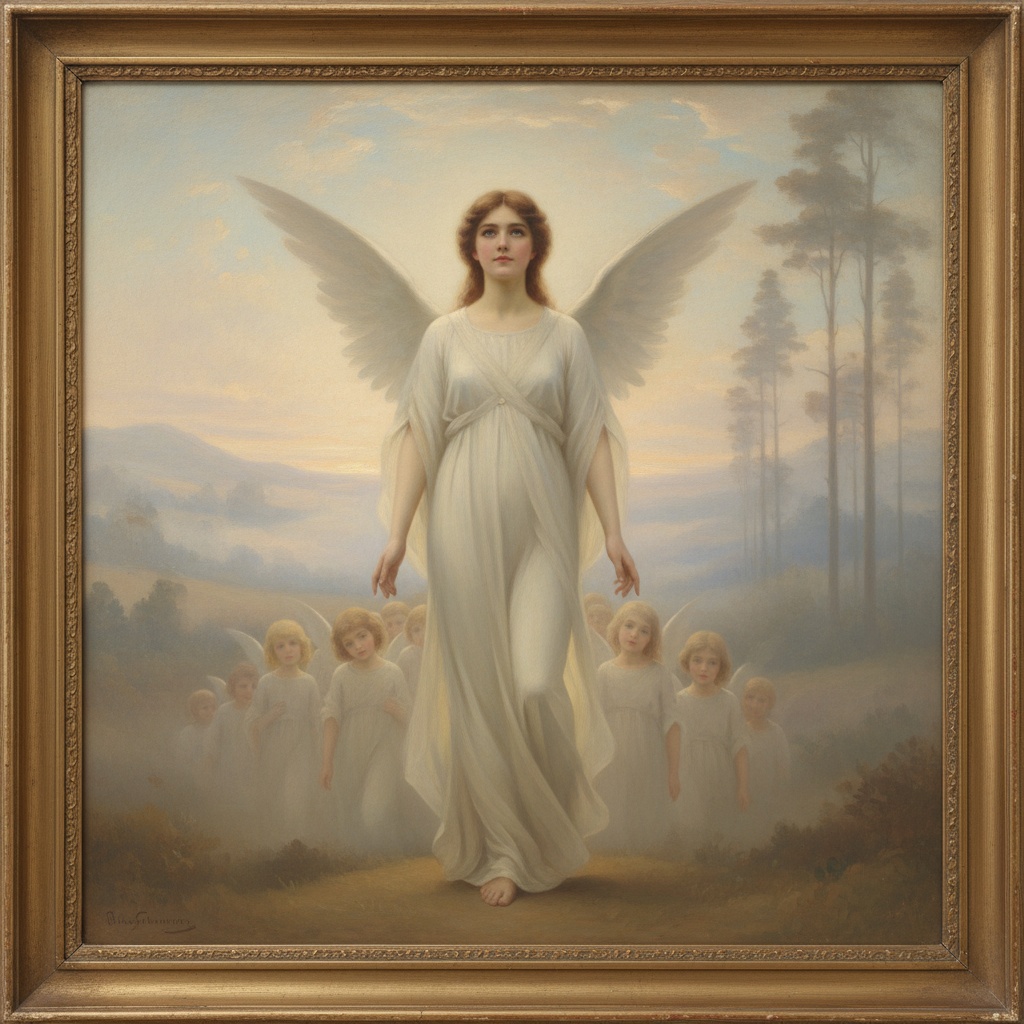
It is perhaps for his “angel paintings” that Abbott Handerson Thayer is best remembered. These works—often featuring his own children as models—are not merely depictions of religious figures but profound explorations of spirituality, innocence, and the feminine ideal. *Angel* (1887), a masterpiece housed at the Smithsonian American Art Museum, exemplifies this approach. The painting portrays Mary Thayer, aged eleven, rendered with an ethereal beauty that transcends earthly concerns. The soft lighting, delicate modeling, and carefully chosen palette create a sense of serenity and grace.
The Renaissance-inspired frame, specifically designed for the work by Stanford White, further enhances its allegorical quality, transforming the painting into a sacred icon. Thayer’s angels are not whimsical cherubs but powerful symbols of hope and redemption. They represent a yearning for something beyond the material world—a connection to the divine that resonated deeply with audiences at the turn of the century. The use of his children as models wasn't accidental; it imbued these paintings with a personal intimacy, grounding the spiritual themes in the tangible reality of family life.
Beyond Angels: Portraits, Landscapes, and Thayer’s Exploration of Nature
While the angel paintings cemented his reputation, Thayer’s artistic output was remarkably diverse. He was a highly sought-after portraitist, capturing the likenesses of prominent figures such as George Washington Cable and Mark Twain with sensitivity and skill. However, even in these portraits, he infused a sense of psychological depth, seeking to reveal not just the outward appearance but also the inner character of his sitters. His landscapes, often depicting scenes around his beloved Mount Monadnock, were equally compelling—meditative studies that captured the beauty and tranquility of the natural world.
These works demonstrate Thayer’s unwavering commitment to observation and detail. He wasn't simply painting pretty pictures; he was striving to understand the underlying principles of form and color, seeking to capture the essence of nature itself. His landscapes often served as backdrops for his allegorical figures, creating a harmonious interplay between the human and natural worlds.
Concealing Coloration & Conservation: Thayer's Scientific Pursuits and Legacy
In the last third of his life, Thayer embarked on an ambitious scientific pursuit that would further distinguish him as a unique figure in American art. Fascinated by the ways animals camouflage themselves from predators, he collaborated with his son, Gerald Handerson Thayer, on a groundbreaking book titled *Concealing-Coloration in the Animal Kingdom* (1909). This work, though initially met with skepticism and even ridicule—famously mocked by Theodore Roosevelt—laid the foundation for modern understanding of camouflage techniques.
Thayer’s research wasn't merely an academic exercise; it was driven by a deep respect for nature and a desire to protect its delicate balance. He became a staunch conservationist, working tirelessly to preserve the forests on the slopes of Mount Monadnock. His efforts led to the establishment of the Thayer Fund, which supported bird sanctuaries along the East Coast. Abbott Handerson Thayer’s legacy extends far beyond his paintings—he was a visionary artist, naturalist, and advocate for environmental stewardship whose work continues to inspire awe and wonder.
Thayer's Enduring Influence on American Art and the Transcendentalist Spirit
Abbott Handerson Thayer's influence on American art is subtle yet profound. He didn’t found a school or establish a rigid set of doctrines, but his innovative techniques, spiritual themes, and unwavering commitment to observation resonated with generations of artists. His work helped pave the way for later movements such as Regionalism and Abstract Expressionism, which also sought to capture the essence of American identity and experience.
Thayer’s art embodies the spirit of Transcendentalism, a philosophical movement that emphasized the inherent goodness of both people and nature. His paintings are not merely representations of reality but windows into a deeper spiritual realm—a world where beauty, innocence, and harmony prevail. Today, his works continue to captivate audiences with their ethereal quality and timeless appeal. Discovering Thayer is an invitation to slow down, contemplate the mysteries of existence, and reconnect with the natural world – a journey that remains as relevant today as it was over a century ago.