

 Preview
 Send
Send Share
Share
 Details

 Download
 Similars
 X-Ray
X-Ray Diaporama
 Stats
StatsSelf Portrait with Stalin
 Acrylic On Canvas
- WallArt
- Primitivist
 1954
1954- Modern
 59.0 x 39.0 cm
 Frida Kahlo Museum
 Read More
Hand Made Oil Reproduction
Hand-painted oil on canvas in your size and frame, made to order by our artists. ( Switch to Print Switch to Digital Image)




P118B $10

P118H $10

P118W $10

P438Z $10

P508JH $12

P508YH $12

P805H $10

P805Z $10

P919BZ $10

P919G $10

P919XJ $10

P959ZH $10

P968JZ $12

W106C $8

W218G $10

W218JH $8

W218Y $10

W307PJ $10

W316G $10

W316PJ $8

W316Y $10

W398PJ $8

W4111J $10

W500HY $15

W500JH $15

W692G $12

W849H $8

W940BG $15

W953PJ $8




Pick from our preset sizes that match the artwork's original proportions.

You may enter your own dimensions to fit a specific frame or space. If your selected size does not match the original image's proportions, we will either crop the artwork or extend the painting with additional hand-painted elements. A digital mockup will be sent for your approval before production begins.
Please note that the on-screen preview does not reflect the actual cropping or extension. Only the mockup will accurately show the final composition.
While custom sizes are available, we recommend selecting a dimension from the predefined list to preserve the original proportions.
After order, OriginalUniqueArt.com team will email client for instructions and provide a mockup preview
Worldwide Delivery () in 3/4 weeks instead of standard 5 weeks. (11 September). No compromise on quality.

Free Worldwide Express Shipping

High-Quality Linen Canvas

Full Shipping Insurance

Customs Tax Refund Guarantee

True Color Matching Guarantee

100-Day Return Policy (Defects Only)

100% Money-Back Guarantee

Bulk Discount Offer
 Glass option is only available in size under 110 CM

Self Portrait with Stalin
Reproduction Medium
Reproduction Size
-


Total Price
$ 300
The Enigmatic Gaze: Frida Kahlo’s “Self Portrait with Stalin”
Frida Kahlo's "Self Portrait with Stalin," painted in 1954, is not merely a depiction of the artist; it’s a complex and unsettling meditation on power, ideology, and the fraught relationship between personal identity and political allegiance. This relatively small canvas – measuring just 59 x 39 centimeters – holds within it a potent visual dialogue that continues to resonate with viewers today. The painting immediately draws attention to Frida herself, posed in a vibrant red dress, her arms crossed in a gesture of both defiance and introspection. Her gaze is directed firmly towards a large portrait of Joseph Stalin hanging in the background, an image rendered largely indistinct – his face obscured, yet his presence undeniably commanding. This deliberate ambiguity is crucial; it’s not about celebrating Stalin, but rather about confronting him, interrogating his authority, and revealing the artist's own conflicted position within the turbulent political landscape of her time.
Painted during a period when Kahlo was grappling with declining health and shifting political alliances – she had recently undergone multiple surgeries and was increasingly disillusioned with the Communist Party – “Self Portrait with Stalin” offers a rare glimpse into her inner turmoil. The choice of Stalin as the subject is particularly striking, given Kahlo’s known Marxist leanings and her admiration for communist ideals. However, the painting isn't a straightforward endorsement; instead, it suggests a critical engagement with the realities of power and the potential dangers of totalitarian regimes. The red dress, typically associated with revolution and passion, here feels tinged with unease, juxtaposed against the imposing figure of Stalin – a symbol of oppression and control.
Primitivist Style and Symbolic Resonance
Executed on masonite, a relatively inexpensive material that allowed Kahlo to work quickly and directly, “Self Portrait with Stalin” exemplifies her distinctive primitivist style. This approach, characterized by bold colors, simplified forms, and an emphasis on symbolic representation rather than meticulous realism, was deeply rooted in Mexican folk art traditions. Kahlo drew inspiration from pre-Columbian imagery and indigenous motifs, infusing her work with a sense of cultural pride and a rejection of European artistic conventions. The painting’s palette is deliberately vibrant – reds, blues, and yellows dominate – creating a visually arresting effect that mirrors the intensity of Kahlo's emotional experience.
Beyond the stylistic elements, “Self Portrait with Stalin” is laden with symbolism. The positioning of Frida in relation to Stalin—her gaze fixed upon him—suggests a confrontation, a questioning of his authority and legacy. The obscured face of Stalin adds another layer of complexity, hinting at the unknowability of power and the potential for manipulation. Some art historians have interpreted the painting as an allegory for Kahlo’s own internal struggles – her battle with illness, her complex relationship with Diego Rivera, and her attempts to reconcile her personal identity with broader political ideologies.
A Window into a Complex Era
Created in 1954, “Self Portrait with Stalin” reflects the anxieties and uncertainties of post-World War II Europe. The Cold War was intensifying, and ideological divisions were deepening across the globe. Kahlo’s painting serves as a poignant reminder of this era's political tensions and the challenges faced by artists attempting to navigate complex social and political landscapes. It is a testament to her ability to transform personal experience into powerful artistic statements, offering viewers a unique perspective on history and human nature.
At OriginalUniqueArt, we are proud to offer meticulously crafted oil painting reproductions of “Self Portrait with Stalin,” allowing art enthusiasts to bring this iconic work into their own homes. Each reproduction is created by skilled artisans using traditional techniques, ensuring that it captures the essence of Kahlo’s original vision with remarkable fidelity. Explore our collection today and discover a piece of art history that continues to provoke thought and inspire dialogue.
Artist Biography
A Life Forged in Pain and Passion
Magdalena Carmen Frida Kahlo y Calderón, known to the world simply as Frida Kahlo, was more than an artist; she was a force of nature, a defiant spirit whose life became inextricably woven into her art. Born on July 6, 1907, in Coyoacán, Mexico City, her existence was marked by physical suffering and emotional turbulence, experiences that would ultimately fuel the intensely personal and symbolic imagery for which she is celebrated. Her father, Guillermo Kahlo, a German-Mexican photographer, fostered her intellectual curiosity and artistic inclinations from an early age. However, Frida’s childhood was shadowed by illness; at six years old, she contracted polio, leaving her with a permanent limp and impacting her physical development. This early encounter with vulnerability and limitation would become a recurring theme in her work, shaping her perspective on the body, pain, and resilience. Even before the devastating accident that defined much of her artistic trajectory, Frida possessed a keen awareness of her own physicality and its inherent fragility.
The Shattered Body, The Blossoming Art
In 1925, at the tender age of eighteen, Frida’s life irrevocably changed. A horrific bus accident left her with catastrophic injuries – fractures to her spine, pelvis, and leg, among others. Confined to a lengthy period of recovery, often bedridden and encased in plaster casts, she turned inward, finding solace and expression through painting. Her mother provided an easel adapted for use while lying down, transforming the confines of her physical limitations into a space for artistic exploration. It was during this time that Frida began to explore self-portraiture with relentless intensity. Unable to venture out into the world, she turned her gaze inward, meticulously documenting her own image as a means of understanding and confronting her pain, both physical and emotional. These early works were not merely representations of her likeness; they were visceral explorations of identity, vulnerability, and the enduring power of the human spirit. The accident wasn’t simply a tragedy; it was a catalyst that unlocked her artistic potential, forcing her to confront her own mortality and find meaning in suffering.
A Tumultuous Union and Artistic Flourishing
Frida's life took another pivotal turn in 1929 when she married the renowned Mexican muralist Diego Rivera. Their relationship was a passionate but tempestuous affair, marked by intense love, infidelity, artistic rivalry, and periods of separation and reconciliation. Despite the emotional turmoil, Rivera proved to be a significant influence on Frida’s artistic development. He encouraged her unique vision, offering constructive criticism while recognizing the raw power and originality of her work. Under his guidance, and through her own relentless experimentation, Frida's style began to coalesce, blending elements of Mexican folk art, realism, and surrealism into a distinctive visual language. Her paintings became increasingly symbolic, exploring themes of identity, the human body, pain, death, and the complexities of female experience. She didn’t shy away from depicting her own suffering; instead, she embraced it as a central theme in her work, transforming personal trauma into universal statements about the human condition.
Symbols of Suffering, Resilience, and Identity
Frida Kahlo is perhaps best known for her self-portraits, which are characterized by their unflinching honesty and symbolic depth. Works like The Two Fridas (1939), a powerful depiction of her dual identity following her divorce from Rivera, showcase her ability to externalize internal conflict through striking visual metaphors. Self-Portrait with Thorn Necklace and Hummingbird (1940) is laden with symbolism – the thorns representing pain, the hummingbird symbolizing hope and resilience, and the black cat a harbinger of bad luck. The Broken Column (1944), a harrowing portrayal of her physical suffering, depicts Frida’s torso split open to reveal a crumbling Ionic column in place of her spine, held together by straps and pierced with nails. Even Henry Ford Hospital (1932), a raw and deeply personal depiction of her miscarriage, demonstrates her willingness to confront taboo subjects with unflinching honesty. These paintings are not simply representations of pain; they are acts of defiance, assertions of selfhood in the face of adversity.
A Lasting Legacy
Frida Kahlo’s influence extends far beyond the realm of art. She was a cultural icon who challenged traditional gender roles and societal expectations through her life and work. Her embrace of Mexican culture and identity helped to elevate its profile on the international stage, and her unflinching portrayal of pain resonated with audiences worldwide, making her a symbol of resilience and strength. She became an important figure for Chicanos in the United States, representing their cultural heritage and struggles. Though she resisted being categorized as a Surrealist, her work shares affinities with the movement’s exploration of the subconscious and dreamlike imagery. Today, Frida Kahlo is celebrated as one of the most important artists of the 20th century, whose legacy continues to inspire generations to embrace their identities, confront adversity, and express themselves authentically. Her art remains a testament to the enduring power of the human spirit to find beauty and meaning even in the darkest of times.
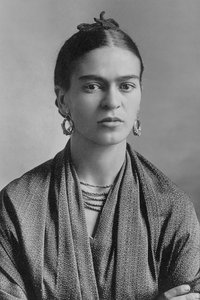
Frida Kahlo
1907 - 1954 , Mexico
Quick Facts
- Artistic Movement Or Style: Surrealism, Folk art
- Artists Or Movements Influenced By This Artist:
- Chicano art
- Feminist artists
- Artists Who Influenced This Artist:
- Mexican folk artists
- European Renaissance painters
- Date Of Birth: July 6, 1907
- Date Of Death: 1954
- Full Name: Magdalena Carmen Frieda Kahlo y Calderón
- Nationality: Mexican
- Notable Artworks:
- The Two Fridas
- Self-Portrait with Thorn Necklace
- The Broken Column
- Henry Ford Hospital
- Place Of Birth: Coyoacán, Mexico
Related Articles

Surrealism's Greatest Hits: 10 Masterpieces for Your Home |
Journey into the dreamlike world of Surrealism! Explore 10 masterpieces by Dali, Magritte & Miró. Discover the stories behind these iconic paintings and find museum-quality art reproductions for your home at .
Revolution on Canvas: Exploring the Socio-Political Power & Artistic Legacy of Mexican Muralism
Explore the powerful world of Mexican muralism! Discover Diego Rivera, Frida Kahlo & Orozco's revolutionary art, social impact & lasting legacy. Expert insights & high-quality reproductions at OriginalUniqueArt.
Unveiling Frida Kahlo: A Journey Through Her Most Iconic Masterpieces and the Soul of Mexican Surrealism
Embark on a profound journey through Frida Kahlo's most iconic masterpieces. Discover the deep symbolism, Mexican heritage, and resilient spirit behind her legendary works in this expert art-historical exploration designed for true art enthusiasts.

The Inner Landscape: Exploring Themes of Introspection in Visual Art Across Movements & Eras
Explore the captivating world of introspective art! Discover how artists across eras – from Rembrandt to Kahlo – used self-portraiture to reveal their inner worlds and emotional depths. A journey through art history & psychology.
Frida Kahlo: A Life Painted – Surrealism, Identity & Autobiographical Narrative
Explore the life & art of Frida Kahlo – a journey through surrealism, identity, pain, and resilience. Discover her autobiographical masterpieces & lasting feminist legacy with OriginalUniqueArt.


