Preview
 Send
Send Share
Share
 Details
 Guide
Guide

 Download
 Similars
 X-Ray
X-Ray Diaporama
 Stats
StatsGrasshopper and Alligator
 Paper
Paper- WallArt
- Contemporary Realism
 2002
2002- Contemporary
 43.0 x 26.0 cm
 USC Fisher Museum of Art
 Read More
The artwork displayed on this page is protected by copyright law, which means we cannot legally create or sell an identical reproduction. This protection is enforced under international agreements such as the Berne Convention and by national laws, including those outlined by the U.S. Copyright Law - Title 17.
This method fully complies with copyright regulations because it does not involve copying or duplicating the protected artwork. Instead, it is a creative reinterpretation - a new painting that is influenced by the original but not identical to it.
Giclée / Art Print
Museum-quality giclée or canvas print with fast production and flexible finish options. ( Buy Hand Made Painting Switch to Digital Image)




P118B $10

P118H $10

P118W $10

P438Z $10

P508JH $12

P508YH $12

P805H $10

P805Z $10

P919BZ $10

P919G $10

P919XJ $10

P959ZH $10

P968JZ $12

W106C $8

W218G $10

W218JH $8

W218Y $10

W307PJ $10

W316G $10

W316PJ $8

W316Y $10

W398PJ $8

W4111J $10

W500HY $15

W500JH $15

W692G $12

W849H $8

W940BG $15

W953PJ $8




Pick from our preset sizes that match the artwork's original proportions.

Type the width and the height you need, to fit your frame or your wall. A print can only be cut, never made bigger than the picture, so a size with a different shape loses a part of the image. We send you a digital mockup to approve before we print anything. The picture shown on this page does not show the real cut — only the mockup does.
Worldwide Delivery () in 2 weeks instead of standard 4/5 weeks. (25 October)

Free Worldwide Express Shipping

High-Quality Linen Canvas

Full Shipping Insurance

Customs Tax Refund Guarantee

True Color Matching Guarantee

100-Day Return Policy (Defects Only)

100% Money-Back Guarantee

Bulk Discount Offer
 Glass option is only available in size under 110 CM

Grasshopper and Alligator
Giclée / Art Print
Reproduction Size
-


Total Price
$ 81
A Dialogue of Silhouettes: The Poetic Contrast in Toledo’s Diptych
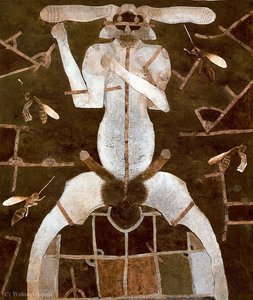
In the evocative diptych Grasshopper and Alligator, the legendary Mexican master Francisco Toledo invites us into a world where the boundaries between the organic and the graphic dissolve. Created in 2002, this work serves as a profound meditation on the duality of nature. The piece presents two distinct yet harmoniously linked book covers, each acting as a window into a simplified, primordial reality. Through the use of stark black silhouettes set against the warm, tactile embrace of beige and brown textured paper, Toledo strips away the unnecessary noise of the natural world to reveal its essential, skeletal truths. It is a composition that breathes with a quiet, rhythmic pulse, capturing the viewer's attention through a masterful balance of negative space and bold, decisive forms.
The technique employed here speaks to the artist’s deep connection to the artisanal traditions of Oaxaca. There is a palpable sense of the handmade in every fiber of the work; the rough, uneven surfaces of the paper provide a sensory depth that prevents the flat silhouettes from feeling static. The method—reminiscent of stenciling or precise paper cutting—creates clean, graphic outlines that define the alligator and the grasshopper with surgical precision. This interplay between the smooth, dark ink of the subjects and the rugged, aged texture of the substrate creates a visual tension that is both sophisticated and primal. For the collector or interior designer, this piece offers a unique textural element, providing a focal point that feels both ancient and strikingly modern.
Symbolism and the Soul of the Oaxacan Landscape
Beyond its aesthetic brilliance, Grasshopper and Alligator is steeped in the symbolic language that defined Toledo’s illustrious career. As an artist whose life was inextricably woven into the Zapotec soul of Mexico, Toledo often utilized fauna to represent the complex hierarchies and survival instincts of the natural world. The pairing of the grasshopper—a creature of lightness, agility, and ephemeral existence—with the alligator—a symbol of prehistoric strength, patience, and grounded power—creates a captivating narrative of contrasts. This is not merely an illustration of insects and reptiles; it is a symbolic exploration of life’s extremes, from the delicate to the formidable.
The emotional impact of the work lies in its deceptive simplicity. There is a certain whimsy in the pairing, yet a profound gravity in the execution. The muted, earthy palette evokes a sense of nostalgia and permanence, as if these figures have emerged from the very soil of Mexico to tell a story of coexistence. For those seeking to adorn a space with art that inspires contemplation, this diptych offers a sophisticated way to introduce themes of nature, resilience, and balance. It is a piece that does not demand attention through loudness, but rather commands it through a quiet, undeniable presence, making it an exquisite addition to any curated collection or thoughtfully designed interior.
Questions & Answers
What color harmony does "Grasshopper and Alligator" by Francisco Toledo display?
The colors of "Grasshopper and Alligator" by Francisco Toledo show a strong color unity harmony. Harmony describes how the colors relate to each other.
Is "Grasshopper and Alligator" by Francisco Toledo a bright or a dark artwork?
In terms of perceived brightness, "Grasshopper and Alligator" by Francisco Toledo is balanced.
What medium is "Grasshopper and Alligator" by Francisco Toledo executed in?
The medium of "Grasshopper and Alligator" by Francisco Toledo is paper. Reproductions aim to render the appearance of this technique.
Artist Biography
A Life Woven into the Soul of Oaxaca
Francisco Benjamín López Toledo, born in Juchitán de Zaragoza, Oaxaca, in 1940, wasn’t merely an artist; he was a cultural architect, a passionate advocate for his homeland, and one of Mexico's most profoundly influential contemporary figures. His life story is inextricably linked to the vibrant traditions and often-overlooked complexities of Oaxacan culture, a heritage that permeates every brushstroke, sculpted form, and woven thread of his extensive oeuvre. Toledo’s artistic journey began early, nurtured by the rich visual language of his Zapotec upbringing and formalized through studies at the Escuela de Bellas Artes de Oaxaca and later at the Centro Superior de Artes Aplicadas del Instituto Nacional de Bellas Artes in Mexico City under the guidance of Guillermo Silva Santamaría. However, formal training only provided a foundation; Toledo’s true education came from immersing himself in the world around him – the landscapes, folklore, and social realities of his native state.A Kaleidoscope of Influences
To categorize Francisco Toledo within a single artistic movement proves impossible, and perhaps even undesirable. His style is remarkably fluid, a captivating synthesis of diverse influences that reflect both his intellectual curiosity and deep-rooted cultural identity. The echoes of Pre-Columbian art resonate strongly in his work, particularly the iconography of Zapotec and other indigenous cultures, manifesting as stylized figures and symbolic motifs. This ancestral connection is beautifully interwoven with the exuberant palette and narrative spirit of Mexican folk art, creating a visual language that feels both ancient and strikingly modern. Yet, Toledo wasn’t content to simply replicate tradition; he fearlessly embraced elements of Surrealism, allowing dreamlike compositions and explorations of the subconscious to surface in his paintings and graphic works. This unique blend—a harmonious collision of history, heritage, and personal vision—defines the distinctive character of his art. He frequently employed bold lines, textured surfaces, and a deliberately limited color palette, creating images that are visually arresting and emotionally resonant.Themes of Identity, Society, and Nature
Recurring themes weave through Toledo’s artistic narrative, revealing his profound engagement with the world around him. Oaxacan culture is not merely a subject matter but a living presence in his work—a celebration of traditions, beliefs, and the everyday lives of its people. Beyond aesthetic representation, Toledo used his art as a powerful vehicle for social commentary, fearlessly addressing issues such as poverty, inequality, and political corruption with both subtlety and directness. His canvases often serve as poignant reflections on the human condition, prompting viewers to confront uncomfortable truths about society. Equally prominent is his fascination with mythology and symbolism, drawing upon Zapotec lore and universal archetypes to imbue his work with layers of meaning. Finally, a deep reverence for nature—the flora and fauna of Oaxaca—is evident in his meticulous depictions of the natural world, where every plant and creature carries symbolic weight.Beyond the Canvas: A Cultural Legacy
Francisco Toledo’s impact extends far beyond the realm of painting and sculpture. He was a tireless advocate for cultural preservation and community development in Oaxaca, recognizing that art is not created in a vacuum but thrives within a supportive ecosystem. His commitment to this belief led him to establish several pivotal institutions that continue to enrich the artistic landscape of his homeland: The Instituto de Artes Gráficas de Oaxaca (IAGO) art library, a treasure trove of visual knowledge; the Museo de Arte Contemporáneo de Oaxaca (MACO), providing a platform for contemporary artists; Patronato Pro-Defensa y Conservación del Patrimonio Cultural de Oaxaca, dedicated to safeguarding cultural heritage; and several other initiatives including a library for the blind, a photographic center, and the Eduardo Mata Music Library. These endeavors demonstrate his unwavering dedication to fostering artistic expression and cultural awareness within his community, solidifying his legacy as not just an artist but a true visionary. His work has been exhibited extensively throughout Mexico and internationally, reaching audiences in Argentina, Brazil, Colombia, Ecuador, Spain, the United Kingdom, Belgium, France, Japan, Sweden, and the United States.An Enduring Influence
Francisco Toledo’s passing in 2019 marked a significant loss for the art world, but his influence continues to resonate deeply. He is rightfully considered one of Mexico's most important contemporary artists, having elevated Oaxacan art onto the international stage and inspired generations of artists with his unique vision and unwavering commitment to social justice. His dedication to both artistic creation and community empowerment solidifies his place as a cultural icon—a testament to the power of art to transform lives and shape a more equitable world. Toledo’s legacy is not simply found in the museums and galleries that display his work, but in the vibrant cultural institutions he founded and the countless individuals whose lives he touched through his artistry and activism.
Francisco Toledo
1940 - , Mexico
Quick Facts
- Artistic Movement Or Style: Surrealism, Folk Art
- Artists Who Influenced This Artist:
- Rufino Tamayo
- Paul Klee
- Jean Dubuffet
- Date Of Birth: 1940
- Full Name: Francisco Benjamín López Toledo
- Nationality: Mexican
- Notable Artworks:
- Grasshopper and Alligator
- Two People Squatting...
- Redes con Cangrejos...
- Place Of Birth: Juchitán de Zaragosa, Mexico
Related Articles

The Refined Aesthetic of Victorian Illustration: A Study in Narrative & Technique
Explore the captivating world of Victorian illustration! Discover Pre-Raphaelite influences, key artists like Rossetti & Stephens, and the era's rich narrative detail. A deep dive for art enthusiasts.
Acrylic on Paper: A Modern Canvas for Contemporary Expression
Explore the versatility of acrylic painting on paper! Discover expert techniques, artist insights & archival practices for creating stunning contemporary art. Learn more at OriginalUniqueArt.

Goya's Masterpieces: Explore 25 Iconic Paintings & Art Prints | OriginalUniqueArt
Delve into the world of Francisco Goya with OriginalUniqueArt. Explore 25 iconic paintings – from 'The Third of May' to his haunting Black Paintings. Discover the stories, techniques & emotions behind these Spanish masterpieces. Find museum-quality art reproductions for your home at OriginalUniqueArt.com!

Angelo Chiacchio: A Mid-Century American Illustration Master & the Rise of Commercial Art
Explore the captivating world of Angelo Chiacchio, a master of mid-century American illustration. Discover his evolution, signature style, and lasting impact on commercial art & design. Learn about his legacy at the Museum of American Illustration.

Kay Rasmus Nielsen: A Golden Age Illustrator's Enchanting Legacy of Symbolism & Narrative
Explore the captivating world of Kay Rasmus Nielsen, a celebrated Golden Age illustrator renowned for his Art Nouveau fairy tale art & Disney contributions. Discover his unique style, enduring legacy, and how to collect his enchanting works.