Symbolist Painting · 1908
Study for (Ferdinand Hodler, 1908)
Ferdinand Hodler (1853–1918) made Study for . It dates from 1908. It belongs to the Symbolist Painting movement. It is made in acrylic. It is kept at National Gallery of Bosnia and Herzegovina in Sarajevo, Bosnia and Herzegovina. It measures 19 × 66 cm.
- 1908
- Acrylic
- 19 × 66 cm
- National Gallery of Bosnia and Herzegovina, Sarajevo

 Preview

 Hand Made Oil Painting
 Send
 Share
 Fact sheet


 Download
 Similars
 X-Ray
 Diaporama
 Q&A

 Stats
Study for , in brief
- Title
- Study for
- Artist
- Ferdinand Hodler (1853–1918)
- Artist born in
- Bern, Switzerland
- Date
- 1908
- Medium
- Acrylic
- Dimensions
- 19 × 66 cm
- Where to see it
- National Gallery of Bosnia and Herzegovina, Sarajevo, Bosnia and Herzegovina
- Movement
- Symbolist Painting
- Subject
- swiss landscape, military group, riders horses, hodler style, 1908 painting, symbolism
What does Study for depict?
A Moment Frozen in Time: Exploring Ferdinand Hodler’s “Study for”
The painting "Study for," by Ferdinand Hodler, transcends mere depiction; it embodies a profound meditation on human existence against the backdrop of Switzerland's landscape. Executed in 1908, this artwork represents more than just a visual record—it’s a carefully crafted symbol reflecting Hodler’s preoccupation with themes of mortality and resilience. The scene unfolds in a serene field populated by thirteen individuals mounted upon horses, each armed with rifles – a juxtaposition that immediately draws the viewer into a contemplation of power dynamics and vulnerability.- Subject Matter: The composition centers around a group of men on horseback engaged in what appears to be a military exercise or perhaps a symbolic representation of courage and preparedness.
- Style: Hodler’s signature style is characterized by its distinctive blend of realism and abstraction. While the figures are rendered with meticulous detail, their forms subtly merge into the surrounding environment, creating an atmosphere of dreamlike stillness.
Historical Context: Symbolism in Fin-de-Siècle Switzerland
“Study for” emerges from the fertile soil of Swiss Symbolism, a movement that flourished during the late 1890s and early 1900s. Influenced by Nietzschean philosophy and Wagnerian opera, Symbolist artists sought to express inner realities beyond the confines of observable phenomena—to tap into universal truths through evocative imagery and suggestive color combinations. Hodler’s work aligns perfectly with this aesthetic impulse, prioritizing emotional impact over literal representation.Symbolic Layers: Mortality and Resilience
The rifles held by the riders are not simply weapons; they represent a confrontation with death—a deliberate acknowledgement of human vulnerability amidst the grandeur of nature. Yet, simultaneously, the posture of the figures conveys an unwavering spirit of determination. Hodler’s masterful use of color and form underscores this duality, capturing the essence of existential contemplation. The horses themselves symbolize stability and endurance, mirroring the human desire to persevere despite adversity.- Emotional Impact: “Study for” evokes a feeling of quiet solemnity—a poignant reminder of our mortality tempered by an appreciation for beauty and strength.
Which museum holds Study for ?
National Gallery of Bosnia and Herzegovina
Sarajevo, Bosnia and Herzegovina
A Sanctuary of Resilience: The Soul of Sarajevo In the beating heart of Sarajevo, a city that has weathered the most profound storms of the twentieth century, stands the National Gallery of Bosnia and Herzegovina as a luminous testament to the enduring power of human creativity. To walk through its doors is to enter a space where the scars of history meet the triumph of the artistic spirit, offering a profound dialogue between a turbulent past and an aspirational future. It serves as a sanctuary where the collective memory of a people is preserved within the delicate strokes of paint and the heavy textures of stone.


High-resolution images of Study for

Ferdinand Hodler, Study for (1908), National Gallery of Bosnia and Herzegovina. Public domain.
Questions on Study for , answered
Which museum holds the original "Study for"?
You can see the original "Study for" at the National Gallery of Bosnia and Herzegovina, Sarajevo, Bosnia and Herzegovina.
In what year was "Study for" by Ferdinand Hodler created?
"Study for" dates from 1908. The date places the work within Ferdinand Hodler's career and its era.
What medium is "Study for" by Ferdinand Hodler executed in?
Ferdinand Hodler used the acrylic technique for "Study for". The technique defines the material nature of the original work.
How big is the original "Study for"?
The recorded dimensions of "Study for" by Ferdinand Hodler are 66 x 19 cm. Reproductions can be ordered in other sizes while keeping the same proportions.
What is "Study for" about?
"Study for" by Ferdinand Hodler depicts: swiss landscape, military group, riders horses, hodler style, 1908 painting, symbolism, field scene.
Can the image of "Study for" by Ferdinand Hodler be freely reproduced?
"Study for" by Ferdinand Hodler is in the public domain - its copyright has expired. This status governs how the image of the work may be reproduced.
Who created "Study for"?
"Study for" was created by Ferdinand Hodler. The information on this page describes Ferdinand Hodler's original work.
Which artistic current is "Study for" by Ferdinand Hodler part of?
"Study for" is a work of Symbolist Painting. The movement indicates the artistic tradition the work is part of.
Which period of Ferdinand Hodler's career does "Study for" belong to?
"Study for" belongs to the Late Period of Ferdinand Hodler's career. This classification relates the work to the artist's development.
About the artist, Ferdinand Hodler
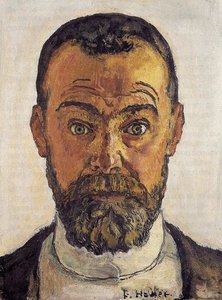
1853–1918, Switzerland
Ferdinand Hodler
The Architecture of Mortality Born in Bern, Switzerland, in 1853, Ferdinand Hodler’s early years were defined by a quiet, persistent grief. Before he reached adolescence, the tuberculosis that claimed his father and two younger brothers left a void in his household. This early encounter with loss became a recurring motif in his work, a shadow that would follow him from the modest beginnings of his apprenticeship to the heights of his professional career. He began his training as a decorative painter, assisting his stepfather with commercial sign-work, a practical education that instilled in him a precise command of line and form.
Also by Ferdinand Hodler
 Eiger, Monch and Jungfrau in Moonlight1908
 Woman in Ecstasy1911
 Sunset on Lake Geneva1915
 Study of two figures1897

Essays around Study for
 Masterpieces of Chaos: The Top 25 Francis Bacon ArtworksExplore the raw power of Francis Bacon's top 25 masterpieces. Discover his iconic works and curated art on OriginalUniqueArt.com.
 Mastering Parallelism: The 25 Most Iconic Artworks by Ferdinand HodlerImmerse yourself in the rhythmic beauty of Ferdinand Hodler. Explore 25 iconic masterpieces of Swiss Symbolism and Parallelism. From soulfu…
 George Stubbs: Anatomical Precision & Romantic Vision in 18th-Century British ArtExplore the captivating world of George Stubbs, the 18th-century master renowned for his anatomical precision & Romantic animal paintings. …