Text size

() ·

A painting made for you, by hand

The Visit

Hand Made Oil Reproduction

Hand-painted oil on canvas in your size and frame, made to order by our artists. ( Switch to Print Switch to Digital Image)

Collectible Description

Experience Félix Vallotton's 'The Visit,' a captivating black-and-white painting of intimacy and quiet observation, showcasing his signature style and masterful composition from 1899.

Artist Biography

A key Nabi known for his striking woodcuts and Intimacies series. Explore the evocative works of Félix Vallotton today.

from ·

Chapter 1

How large should it be?

Slide to change the size; the picture on the left shows the frame at its real width. The proportions of the original are kept.

Standard
custom
CM
INCH

Pick from our preset sizes that match the artwork's original proportions.

width
height

Type the width and the height you need, to fit your frame or your wall. This is hand-painted, so for a size with a different shape the artist can paint a bit more around the picture, or cut a bit — you choose. We send you a digital mockup to approve before the painting starts. The picture shown on this page does not show the real result — only the mockup does.

Chapter 2

How should it arrive?

Choose the edges of the stretched canvas

Choose your frame

Corner sample of the WhiteWrap canvas edge finish, stretched on solid wood bars
White $1
Corner sample of the BlurSideWrap canvas edge finish, stretched on solid wood bars
Blurside $1
Corner sample of the ExtendedWrap canvas edge finish, stretched on solid wood bars
Extended $1
Corner sample of the P118B picture frame: moulded polystyrene, 5 cm wide and 3 cm thick
P118B $10
Corner sample of the P118H picture frame: moulded polystyrene, 5 cm wide and 3 cm thick
P118H $10
Corner sample of the P118W picture frame: moulded polystyrene, 5 cm wide and 3 cm thick
P118W $10
Corner sample of the P438Z picture frame: moulded polystyrene, 5.5 cm wide and 3.5 cm thick
P438Z $10
Corner sample of the P508JH picture frame: moulded polystyrene, 7 cm wide and 3.5 cm thick
P508JH $12
Corner sample of the P508YH picture frame: moulded polystyrene, 7 cm wide and 3.5 cm thick
P508YH $12
Corner sample of the P805H picture frame: moulded polystyrene, 5 cm wide and 3.5 cm thick
P805H $10
Corner sample of the P805Z picture frame: moulded polystyrene, 5 cm wide and 3.5 cm thick
P805Z $10
Corner sample of the P919BZ picture frame: moulded polystyrene, 7 cm wide and 3.5 cm thick
P919BZ $10
Corner sample of the P919G picture frame: moulded polystyrene, 7 cm wide and 3.5 cm thick
P919G $10
Corner sample of the P919XJ picture frame: moulded polystyrene, 7 cm wide and 3.5 cm thick
P919XJ $10
Corner sample of the P959ZH picture frame: moulded polystyrene, 5 cm wide and 3 cm thick
P959ZH $10
Corner sample of the P968JZ picture frame: moulded polystyrene, 6 cm wide and 4 cm thick
P968JZ $12
Corner sample of the W106C picture frame: solid wood, 5 cm wide and 3 cm thick
W106C $8
Corner sample of the W218G picture frame: solid wood, 5 cm wide and 3 cm thick
W218G $10
Corner sample of the W218JH picture frame: solid wood, 5 cm wide and 3 cm thick
W218JH $8
Corner sample of the W218Y picture frame: solid wood, 5 cm wide and 3 cm thick
W218Y $10
Corner sample of the W307PJ picture frame: solid wood, 6 cm wide and 3 cm thick
W307PJ $10
Corner sample of the W316G picture frame: solid wood, 6 cm wide and 3 cm thick
W316G $10
Corner sample of the W316PJ picture frame: solid wood, 6 cm wide and 3 cm thick
W316PJ $8
Corner sample of the W316Y picture frame: solid wood, 6 cm wide and 3 cm thick
W316Y $10
Corner sample of the W398PJ picture frame: solid wood, 5 cm wide and 3 cm thick
W398PJ $8
Corner sample of the W4111J picture frame: solid wood, 6.5 cm wide and 3.5 cm thick
W4111J $10
Corner sample of the W500HY picture frame: solid wood, 7 cm wide and 5 cm thick
W500HY $15
Corner sample of the W500JH picture frame: solid wood, 7 cm wide and 5 cm thick
W500JH $15
Corner sample of the W692G picture frame: solid wood, 8 cm wide and 4 cm thick
W692G $12
Corner sample of the W849H picture frame: solid wood, 5 cm wide and 3 cm thick
W849H $8
Corner sample of the W940BG picture frame: solid wood, 7.5 cm wide and 4.5 cm thick
W940BG $15
Corner sample of the W953PJ picture frame: solid wood, 6 cm wide and 3.5 cm thick
W953PJ $8
Corner sample of the H24-GOLD picture frame: carved wood with gesso, 10 cm wide and 6 cm thick
H24-GOLD $30
Corner sample of the H24-SILVER picture frame: carved wood with gesso, 10 cm wide and 6 cm thick
H24-SILVER $30
Corner sample of the H36-GOLD picture frame: carved wood with gesso, 15 cm wide and 6.5 cm thick
H36-GOLD $45
Corner sample of the H36-SILVER picture frame: carved wood with gesso, 15 cm wide and 6.5 cm thick
H36-SILVER $45
Frame preview
Framed

Moulding: . Overall size with the frame: .

Chapter 3

Who paints it, and should anything change?

Examples of what can be changed: Replace face with customer photo; Add pet (e.g., replace cat with dog); Include hidden message in background; Change background landscape or elements.
After order, OriginalUniqueArt.com team will email client for instructions and provide a mockup preview

Worldwide Delivery () in 3/4 weeks instead of standard 5 weeks. (9 November). No compromise on quality.

Chapter 4

The finishing touches

A nameplate, as in a museum?

Engraved Bronze Plaque Details

This elegant plaque features the artist's name and the title of the artwork, finely engraved for a timeless presentation.

It is made from bronze with a refined, elegant finish. The text is precisely laser-engraved for a sharp and permanent result. Measuring 9x2 cm, the plaque is compact yet easy to read. It's built to be durable and scratch-resistant, offering a professional, museum-quality look. Mounting is simple thanks to the included adhesive backing.

Transparent Acrylic Plaque Details

The plaque includes essential engraved details such as the artist's name, the title of the artwork, the date it was created, the type of media used-like oil on canvas or watercolor-a brief description of the piece, and a QR code that links to the complete artwork information.

It is crafted from clear acrylic, offering a sleek, modern appearance. The text is UV-engraved in black to ensure strong visual contrast. With a size of 10x15 cm, it ensures optimal readability. It comes equipped with two metal hooks for secure wall mounting. The plaque is designed to be weather-resistant, making it suitable for various environments, and it includes interactive features that work seamlessly with smartphone scanning.

Black Acrylic Plaque Details

This elegant plaque includes engraved information such as the artist's name, the title of the artwork, the date it was created, the type of media used (like oil on canvas or watercolor), a short description of the artwork, and a QR code for quick access to more information.

The plaque itself is made from refined black acrylic with a premium finish. The text is laser-engraved in white for high contrast and readability. Its size is 10x15 cm, designed to be easy to read. It comes with two metal hooks for professional mounting. The design is sleek and fits any interior style. It is also weather-resistant and durable, with built-in digital integration for mobile compatibility.

A protective varnish?

When do you need it?

Chapter 5

Your painting, as you ordered it

The Visit

Reproduction Medium

Reproduction Size

-

Elite Senior Artist

More detail, finesse, and extra production time

-

Reproduction Frame

-

-

For artworks or reproductions larger than 105 cm (approximately 41 inches) on any side, the frame will be shipped as a kit, disassembled. This method ensures safe delivery and prevents damage during transport.

Professional assembly required - this is not a DIY product.
The kit must be assembled and the canvas stretched by an experienced professional framer, using wood glue (not supplied), a canvas stretching plier and clamps to hold the bars square while the glue dries. Incorrect assembly or uneven canvas tension can permanently damage the artwork and is not covered by our warranty.

  • All solid wood bars are included, precisely cut to size.

  • Assembled with the screws provided, plus wood glue for the corner joints, which is not supplied and must be sourced by your framer.

  • Professional tools are required and not included: a canvas stretching plier (tensioner) and clamps to hold the bars square while the glue dries.

Important:
The corner joints require wood glue, the bars must be held with clamps until the glue is fully dry, and tightening the canvas on the assembled frame requires a canvas stretching plier. None of these are included in the kit. Please arrange an experienced professional framer before ordering this size.

Nameplate

-

-

Protective Varnish

Glossy Varnish (enhances colors, protects against light/moisture)

-

Customize My Artwork

Examples of what can be changed: Replace face with customer photo; Add pet (e.g., replace cat with dog); Include hidden message in background; Change background landscape or elements.

-

Urgent

Worldwide Delivery () in 3/4 weeks instead of standard 5 weeks. (9 November). No compromise on quality.

-

Express Shipping

Worldwide Delivery () in 5 weeks. (16 November).

Included

Total Price

$ 300

Total Price $ 300

Glass option is only available in size under 110 CM

Included with every order

  • Free Worldwide Express Shipping
  • High-Quality Linen Canvas
  • Full Shipping Insurance
  • Customs Tax Refund Guarantee
  • True Color Matching Guarantee
  • 100-Day Return Policy (Defects Only)
  • 100% Money-Back Guarantee
  • Bulk Discount Offer

The Intimate Dance of Light and Shadow: Félix Vallotton’s “The Visit”

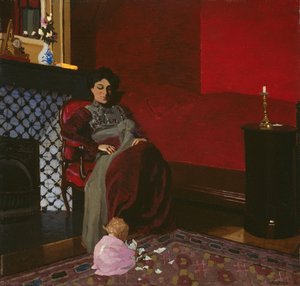
Félix Vallotton's "The Visit," painted in 1899, isn’t merely a depiction of a couple sharing a quiet moment; it’s a masterclass in capturing the subtle tensions and unspoken desires that simmer beneath the surface of domestic life. This work, rendered in delicate gouache on cardboard, exemplifies Vallotton's signature style – a restrained elegance combined with an almost unsettling psychological depth. He eschewed the grand narratives favored by many of his contemporaries, instead focusing on the quiet dramas unfolding within the confines of everyday existence. The painting immediately draws the eye to the central figures: a man and woman standing close together in what appears to be a modestly furnished living room. The composition is remarkably simple, yet profoundly effective; Vallotton utilizes a limited palette of blues, browns, and creams, creating a sense of muted intimacy. Notice how he avoids dramatic lighting or elaborate details, opting instead for the soft, diffused light that suggests an afternoon indoors – a light that seems to both illuminate and conceal. The room itself is subtly rendered, with a comfortable couch and two chairs arranged around a small table, hinting at a familiar setting, yet offering no specific clues about its occupants’ lives.

A Nabis Masterpiece: Vallotton's Exploration of Modern Relationships

Vallotton was a key figure in the *Nabi* movement, a group of artists who sought to break away from academic traditions and explore new ways of representing modern life. The *Nabis*, meaning “prophets,” were interested in capturing the fleeting moments of everyday experience, often focusing on themes of sexuality, leisure, and urban alienation. "The Visit" perfectly embodies this aesthetic – it’s not a romanticized portrayal of love, but rather an observation of its complexities. Vallotton's approach was markedly different from that of his predecessors; he rejected the idealized representations of beauty prevalent in earlier art, opting instead for a more realistic and psychologically nuanced style. He frequently depicted scenes of urban life, capturing the energy and dynamism of Paris at the turn of the century. However, within this broader context, "The Visit" stands out for its intensely personal focus, inviting viewers to contemplate the unspoken emotions between the two figures. The painting’s power lies in its ambiguity; we are left to interpret their relationship – is it a tender embrace, a charged encounter, or simply a comfortable familiarity?

Technique and Style: The Language of Restraint

Vallotton's technique is characterized by remarkable restraint and precision. He employed a *cloisonnism* style, which involves outlining forms with dark lines and filling them in with flat areas of color – a method borrowed from medieval enamelwork. This creates a sense of clarity and definition, particularly evident in the figures’ clothing and the furniture. His brushstrokes are smooth and controlled, contributing to the painting's overall sense of calm and composure. Crucially, Vallotton was a master of capturing subtle tonal variations – he used delicate gradations of color to create a sense of depth and atmosphere. The shadows aren’t stark or dramatic; they are soft and diffused, blending seamlessly into the surrounding colors. This meticulous attention to detail is what gives "The Visit" its remarkable realism and emotional resonance. Furthermore, Vallotton's use of gouache on cardboard allowed for a luminous quality, enhancing the painting's overall effect.

Symbolism and Emotional Resonance: A Portrait of Quiet Tension

While seemingly straightforward, “The Visit” is rich in symbolic potential. The couple’s proximity suggests intimacy, but their averted gazes hint at unspoken anxieties or unresolved tensions. The neutral setting – a simple living room devoid of personal touches – further emphasizes the emotional distance between them. Some art historians have interpreted the painting as a commentary on the changing roles of men and women in late 19th-century society, where traditional gender roles were being challenged. The woman’s blue dress, a color often associated with femininity and serenity, contrasts subtly with the man's more subdued attire. The overall effect is one of quiet contemplation – a feeling that lingers long after you’ve turned away from the canvas. "The Visit" isn’t about grand gestures or dramatic declarations; it’s about the subtle nuances of human interaction, the unspoken words and hidden emotions that shape our relationships. It invites us to consider the complexities of intimacy and the enduring power of quiet moments.

A Timeless Masterpiece: Reproductions and Beyond

Reproductions of “The Visit” offer a remarkable opportunity to experience Vallotton’s masterful technique and evocative imagery firsthand. Whether displayed in a contemporary interior or studied in an art museum, this painting continues to captivate viewers with its understated beauty and psychological depth. Consider how the muted palette and carefully rendered details would complement a modern space – perhaps alongside other works that share a similar sense of quiet elegance. "The Visit" is more than just a beautiful painting; it’s a poignant reflection on the complexities of human relationships, a testament to Vallotton's artistic vision, and a timeless masterpiece for art lovers everywhere.

Questions & Answers

What kind of piece is "The Visit"?

"The Visit" by Félix Vallotton is classified as wall art. The category describes the kind of artwork the original is.

Is "The Visit" by Félix Vallotton in the public domain, and why?

"The Visit" by Félix Vallotton is in the public domain - its copyright has expired. Copyright duration runs from the artist's death, which occurred in 1925.

How does the style of "The Visit" relate to its creator's era?

"The Visit" by Félix Vallotton is placed in the Les Nabis movement, within the 19th-Century era of its creator.

More about this painting

Preview AR preview Switch to Print Switch to Digital Image Send
Details Guide Add to favorites Download Similars X-Ray Diaporama Q&A Stats

In numbers

  • 1899the year it was painted
  • 29frames to choose from
  • standard sizes, in its own proportions
  • 5weeks to paint and deliver it
Félix Vallotton

Félix Vallotton

1865 - 1925, Switzerland

Quick facts about Félix Vallotton

  • Artistic Movement Or Style: Post-Impressionism, Symbolism, Les Nabis
  • Artists Or Movements Influenced By This Artist:
    • Edvard Munch
    • Ernst Ludwig Kirchner
  • Artists Who Influenced This Artist:
    • Leonardo da Vinci
    • Holbein
    • Dürer
    • Goya
    • Manet
    • Ingres
  • Full Name: Félix Édouard Vallotton
  • Nationality: Swiss and French
  • Notable Artworks:
    • The Artist's Mother
    • Self Portrait at 20
    • The Lie
    • The Red Room
    • Portrait of Gertrude Stein
  • Place Of Birth: Lannes, Switzerland
  • Date Of Birth: 1865
  • Date Of Death: 1925

Artist Biography

Early Life, Family and Training

Félix Vallotton was born in Lausanne, Switzerland, in 1865. He grew up in a Protestant household where life followed a more predictable, conservative path. His father worked as a pharmacist and later transitioned into the business of making chocolate. While his family's background was rooted in these steady, practical trades, the young man felt a pull toward something else entirely. By the age of sixteen, he left the familiarity of Switzerland for the crowded streets of Paris, driven by the desire to make a living through art.

Upon arriving in Paris, he enrolled at the Académie Julian in January 1882. This was a period of intense technical development. He studied under Jules Joseph Lefebvre and Gustave Boulanger, learning the discipline required to master form and composition. His talent was evident early on; in 1883, he succeeded in the competition to enter the École des Beaux-Arts. Despite this achievement, he chose to remain at the Académie Julian, staying close to his peers and the social circles that would eventually shape his career.

Association with the Nabis Group

In the 1890s, Vallotton found himself moving within the circle of a group of young artists known as Les Nabis. He formed close friendships with Pierre Bonnard and Edouard Vuillard, finding a sense of community among these creative spirits. Despite these personal connections, he was often an uneasy fit for the group. He was a man of different origins, and his peers sometimes referred to him as le Nabi étranger. This label reflected his status as a Swiss-born artist among a predominantly French circle.

His time with the Nabis was relatively brief. While he shared their interest in certain aesthetics, he did not fully settle into the movement. In fact, he only exhibited with them on one occasion. His presence in the group was more of a personal affiliation than a permanent membership. He remained a singular figure, maintaining a distinct perspective even while surrounded by the avant-garde energy of Paris.

Technique and Artistic Style

Vallotton’s approach to art was marked by a certain controlled distance. His style blended elements of Post-Impressionism and Symbolism, often resulting in a look that felt both modern and strangely still. In his paintings, he frequently moved away from the soft, blended edges of traditional portraiture. Instead, he favored flat areas of color, hard edges, and a deliberate simplification of detail. This method gave his work a structured, almost graphic quality that set him apart from many of his contemporaries.

While his paintings often leaned toward this simplified aesthetic, his technical execution remained precise. He used brushstrokes characteristic of Neo-Impressionism, layering pigment to create depth and luminosity. Despite this technical care, his subjects were often presented in an unemotional, realistic style. He did not seek to heighten the drama of a scene through sweeping gestures; rather, he captured the quiet, sometimes unsettling reality of the moment. This restraint allowed the composition and the interplay of light and shadow to carry the weight of the image.

He was perhaps most influential through his work with the woodcut. Vallotton became a central figure in the development of the modern woodcut, using the medium to experiment with bold, inventive printing techniques. He understood how to use the starkness of the woodblock to create striking visual impact, often using the medium to comment on the social and political realities of his time. His ability to translate complex ideas into these direct, powerful prints helped redefine the possibilities of the medium.

Key Works and Subject Matter

Vallotton’s interests were broad, ranging from quiet portraits and still lifes to landscapes and nudes. He often looked at the everyday, finding a way to capture the stillness of a room or the light on a landscape. In 1892, he produced The Sick Girl, a work that reflects his ability to handle human subjects with a sense of realism. By 1895, his focus shifted toward more atmospheric scenes, such as Moonlight, which used simplified forms to suggest a mood rather than just a literal view of the night.

His woodcuts allowed him to explore even more intense, psychological territory. In December 1898, he published his Intimacies series, a collection of woodcuts that examined the tensions within domestic life. This same year, he created The Red Room, a tempera-on-cardboard painting that used a deep red interior to frame a couple in a doorway. These works often felt a bit unsettling, capturing a sense of isolation even when people were together. He had a way of making a scene feel both intimate and strangely distant.

As his career progressed, he continued to refine how he approached his subjects. In 1907, he painted the Portrait of Gertrude Stein, a work that required a methodical, almost layered approach to the canvas. Whether he was working with the bold lines of a print or the subtle textures of an oil painting, his subjects remained grounded in a certain observational honesty.

  • The Sick Girl (1892)
  • Moonlight (1895)
  • Intimacies (1898)
  • The Red Room (1898)
  • Portrait of Gertrude Stein (1907)

Later Years and Death

Life brought a significant shift to Vallotton's circumstances in 1898 when he married Gabrielle Rodrigues-Henriques, a wealthy widow. This union provided him with a level of financial security that changed the direction of his career. No longer needing to rely on the income from his successful illustrations, he turned his full attention toward painting. By 1900, he had become a French citizen, further cementing his place within the country he had called home since his youth.

His later years were marked by a continued commitment to his specific way of seeing the world. He remained a Swiss and French painter and printmaker, maintaining a presence in the art world through his distinct, often unsettling, depictions of reality. Even as the decades passed, his work held onto a certain clarity and a refusal to follow the more experimental paths of the avant-garde. He lived through a period of immense global change, yet his focus remained on the quiet, often tense, details of domestic and social life.

Félix Vallotton died in Paris on December 29, 1925. He left behind a body of work that reflected a life lived between the traditions of his Swiss upbringing and the modern energy of France.

Legacy and Enduring Influence

Vallotton left behind a body of work that felt singular, often leaving those who viewed it with a sense of disquiet. He did not seek to please the eye with easy comforts; instead, his images often captured a certain tension or a quiet, unsettling atmosphere. This quality made him a major figure within the French avant-garde group Les Nabis, even if he remained a somewhat distinct presence among his peers. He moved through the art world with a way of seeing that was entirely his own, refusing to follow the more experimental paths of abstraction or cubism that his contemporaries embraced.

His impact was perhaps most felt in the way he breathed new life into the medium of the woodcut. He became a leader in the revival of true woodcut printing, transforming it from a simple method of illustration into a respected and independent artistic form. Through his prints, he achieved a graphic clarity that spoke to the modern age. His ability to use bold lines and stark contrasts allowed him to comment on the social and political realities of his time with a directness that few others could match.

  • The Red Room (1898)
  • Portrait of Gertrude Stein (1907)
  • Un soir sur la Loire (1923)

Where to See the Works Today

To encounter the quiet tension of Vallotton’s interiors, one might travel to the Cantonal Museum of Fine Arts in Lausanne, Switzerland, where The Red Room is kept. This piece, which captures a couple standing in a dark doorway, offers a glimpse into the domestic atmospheres he often explored. In Zurich, the Kunsthaus Zürich holds several of his significant works, including The Sick Girl and The Visit.

His presence in Paris is felt at the Musée d'Orsay, which preserves The Balloon. This work reflects the way he could capture a specific moment in time through his unique lens. For those interested in his portraits, his depiction of Portrait of Zola remains part of our catalog, alongside other pieces like The Waltz.

  • The Red Room, Cantonal Museum of Fine Arts, Lausanne, Switzerland
  • The Sick Girl, Kunsthaus Zürich, Zurich
  • The Visit, Kunsthaus Zürich, Zurich
  • The Balloon, Musée d'Orsay, Paris

Quick Facts

  • Artistic style: Realism, Intimacies
  • Dimensions: 5 x 87 cm
  • Artist: Félix Vallotton
  • Location: Metropolitan Museum
  • Subject or theme: Domestic encounter
  • Year: 1899

Art Quiz

There is only one correct answer for each question.

Question 1:
What is the primary subject depicted in Félix Vallotton’s ‘The Visit’?
Question 2:
In what year was ‘The Visit’ painted?
Question 3:
Which artistic movement is most closely associated with Félix Vallotton’s style, as evidenced in ‘The Visit’?
Question 4:
What technique is prominently used by Vallotton in ‘The Visit’?
Question 5:
Based on the image description, what is the overall mood or atmosphere conveyed by ‘The Visit’?