Expressionism
Prophet (Emil Nolde)
Emil Nolde (1867–1956) made Prophet. It belongs to the Expressionism movement.

 Preview

 Hand Made Oil Painting
 Send
 Share
 Guide


 Download
 Similars
 X-Ray
 Diaporama
 Q&A

 Stats
Prophet: the essentials
- Title
- Prophet
- Artist
- Emil Nolde (1867–1956)
- Artist born in
- Nolde, Denmark
- Movement
- Expressionism
- Subject
- body, religious
Prophet in high resolution
Emil Nolde, Prophet. Public domain.
A digital expert checks the colors against the original painting and retouches the file, faithful to the artist's brushwork.
Buy the high-resolution imageQuestions about Prophet
Is Emil Nolde, creator of "Prophet", known under other names?
Emil Nolde is also known as Emile Nolde, Emil Hansen, Emile Hansen, Nolde, E. Nolde.
What orientation does "Prophet" by Emil Nolde have?
"Prophet" by Emil Nolde is a portrait composition. The proportions are worth checking before choosing a print size.
What explains the copyright situation of "Prophet" by Emil Nolde?
The copyright status of "Prophet" - in the public domain - its copyright has expired - follows from the artist's death in 1956.
Is "Prophet" by Emil Nolde a light or a dark artwork?
"Prophet" by Emil Nolde is recorded as deep_shadow, with a soft shadow luminance.
Is "Prophet" by Emil Nolde a bright or a dark artwork?
The perceived brightness of "Prophet" by Emil Nolde is deep_shadow. It can be matched to the light of the intended space.
Are there works similar to "Prophet"?
What style does "Prophet" belong to?
"Prophet" is a work of Expressionism. The movement indicates the artistic tradition the work is part of.
Where can I download "Prophet" by Emil Nolde?
The image of "Prophet" by Emil Nolde can be downloaded from the artwork's Download page: a high-resolution digital image download.
What saturation and intensity does "Prophet" by Emil Nolde show?
"Prophet" by Emil Nolde is recorded with a muted saturation and a monochromatic intensity.
About the artist, Emil Nolde
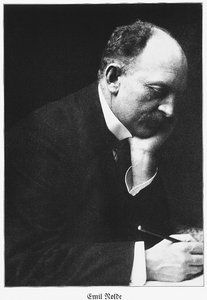
1867–1956, Denmark
Emil Nolde
The Life and Identity of Emile Nolde Born Hans Emil Hansen on 7 August 1867, the man who would become known as Emile Nolde grew up near the village of Nolde in the Duchy of Schleswig. His early years were shaped by the rural, agrarian life of his family. He eventually moved away from this path, choosing instead to work as a wood carver and furniture decorator. This tactile, physical labor preceded his shift toward painting and printmaking.
Also by Emil Nolde
 Sunset
 Sea with Red Sky
 Couple on the beach1903
 Masks1911
Essays around Prophet
 Egon Schiele's Top 25 Masterpieces: The Raw Power of ExpressionismExplore 25 iconic Egon Schiele masterpieces of Austrian Expressionism. Discover the raw emotion behind each work on OriginalUniqueArt.com.
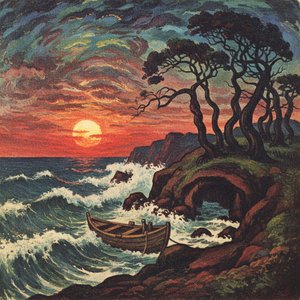 Emile Nolde: A Journey into Expressionist Nature & the Primal SelfExplore the powerful Expressionism of Emile Nolde – a pioneer of emotive landscapes & spiritual themes. Discover his journey, influences, a…
 Master of Emotion: The 25 Greatest Artworks by Rogier van der WeydenImmerse yourself in the profound emotion of Rogier van der Weyden. Explore 25 iconic Early Netherlandish masterpieces, from intricate textu…